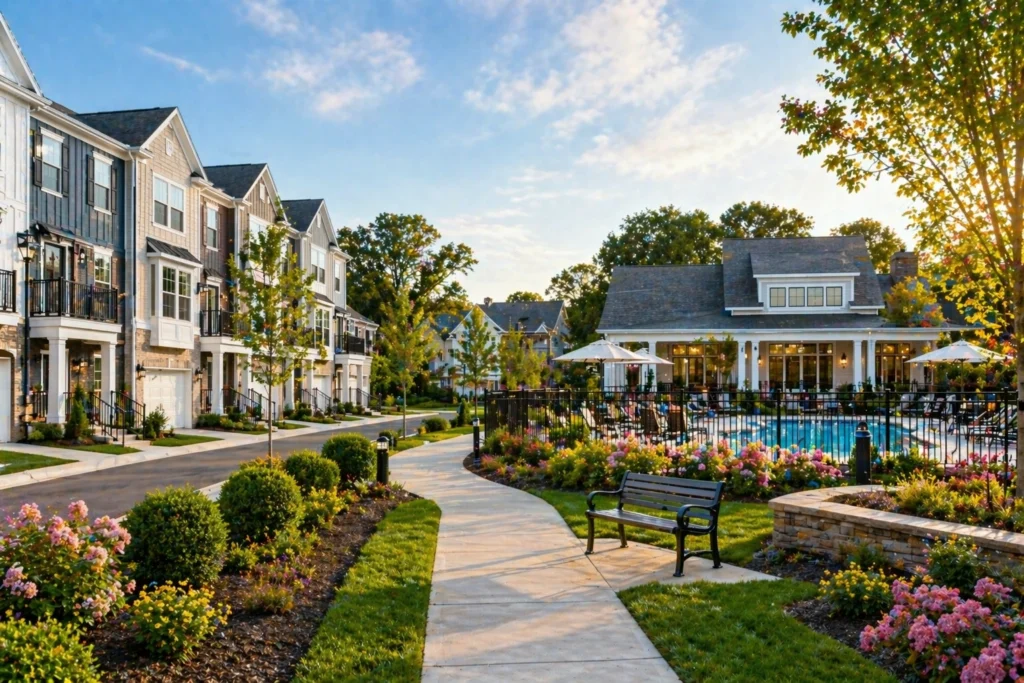

Low-maintenance living is one of the most searched-for lifestyle goals in the Charlotte area, but it does not mean the same thing in every community. In some neighborhoods, low-maintenance means townhome living where lawn care and some exterior work are handled by the HOA. In others, it means condo ownership where shared-building maintenance is part of the structure. In the 55+ world, it often means a mix of lawn care, easier exterior upkeep, and amenity-driven living designed to free up time for travel, social life, and recreation. Builders and community operators in this space consistently market low-maintenance living around fewer routine chores and more lifestyle flexibility.
That is why buyers should be careful not to assume too much from the phrase alone. “Low-maintenance” does not mean “no maintenance,” and it does not guarantee the same HOA coverage from one community to the next. What is included can vary widely, and the CFPB notes that condo or HOA fees vary widely and are usually paid separately from your monthly mortgage payment. Those fees also need to be treated as part of your real monthly housing cost when you decide what you can afford.
In the Charlotte region, low-maintenance options usually fall into three main buckets: townhomes, condos, and 55+ or active-adult communities. HomeBuildersCLT.com already reflects that mix through townhome communities, lower-maintenance builders, and active-adult-focused builders such as EPCON Communities, Kolter Homes, Lennar, Pulte Homes, and others.
What does low-maintenance actually mean?
In practical terms, low-maintenance usually means the owner is personally responsible for less of the routine exterior work than they would be in a standard detached single-family home. That often includes lawn care, some landscaping, and in some communities certain exterior building obligations. In condo settings, it can extend much further because the association is typically responsible for more of the building envelope and shared common areas. In active-adult communities, low-maintenance is often paired with amenity access and a lifestyle message built around less time on chores and more time for activities.
The key point for buyers is that low-maintenance is not a legal category by itself. It is a lifestyle description. That means you still have to verify what the HOA covers, what the owner still handles, and whether there are special assessments, capital contributions, or other costs at closing or after move-in. The CFPB’s disclosure guidance also makes clear that homeowner or condominium association charges can show up in transaction costs and should be part of your overall cost review.
Townhomes are often the first low-maintenance option buyers compare
For many buyers in Charlotte, townhomes are the most obvious entry point into low-maintenance living. They often offer a more practical ownership path than a detached home in the same location, while still reducing some exterior responsibilities. On HomeBuildersCLT.com, communities such as Ashley Townhomes by Ryan Homes in Charlotte and Bryton Crossing Townhomes by Eastwood Homes in Huntersville are described around low-maintenance ownership.
The appeal of townhomes is straightforward. You often get a newer home, less yard to manage, and a more manageable day-to-day maintenance burden than a standard detached house. Many buyers also like the lock-and-leave aspect. If you travel often, work long hours, or simply do not want to spend weekends handling landscaping and exterior upkeep, townhome living can make a lot of sense.
The tradeoff is that townhome ownership is still ownership. You may have shared walls, HOA rules, and less privacy than in a detached home. And unlike a condo, the maintenance split can be less intuitive, because some townhome HOAs cover more exterior obligations than others. One Charlotte community page on HomeBuildersCLT.com, Central Living at Craig by David Weekley Homes, specifically notes HOA coverage including water, lawn maintenance, garbage and recycling, roof, and exterior maintenance, which is a good example of why buyers need to review the actual coverage list rather than relying on the label alone.
Condos can be the most maintenance-light, but the HOA role is bigger
Condo living is often the lowest-maintenance path from a pure chores standpoint because owners usually do not handle their own exterior building maintenance in the same way detached-home owners do. Del Webb’s explanation of condos, townhomes, and villas notes that condos typically do not require owners to do their own exterior maintenance, though that often comes with higher HOA dues and less privacy than a single-family home.
That is the basic condo tradeoff in a nutshell. You often gain simplicity and location efficiency, but you usually take on a stronger HOA structure, more shared decision-making, and fees that can be higher than buyers expect. Condo dues are still part of your monthly cost picture even when they are not paid with your mortgage servicer, and the CFPB specifically warns buyers to account for condo or HOA fees in their real housing budget.
For Charlotte-area buyers, condos can make the most sense when the priority is convenience, lock-and-leave ownership, or in-town living where detached housing is less practical. The main caution is to understand the association well. Condo ownership tends to depend more heavily on HOA rules, reserves, maintenance obligations, and fee structure than many buyers realize at first.
55+ communities blend low-maintenance living with a lifestyle package
In the Charlotte area, 55+ communities are one of the clearest places where “low-maintenance” becomes part of a broader lifestyle promise. Communities like Cresswind Charlotte and Cresswind Wesley Chapel are marketed around active-adult living, amenities, and low-maintenance ownership, and Kolter has also announced Cresswind at Rocky River in Locust for the Charlotte-area market.
This is important because 55+ buyers are often not just choosing a home type. They are choosing a pace of life. Builders in the active-adult space frequently describe HOA-supported lawn care, easier exterior upkeep, trails, clubhouses, fitness, pickleball, and social activities as part of the value proposition. Epcon and Kolter both lean into that framing in their low-maintenance and 55+ materials.
Compared with a standard single-family home, a 55+ community can make a lot of sense for buyers who want less time spent on yard work and more time spent using the community. The tradeoff is that buyers need to be honest about whether they want the HOA structure, age restrictions, and amenity costs that often come with that lifestyle.
What is usually included in HOA dues?
This is one of the most important questions in the entire search, and it is where buyers should slow down. HOA dues may cover some combination of lawn care, landscape maintenance, exterior maintenance, roof obligations, trash, water, common-area upkeep, insurance on shared elements, recreational amenities, management fees, and community programming. But no universal package exists. The exact list depends on the community and ownership structure.
That variation is not theoretical. The Central Living at Craig example on HomeBuildersCLT.com lists water, lawn maintenance, garbage and recycling, roof, and exterior maintenance in the HOA. Del Webb’s HOA example for one of its active-adult communities lists lawn maintenance, irrigation-system maintenance, pool and lodge expenses, management fees, common insurance, common utilities, and community-wide activities. That is a big range, and it shows why buyers should ask for the actual HOA summary, budget, and governing documents before assuming what is covered.
The CFPB also notes that if you do not pay HOA or condo fees, you can face collection action and even foreclosure risk through the association, which is another reminder that these dues are not optional side costs. They are part of ownership.
Pros and cons compared with a standard single-family home
A standard detached single-family home usually gives the owner the most privacy, the most direct control over the property, and fewer shared-wall or association limitations. But it also usually comes with the highest maintenance burden. Yard work, exterior upkeep, roof planning, landscaping, and the endless list of “weekend house stuff” fall more directly on the owner. Low-maintenance communities reduce that burden, but they do it by shifting cost and control into an HOA structure.
Townhomes usually sit in the middle. They can be a great fit for buyers who still want ownership and often a little more space than a condo, but with less exterior upkeep than a detached home. Condos usually push further toward simplicity, but with more shared decision-making and less privacy. 55+ communities can be especially attractive when the buyer wants both lower-maintenance living and a social or amenity-based lifestyle.
The downside across all three is similar: fees, rules, and the need to understand what you are buying into. A buyer who hates HOA oversight may be happier in a detached home even if it means more chores. A buyer who values convenience, travel flexibility, or a more turnkey lifestyle may happily make the opposite trade.
Helpful Related Pages
What buyers should verify before they buy
Before buying into any low-maintenance community, ask exactly what the HOA covers, what the owner still handles, whether there is a capital contribution due at closing, whether fees have changed recently, and whether there are rental restrictions, pet restrictions, parking rules, or special assessment history. Also ask whether the community is more townhome, condo, or active-adult in structure, because that affects how maintenance responsibilities are split. The CFPB recommends sharing property-tax and HOA information with lenders so your cost estimates are accurate, which is another reason to pin down these details early.
This is also where working through the documents matters more than the marketing language. “Low-maintenance” can sound great in a brochure, but the real decision comes down to the budget, the rules, and whether the HOA responsibilities line up with the lifestyle you want.
Helpful Related Pages
Final takeaway
Low-maintenance communities in the Charlotte area can be a smart fit for buyers who want easier ownership, less yard work, more travel flexibility, or a lifestyle built around amenities instead of chores. Townhomes, condos, and 55+ communities each offer a different version of that trade. Townhomes often balance ownership and convenience, condos usually reduce exterior responsibilities the most, and 55+ communities often combine lower-maintenance living with a stronger amenity and activity package.
The best option depends on what you are trying to simplify. If you mainly want less yard work, a townhome may be enough. If you want a true lock-and-leave setup, a condo may be worth the extra HOA role. If you want easier upkeep plus a more social active-adult environment, a 55+ community may fit better. The right answer is less about the label and more about the actual maintenance split, fee structure, and lifestyle fit.
How We Can Help
At HomeBuildersCLT.com, we help buyers compare low-maintenance communities in a more practical way by looking at home type, HOA structure, builder style, lifestyle fit, and what the published dues and responsibilities actually appear to cover. If you are trying to decide between a townhome, condo, 55+ community, or a more traditional single-family home, we can help you sort through the tradeoffs before you move forward.
Need Help Comparing Low-Maintenance Communities in the Charlotte Area?
Townhomes, condos, and 55+ communities can all reduce day-to-day upkeep, but the tradeoffs are not the same. HomeBuildersCLT.com helps buyers compare community style, builder options, HOA structure, and lifestyle fit so you can focus on the low-maintenance option that actually works for you.
Frequently Asked Questions
What does low-maintenance living mean in a Charlotte-area community?
It usually means the owner is personally responsible for less routine exterior upkeep than they would be in a standard detached single-family home. That often includes lawn care, landscaping, and in some communities parts of the exterior, but the exact coverage varies by HOA and community.
Are townhomes considered low-maintenance?
Often, yes. Many townhome communities reduce yard work and some exterior responsibilities compared with a detached home, but coverage varies. HomeBuildersCLT.com identifies several Charlotte-area townhome communities around low-maintenance ownership.
Are condos lower maintenance than townhomes?
Usually they are, from a chores standpoint. Condo ownership often involves less direct exterior-maintenance responsibility than townhome ownership, but it also tends to come with stronger HOA involvement and less privacy.
What is usually included in HOA dues?
That varies widely, but common items may include lawn care, landscaping, exterior maintenance, roof obligations, trash, water, common-area upkeep, insurance on shared elements, amenity expenses, management fees, and community programming. Always verify the actual community documents.
Are HOA fees included in the mortgage payment?
Usually not. The CFPB says condo or HOA dues are usually paid directly to the association and are often separate from the payment made to the mortgage servicer, though they still need to be counted as part of total housing cost.
Are 55+ communities usually low-maintenance?
Very often, yes. Active-adult communities are commonly marketed around easier upkeep, lawn care, and amenity-focused living, but buyers should still confirm the exact maintenance coverage and fee structure.
Sources
- CFPB: Are condo or HOA dues included in my monthly mortgage payment?
- CFPB: Mortgage key terms
- CFPB: Your mortgage calculator may be setting you up for a surprise
- CFPB: Request and review multiple Loan Estimates
- HomeBuildersCLT.com Builder Guide
- HomeBuildersCLT.com Community Guide
- HomeBuildersCLT.com: Ashley Townhomes by Ryan Homes
- HomeBuildersCLT.com: Bryton Crossing Townhomes by Eastwood Homes
- HomeBuildersCLT.com: Central Living at Craig by David Weekley Homes
- Epcon Communities: Low-Maintenance Lifestyle Homes
- Epcon Communities: Must-Have Features for 55+ Buyers
- Epcon Communities: Popular 55+ Community Amenities and Features
- Del Webb: Condos, Townhomes and Villas
- Del Webb: How to Choose a 55+ Retirement Community
- Kolter Homes: 55+ Communities
- Kolter Homes: Cresswind Charlotte
- Kolter Homes: Cresswind Wesley Chapel
- Kolter Homes: Cresswind at Rocky River Announcement
Stay Updated and Get Expert Help With Your New Home Search
Sign up to receive updates on Charlotte-area communities, builders, and market trends, and let us know if you’d like to be contacted by a real estate professional for personalized guidance.