


If you are buying a new construction home, the sticker price is only part of the story. Many buyers focus on whether the builder will reduce the base price, but in many cases the better opportunity is negotiating incentives that improve affordability, reduce cash to close, or add long-term value.
That matters even more in today’s market. National builder data has shown that a large share of builders continue offering incentives, and mortgage rate buydowns remain one of the most common tools builders use to help move inventory and address affordability concerns.
For buyers in the Charlotte area, that means there may be more room to negotiate than many people realize, especially on spec homes, quick move-in homes, or inventory that has been sitting longer than the builder expected.
The key is knowing which incentives actually help you most.
Why builders often prefer incentives over price cuts
Builders do not always want to lower the published sales price. A visible price reduction can affect future appraisals, comparable sales within the neighborhood, and the builder’s ability to defend pricing on the next phase. Incentives often let the builder keep the headline price stronger while still making the deal more attractive to the buyer.
That is why you will often see builders offer things like rate buydowns, closing cost assistance, design center credits, appliance packages, lot premium relief, or free upgrades on select inventory homes.
In many cases, these can be worth more to your household than a modest reduction in price, especially if they improve monthly affordability or reduce your upfront cash burden.
1. Mortgage Rate Buydowns
One of the most valuable incentives to negotiate is a mortgage rate buydown.
A builder may offer to pay for a temporary buydown, such as a 2-1 buydown, or may contribute funds toward a permanent rate reduction through discount points. In a higher-rate environment, this can have a major impact on your monthly payment.
The important part is understanding exactly what is being offered. Buyers should clarify whether the incentive is a temporary or permanent buydown, whether they have to use the builder’s preferred lender, and whether the overall loan terms are still competitive.
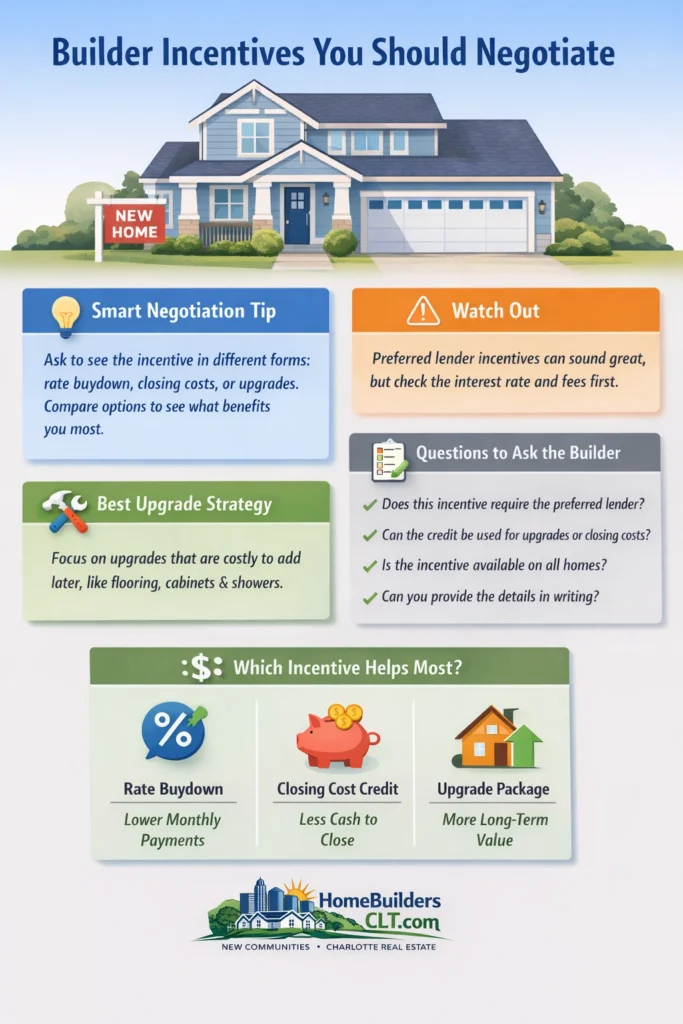
Smart Negotiation Tip
Ask the builder to show the same incentive in more than one format. For example, compare a temporary buydown, a permanent buydown, and the same dollar amount applied toward closing costs so you can see which option helps you most.
Some buyers care most about reducing the monthly payment in the first few years. Others would rather use that same builder contribution to reduce closing costs or improve their long-term rate. Looking at more than one version of the incentive can help you make a smarter choice.
2. Closing Cost Assistance
Another major builder incentive is closing cost help. This can reduce how much cash you need at closing and make a purchase more manageable, especially if you want to keep more reserves after move-in.
This is one of the most common incentives builders offer, but buyers should not stop at asking whether the builder will “pay closing costs.” The better question is how much the contribution is, what it can be used for, and whether using the builder’s preferred lender is required.
Questions to Ask the Builder
- How much is the closing cost credit?
- Does it require use of the preferred lender?
- Can the credit be shifted toward a rate buydown instead?
- Are there any lender fees that reduce the value of the incentive?
A builder credit can be extremely helpful, but what matters most is the net benefit after you factor in the loan terms, lender fees, and total cash to close.
3. Design Center Credits and Structural Upgrades
Many builders would rather give you upgrades than reduce the sales price. That creates an opportunity if you negotiate strategically.
Possible incentives to request include upgraded cabinets, countertops, flooring, tile, appliances, lighting, trim, outdoor living options, shower upgrades, or garage finish upgrades. These can carry high markups through the design center, so even a modest credit may go a long way.
Not all upgrades are equally valuable, though. It usually makes the most sense to prioritize things that are harder or more expensive to change after closing, such as flooring, cabinets, countertops, expanded patios, additional windows, or major shower upgrades.
Best Upgrade Strategy
Focus first on upgrades that are expensive, messy, or unrealistic to add later.
Flooring, cabinets, counters, tile showers, and structural outdoor features usually offer better long-term value than smaller decorative add-ons you could change after move-in.
Ask the builder to put the incentive details in writing so you know exactly what categories and products the credit applies to.
4. Lot Premium Relief
If you are buying a home on a larger, wooded, cul-de-sac, or more private lot, the builder may charge a lot premium. Buyers sometimes assume these premiums are fixed, but that is not always the case.
Depending on the stage of the community, demand for the lot, and how badly the builder wants to move a particular home, there may be room to reduce the lot premium or offset it elsewhere in the contract.
If the builder will not reduce the premium directly, they may still be willing to match that value with upgrades or a credit in another part of the deal.
5. Appliance, Blinds, Refrigerator, Washer, and Dryer Packages
These incentives may not be the flashiest, but they can save meaningful money right after closing. Builders sometimes offer a refrigerator, washer and dryer, blinds, garage door opener upgrades, smart home features, or security system packages.
For buyers trying to manage move-in costs, these can be very helpful. They may not change the mortgage payment, but they can keep you from spending thousands more in the first few weeks after you get the keys.
These items are often easier to negotiate on quick move-in homes than on to-be-built homes, especially when a builder is trying to clear standing inventory.
6. HOA Dues, Transfer Fees, or Prepaid Costs
Some builders may be willing to help with smaller but still useful expenses tied to closing and move-in, such as HOA initiation fees, transfer fees, capital contributions, or other prepaid property-related costs.
These line items may not be as exciting as a financing incentive, but they can still make a difference when you are trying to keep your out-of-pocket expenses down.
A good strategy is to get a projected cash-to-close number early, identify which costs matter most, and see whether the builder will offset them.
7. Extended Warranties or Service Commitments
Many builders already include a limited warranty program, but there may still be room to negotiate better post-closing support.
That might include clearer punch-list commitments, extra walkthroughs, written repair timelines, or additional reassurance on certain finish items before close.
This can be especially important on inventory homes that have been completed for a while or shown frequently.
Watch Out
Do not rely on verbal promises from the sales office. If a repair, touch-up, appliance, or service commitment matters to you, ask for it in writing as part of the contract or addendum.
Clear written expectations can be just as valuable as a financial incentive.
8. Better Overall Deals on Inventory Homes
Sometimes the best incentive is not a single add-on. It is a stronger overall package on a quick move-in or inventory home the builder wants sold.
That could include a combination of a small price improvement, a rate buydown, appliance package, design credit, and closing cost assistance. Inventory homes often create some of the best opportunities because the builder may be more motivated to close them quickly.
If the home is already completed, the end of the month or quarter is approaching, or the builder has several standing homes left, buyers may have more leverage than they realize.
Which Incentive Helps Most?
Rate buydown: Best for buyers focused on lowering monthly payments.
Closing cost credit: Best for buyers who want to bring less cash to closing.
Upgrade package: Best for buyers who want more finished features and items that may be harder to add later.
That side-by-side approach often gives you a better picture of the real value than focusing on one headline offer.
A Big Warning About Preferred Lenders
Many builder incentives are tied to using the builder’s preferred lender or affiliated lender. Sometimes that works in the buyer’s favor. Sometimes it does not.
The mistake many buyers make is focusing only on the advertised incentive without comparing the interest rate, lender fees, discount points, monthly payment, and total long-term cost of the loan.
Watch Out
A builder incentive may sound generous, but if the preferred lender has a higher rate or higher fees, the true value of that incentive may be lower than it appears.
An incentive is only a good deal if the total financing package is competitive.
What Is Usually Easiest to Negotiate
In many new construction transactions, the items that are often easiest to negotiate are:
- closing cost credits
- temporary rate buydowns
- appliance packages
- blinds
- design center credits
- inventory-home upgrades
- lot premium offsets
What may be harder to negotiate includes large base price cuts on early-phase homes, deep discounts on a builder’s hottest floor plans, or structural changes once construction is already underway.
Even then, there may still be room to improve the deal through credits or included features.
When Buyers Usually Have the Most Leverage
Buyers often have more leverage when:
- the home is already completed or near completion
- the builder wants the home closed in the current month or quarter
- the community has multiple standing inventory homes
- traffic has slowed
- affordability pressures are affecting demand
- a new phase is opening and the builder wants older inventory cleared
You may have less leverage when a community has limited inventory, strong demand, or a builder has waiting lists for a particular floor plan.
How to Negotiate Builder Incentives the Right Way
A smart approach is to negotiate in this order:
1. Decide your real priority
Is your biggest goal a lower monthly payment, less cash to close, better finishes, or the strongest overall value?
2. Compare financing options
Even if you expect to use the builder’s lender, it helps to compare outside quotes first.
3. Ask for the incentive details in writing
Do not rely on conversations alone.
4. Compare the total structure of the deal
A flashy incentive may not be the best option once you look at the full math.
5. Think long term
Some incentives help right now. Others improve comfort, resale appeal, or long-term value.
How a Buyer’s Agent Can Help
Builder incentives can be helpful, but not all offers are equal. A buyer’s agent can help you look beyond the headline promotion and compare the full picture, including lender terms, closing costs, upgrade value, lot premiums, and inventory-home opportunities. Since the builder’s on-site team works for the builder, having your own representation can help you negotiate more confidently and make sure the deal you choose fits your goals, budget, and long-term plans.
Need Help Comparing Builder Incentives?
Not all builder incentives are equal. A lower rate, closing cost credit, appliance package, or design upgrade can each affect your deal differently. We can help you compare builders, lender options, quick move-in homes, and new construction communities across the Charlotte area.
You can also browse new construction communities, explore Charlotte-area builders, or read Should You Use an Agent for New Construction?.
The Bottom Line
Builder incentives can be one of the biggest advantages of buying new construction, but only if you negotiate them carefully and compare the true value of each option.
For some buyers, the best move is a mortgage rate buydown. For others, it is closing cost help, meaningful upgrades, or a better overall package on a quick move-in home. The right answer depends on your loan, budget, timeline, and how long you expect to keep the home.
A builder’s sales team works for the builder. A buyer’s agent can help you compare lender offers, pressure-test incentive packages, spot where the deal is stronger than it looks, and identify when a flashy incentive may be masking weaker loan terms somewhere else.
If you are comparing Charlotte-area builders, communities, or quick move-in opportunities, HomeBuildersCLT.com can help you sort through the options and understand where the real negotiating leverage may be.
Sources
- National Association of Home Builders (NAHB) / Wells Fargo Housing Market Index
- Consumer Financial Protection Bureau (CFPB) – Loan Estimate, Closing Disclosure, lender credits, and discount points guidance
- Fannie Mae Selling Guide – Interested Party Contributions and lender incentives
- Freddie Mac Guide – Interested party contributions
- U.S. Department of Veterans Affairs – Temporary buydowns and seller concessions
- USDA Rural Development – Seller contribution guidance
- National Association of REALTORS® – Seller concessions guidance
Stay Updated and Get Expert Help With Your New Home Search
Sign up to receive updates on Charlotte-area communities, builders, and market trends, and let us know if you’d like to be contacted by a real estate professional for personalized guidance.