
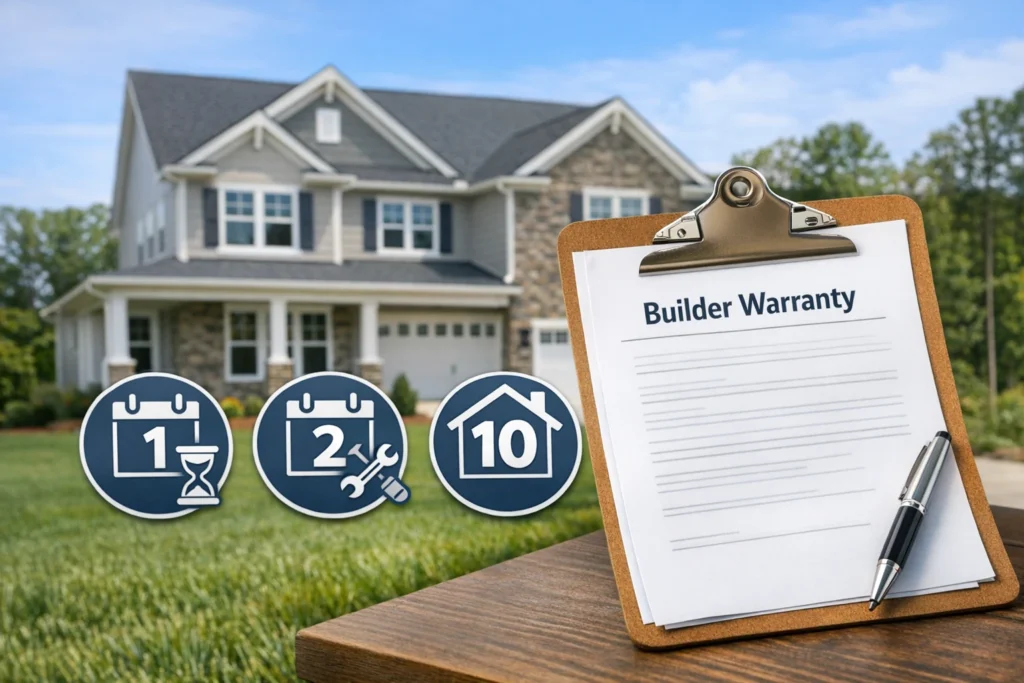

Buying a new construction home comes with benefits that many resale homes do not offer, and builder warranty coverage is one of the biggest. For many buyers, that added protection is part of what makes new construction feel more comfortable. Still, not all builder warranties are the same, and the details matter more than the headline. A buyer may hear “1-2-10 warranty” and assume the entire home is covered from top to bottom for ten years, but that is usually not how it works. Most builder warranties are layered, with broader coverage in the first year and narrower protection as time goes on. The Federal Trade Commission explains that new-home warranties commonly include one year for workmanship and materials, two years for systems like plumbing, electrical, and HVAC, and longer structural coverage for certain major defects.
If you are comparing builders in the Charlotte area, understanding warranty differences can help you look beyond the model home and sales pitch. It also helps to compare builders and browse communities with the long-term ownership experience in mind.
This is also one reason many buyers benefit from reading Should You Use an Agent for New Construction?, since contract details, warranty questions, and builder processes can be easier to navigate when you have someone focused on your side of the transaction.
That is also why it helps to understand how buyer-agent compensation works with builders. If builder-paid compensation is available, having representation while comparing contracts, warranty language, and community differences can add value well beyond the initial tour.
If you want help narrowing down options, comparing warranty approaches, and evaluating builders across the region, visit our contact page.
What Is a Builder Warranty?
A builder warranty is protection tied to the construction of a newly built home. In general, it is meant to address certain defects in workmanship, materials, or specific systems for a defined period after closing. The FTC distinguishes this from a separate home warranty or service contract, which is usually purchased separately and often focuses more on appliances and mechanical systems. That distinction matters because many buyers assume all warranties work the same way, when in reality a builder warranty and a third-party home warranty can cover very different things.
In practical terms, a builder warranty is usually your first layer of protection after move-in. It may cover items such as drywall, trim, paint, doors, or installation-related issues in the early months, then continue with more limited protection for certain systems or structural components. But every warranty comes with exclusions, procedures, deadlines, and standards of performance. That is why buyers should always ask for the actual warranty documents before closing rather than relying on a quick summary from the sales office.
Are Builder Warranties Required in North Carolina?
North Carolina is often misunderstood on this point. Many buyers assume state law requires every builder to provide a standard one-year written warranty, but NC REALTORS says that is not the case. Builders in North Carolina may offer a written or express warranty, but there is no blanket legal requirement that they must provide a one-year written builder warranty on every new home.
That does not mean North Carolina buyers are unprotected. It does mean they should pay close attention to the contract documents and warranty paperwork provided by the builder. Some builders offer strong written coverage, while others may provide more limited terms or route claims through a third-party warranty company. The real protection depends on the written documents, the builder’s process, and how clearly the warranty defines what is covered and what is not.
How South Carolina Differs
South Carolina has a more defined statutory framework in this area. Under the South Carolina Homebuyers Protection and Warranty Act, when a builder disclaims implied warranties, the law provides for certain express minimum warranty standards. Those standards include one year for defects related to building standards, workmanship, and materials, two years for faulty installation of plumbing, electrical, heating, cooling, and ventilating systems, and ten years for major structural defects. The statute also allows builders to exceed those minimums.
For buyers shopping on both sides of the state line, that difference matters. North Carolina does not create the same across-the-board expectation of a written one-year builder warranty, while South Carolina’s framework is more explicit when implied warranties are disclaimed. Even so, buyers in both states should still review the exact written warranty from the builder, because the actual coverage, exclusions, and procedures can still vary quite a bit from one company to another.
The Typical 1-Year Builder Warranty
The first year is usually where coverage is broadest and where most buyers notice small issues after moving in. The FTC says one-year coverage commonly applies to workmanship and materials for many components, including items like siding, stucco, doors, trim, drywall, and paint. In everyday terms, this is the period when buyers often submit punch-list type concerns such as trim separation, drywall cracks, nail pops, cabinet adjustments, sticking doors, or caulk gaps that develop as the home settles.
That does not mean every cosmetic concern is automatically covered. Many builders use written performance standards that define what qualifies as warrantable and what falls within normal tolerance. Some issues may be corrected as a customer-service matter, while others may be excluded as ordinary shrinkage, minor settling, or homeowner maintenance. Toll Brothers’ published warranty materials, for example, outline standards of performance and procedures rather than promising blanket correction of every cosmetic item a homeowner notices.
For buyers, the biggest takeaway is to document issues clearly and early. Photos, written repair requests, and a record of when concerns were reported can make the process much smoother. This is also one reason many buyers benefit from reading whether you should use an agent for new construction, since contract details, warranty questions, and builder processes can be easier to navigate when you have someone focused on your side of the transaction.
What the 2-Year Coverage Usually Means
The two-year portion of a builder warranty is usually more focused on systems than on finishes. The FTC says HVAC, plumbing, and electrical systems are generally covered for two years under many new-home warranty structures. South Carolina’s statutory framework similarly points to two-year protection for faulty installation of plumbing, electrical, heating, cooling, and ventilating systems. David Weekley and other major builders also describe a separate second layer of coverage aimed at mechanical systems.
This part of the warranty is also easy for buyers to misunderstand. It does not always mean every appliance or connected piece of equipment is fully covered by the builder for two years. In many cases, the builder warranty may apply more to installation-related defects or distribution systems, while the equipment itself may be subject to a manufacturer warranty. The FTC specifically notes that items covered by manufacturer warranties may not be covered under the builder warranty.
That is why it is smart to keep both sets of paperwork after closing. Save the builder warranty, appliance warranties, HVAC documentation, and any paperwork tied to plumbing fixtures, electrical components, or other installed systems. The answer to “who covers this?” is not always the builder. Sometimes it is the manufacturer, and sometimes it depends on whether the issue is with the product itself or the way it was installed.
What About 3-, 5-, or 10-Year Coverage?
Longer-term coverage is usually much narrower. Buyers often hear “10-year structural warranty” and assume that means broad protection for the house for a full decade, but most of the time the long-term portion is limited to major structural defects. The FTC says some builders provide coverage for up to ten years for major structural defects, often involving conditions serious enough to make the home unsafe. South Carolina’s statutory framework also defines major structural defects around designated load-bearing portions that affect safety or livability.
That means longer coverage usually applies to major load-bearing elements such as parts of the foundation, structural framing, or certain critical structural components, not ordinary wear, trim movement, cracked caulk, or surface-level cosmetic issues. Builders and third-party administrators often define these structural defects very specifically. A homeowner may feel that any sizable issue should count as “structural,” but the written warranty may use a much narrower standard.
This is one reason warranty marketing can sound broader than the practical reality. A “10-year warranty” is still valuable, but it usually is not ten years of top-to-bottom coverage. Buyers should understand what part of the house is covered for that full term and what drops off much sooner.
NC and SC Legal Backdrop Beyond the Builder Warranty
Another difference between North Carolina and South Carolina is the legal backdrop for construction-defect claims. North Carolina’s statute of repose generally bars actions arising from defective or unsafe conditions in improvements to real property more than six years from the later of substantial completion or the last specific act or omission of the defendant. South Carolina’s comparable statute generally sets that outside limit at eight years after substantial completion.
That does not mean every buyer automatically has six years or eight years of warranty coverage. It means the legal time limits for certain claims are different in the two states. A written builder warranty may be shorter, narrower, or more detailed than those larger legal frameworks. For buyers in the Charlotte region who may be open to communities in both North Carolina and South Carolina, that is one more reason to compare not just neighborhoods and builders, but also the actual warranty package and claims process tied to each home.
Builders That Go Beyond the Basics
Some builders do more than the bare minimum. David Weekley Homes promotes a multi-level warranty program that includes one-year limited warranty coverage, additional mechanical systems coverage, ten-year major structural defect coverage, and a one-year anniversary walk-through with a Warranty Service Representative. That extra structure can be meaningful for buyers who value a more organized post-closing experience.
Other builders also use the familiar 1-2-10 style. Lennar materials describe a one-year, two-year, and ten-year structure, while Toll Brothers publishes a detailed limited warranty package with standards of performance and claim procedures. The specifics vary, but the larger point is that builders do not all handle warranty service the same way. Some are more transparent, more detailed, or more proactive than others.
This can be an overlooked part of the buying decision. Many buyers spend a lot of time comparing design centers, incentives, and upgrade allowances, but not enough time comparing what happens after closing if something needs attention. That is also why it helps to understand how buyer-agent compensation works with builders. If builder-paid compensation is available, having representation while comparing contracts, warranty language, and community differences can add value well beyond the initial tour.
What Builder Warranties Usually Do Not Cover
The exclusions section matters just as much as the coverage section. The FTC notes that many newly built home warranties do not cover household appliances, small cracks in brick, tile, cement, or drywall, or components already covered by a manufacturer’s warranty. It also notes that warranties often do not cover the extra costs a homeowner may incur if they need to leave the home temporarily during repairs.
State law and builder documents can add more exclusions. South Carolina’s framework allows exclusions for certain detached structures, landscaping, off-site improvements, normal wear and tear, damage caused by owner neglect, and defects not reported within the required timeframe. Builder documents may also exclude conditions caused by lack of maintenance, alterations made after closing, weather events, or work done by others after the home is complete.
For that reason, buyers should avoid assuming that “new construction” means “everything is covered.” Warranties are real and valuable, but they are still limited. Reading the exclusions ahead of time can prevent frustration later.
Should You Buy a Separate Home Warranty Too?
Sometimes yes, but not always right away. The FTC explains that a separate home warranty is really a service contract, and it usually costs extra. It may focus more on appliances and systems than on workmanship or structural issues. The FTC also warns that some service contracts can duplicate coverage that a homeowner already has through the builder or through manufacturer warranties.
For a brand-new home, buying an outside home warranty immediately may not always be necessary. In many cases, the builder warranty and manufacturer warranties already cover the areas buyers are most worried about in the early months. A separate home warranty can make more sense later, especially once builder coverage ends and original manufacturer protection starts to expire. That decision should be based on the actual warranty gap, not just on a sales pitch that makes it sound essential from day one.
A good practical step is to make a simple list after closing: what the builder covers, what the manufacturer covers, and what is not clearly covered by either. That makes it easier to decide whether a separate service contract is worth the cost.
Questions Buyers Should Ask Before Closing
Before you close on a new construction home, ask for the full warranty booklet or digital warranty package. Ask who administers claims, whether warranty service is handled directly by the builder or through a third-party company, how quickly issues must be reported, and whether the warranty transfers if you sell the home. Those details can affect your ownership experience more than many buyers realize.
It is also smart to ask what happens at the one-year mark. Some builders schedule a formal anniversary review, while others expect homeowners to submit issues as they arise. Knowing the process upfront can help you stay organized and avoid missing deadlines.
Helpful Next Steps
Final Thoughts
Builder warranties are one of the real advantages of buying a newly built home, but they work best when buyers understand what they do and do not cover. The strongest warranty is not just the one with the biggest number attached to it. It is the one that is clearly written, realistic about expectations, backed by a builder with a good service process, and matched to the kind of protection you actually want after closing.
If you are weighing different builders or communities, warranty details deserve a closer look. They may not be as exciting as a model home tour, but they can make a real difference once you are living in the house.
Buying a new construction home involves more than picking a floorplan and lot. Warranty terms, incentives, closing costs, upgrade pricing, contract language, and builder processes can vary from one community to the next. At HomeBuildersCLT.com, we help buyers compare builders and communities across the Charlotte area so they can ask smarter questions before they sign. If you are exploring new construction in North Carolina or South Carolina, we can help you narrow down options, understand what to watch for, and take the next step with more confidence.
Need Help Comparing Builders and Communities?
Builder warranties, incentives, floorplans, lot premiums, and contract terms can vary from one community to the next. We help buyers compare options across the Charlotte area so they can move forward with more clarity and confidence.
Helpful Next Steps
Frequently Asked Questions
Do builders have to provide a warranty in North Carolina?
Not necessarily in the form many buyers assume. NC REALTORS states that North Carolina law does not obligate home builders to provide a written one-year builder warranty, even though many builders do offer written warranties.
What does a 1-year builder warranty usually cover?
It usually covers workmanship and materials for many visible components of the home, such as drywall, trim, paint, siding, and similar finish items, subject to the builder’s standards and exclusions.
What is usually covered under the 2-year portion of a builder warranty?
The two-year portion commonly applies to plumbing, electrical, HVAC, ductwork, and other major mechanical or distribution systems, though exact wording varies by builder and warranty administrator.
Does a 10-year builder warranty cover everything?
No. Ten-year coverage is usually limited to major structural defects involving designated load-bearing elements, not routine wear, cosmetic issues, or every component in the home.
Should I buy a separate home warranty on a new construction home?
Sometimes, but not always. The FTC says a separate home warranty is really a service contract that costs extra and may duplicate coverage you already have from the builder or manufacturers. It often makes more sense to review the builder and manufacturer warranties first before paying for additional coverage.
Sources
- Federal Trade Commission — Warranties for New Homes
- NC REALTORS — Are home builders required to provide a one-year warranty on new construction?
- North Carolina General Statutes — G.S. 1-50
- South Carolina Code of Laws — Section 15-3-640
- South Carolina Legislature — Homebuyers Protection and Warranty Act
- 2-10 Home Buyers Warranty — One Year Home Warranty and Warranties
- 2-10 Home Buyers Warranty — Builder Warranty FAQs
- David Weekley Homes — Our New Home Warranty
- David Weekley Homes — The Industry-leading New Home Warranty
- Lennar — Signing the Purchase Agreement
- Toll Brothers — Limited Warranty
Stay Updated and Get Expert Help With Your New Home Search
Sign up to receive updates on Charlotte-area communities, builders, and market trends, and let us know if you’d like to be contacted by a real estate professional for personalized guidance.