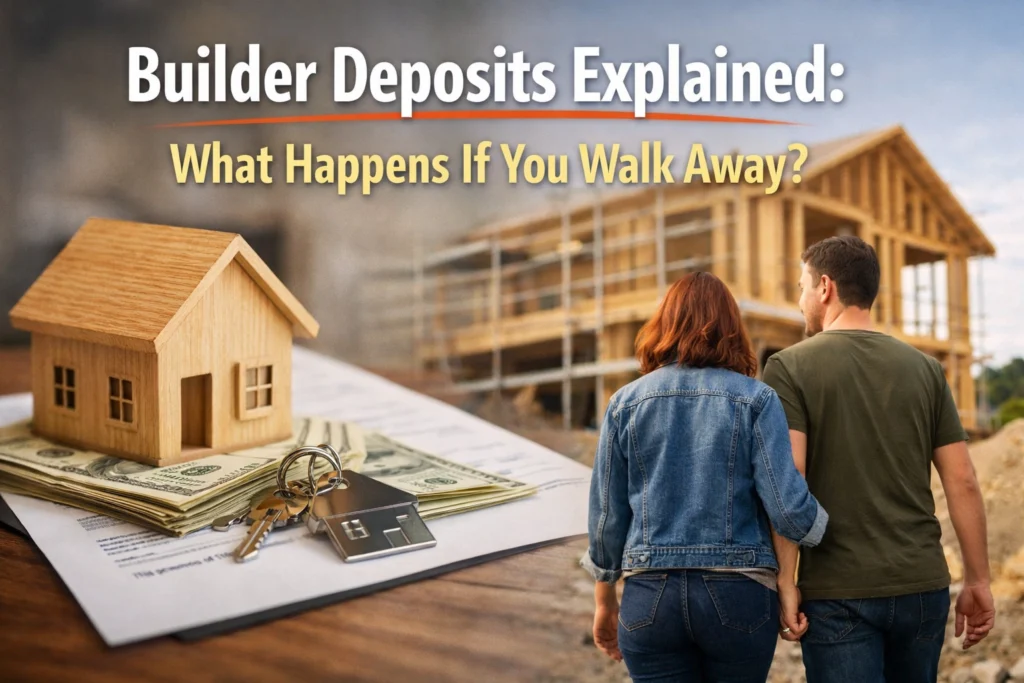

When buyers start looking at new construction, one of the first money questions is not just about the down payment. It is about the builder deposit.
That matters because many buyers discover quickly that a builder may ask for money well before closing. A builder deposit is often paid when you sign the contract, and depending on the builder and community, it can be a meaningful amount.
The most important takeaway is this: a builder deposit is not the same thing as a down payment, and what happens if you walk away usually depends on the contract you signed.
What Is a Builder Deposit?
A builder deposit is usually money you put up front when you sign a new construction contract to show that you are serious about moving forward.
On new construction, that deposit may come up earlier and feel more significant than buyers expect, especially if you are building from the ground up instead of buying a completed or quick move-in home.
In many cases, buyers hear terms like builder deposit, earnest money, or initial deposit used in similar ways. The exact structure can vary by builder, but the practical issue is the same: you may need to put money at risk before closing.
Builder Deposit vs. Down Payment
This is where buyers often get confused.
Your builder deposit is typically money paid when you go under contract. Your down payment is the portion of the purchase price tied to your mortgage financing and brought into the transaction by closing.
That means you may need cash for a builder deposit before you are anywhere near closing day. Even if your mortgage allows a low down payment, that does not mean your upfront deposit requirement will be low too.
Builder Deposit vs. Down Payment
Builder deposit: Upfront money often due when you sign the builder contract.
Down payment: The portion of the purchase price you pay based on your loan structure at closing.
Related guide: How Much Do You Need for a Down Payment?
Are Builder Deposits Refundable?
Sometimes yes. Sometimes no. The answer is usually in the contract.
That is the key point for new construction buyers: do not assume a deposit is automatically refundable just because the home is not finished yet, and do not assume it is automatically lost either. The contract language controls a lot of what happens next.
If you are buying a quick move-in home, the deposit terms may look different than they do on a from-the-ground-up build with lot selection, structural options, and design center choices. The farther you go into customization, the more important those terms usually become.
What Happens If You Walk Away?
If you walk away from a new construction contract, there is no single universal outcome.
In some cases, a buyer may get the deposit back because the contract allows termination under certain conditions. In other cases, the builder may keep some or all of the deposit.
Because builder contracts can differ significantly from standard resale contracts, buyers should be careful about assuming normal resale expectations apply the same way to new construction.
Why Builder Deposits Can Feel Riskier on New Construction
New construction contracts often involve longer timelines, upgrade selections, lender coordination, and delivery uncertainty. That can make the deposit feel more exposed because there is simply more time for buyer circumstances to change.
This matters because buyers sometimes commit early, then later run into issues involving payment, timing, job changes, rate changes, appraisal concerns, or second thoughts about the location or home itself. Whether those events allow you to recover your deposit depends heavily on what your contract says.
Watch Out
A low down payment loan does not necessarily mean a low upfront cash requirement. Builder deposits, upgrade money, and other early costs can still be significant on new construction.
Situations Buyers Should Review Carefully Before Signing
Before you sign a builder contract, you want to understand what happens to your deposit if:
- your financing falls through
- the appraisal comes in low
- the builder delays completion
- you decide to switch lenders
- you change your mind about the purchase
- you want to cancel after making design selections or upgrades
- the builder defaults or cannot deliver as promised
These are the kinds of real-world situations that can determine whether your deposit is returned, partially kept, or fully lost.
Smart Contract Tip
Before you sign, ask the builder to point out the exact contract language covering your deposit, when it becomes non-refundable, and what happens if financing, appraisal, delays, or other issues come up.
Who Holds the Deposit?
In many transactions, earnest money is held by a third party in escrow until closing or until any dispute is resolved.
That said, builder transactions can have their own procedures, so buyers should confirm who is holding the money, where it is being held, and what the release process looks like if a dispute comes up.
This is one of those details buyers may overlook early, but it becomes very important if the deal gets complicated later.
Does a Builder Deposit Count Toward Closing?
Usually, if the deal closes, the deposit is credited into the transaction rather than disappearing.
That is why the deposit still matters even if you are fully committed to buying. It is part of your total cash planning, not just a box to check at contract signing.
What Buyers Should Ask Before Paying a Builder Deposit
Questions to Ask Before Paying a Builder Deposit
- How much is the deposit?
- Who will hold the deposit?
- Under what conditions is it refundable?
- What happens if financing falls through?
- What happens if the appraisal is low?
- Does the builder keep all or part of the deposit if I cancel?
- What happens if the builder delays or cannot complete the home?
- Will the deposit be credited toward my closing costs or down payment if I close?
Why Having Your Own Representation Can Help
A buyer’s agent can help you understand whether the deposit terms look reasonable, flag questions to raise before signing, and help you compare a quick move-in contract versus a from-the-ground-up build where deposit exposure may be greater.
The builder’s sales team works for the builder. That does not mean they are unhelpful. It does mean they are not there to advise you on whether the deposit terms are balanced for your situation.
That is one reason many buyers want their own representation, especially when the contract involves a large deposit, upgrades, or a long construction timeline.
How This Connects to the Rest of Your Budget
Builder deposits are only one part of the full upfront cost picture.
Buyers also need to think about:
- down payment
- closing costs
- inspections
- lender fees
- upgrades
- appliances or window treatments
- moving costs
- reserves after closing
That is why a new construction purchase should be evaluated as a full financial package, not just by looking at the minimum down payment or builder incentive headline.
Big Picture Reminder
A builder deposit is just one piece of the cash puzzle. Make sure you are also budgeting for down payment, closing costs, inspections, upgrades, and move-in expenses before committing.
The Bottom Line
A builder deposit is one of the most important early money decisions in a new construction purchase. It is usually separate from your down payment, it may be credited toward the transaction if you close, and whether you get it back if you walk away often depends on the contract language and the reason the deal ends.
For Charlotte-area buyers, the safest approach is to understand the deposit terms before signing, ask direct questions about refund conditions, and make sure you know what happens if financing, appraisal, delays, or other issues arise.
If you are comparing builders or contracts and want another set of eyes on the process, HomeBuildersCLT.com can help you take the next step more confidently.
Need Help Comparing Builder Contracts and Costs?
Builder deposits, incentives, lender offers, and contract terms can all affect the total risk and cost of a new construction purchase. We can help you compare communities, builders, and the bigger financial tradeoffs across the Charlotte area.
You can also read How Much Do You Need for a Down Payment?, Builder Incentives You Should Negotiate Before You Buy, and Questions to Ask Before Signing a Builder Contract.
Helpful Related Guides
Builder deposits are only one piece of the new construction cost picture. These guides can help you compare the rest.
Sources
- Consumer Financial Protection Bureau – Mortgage Key Terms
- Consumer Financial Protection Bureau – New Construction Home Buying Guidance
- Consumer Financial Protection Bureau – Closing Guidance
- National Association of REALTORS® – Escrow and Earnest Money
- North Carolina Real Estate Commission – Earnest Money Brochure
Stay Updated and Get Expert Help With Your New Home Search
Sign up to receive updates on Charlotte-area communities, builders, and market trends, and let us know if you’d like to be contacted by a real estate professional for personalized guidance.