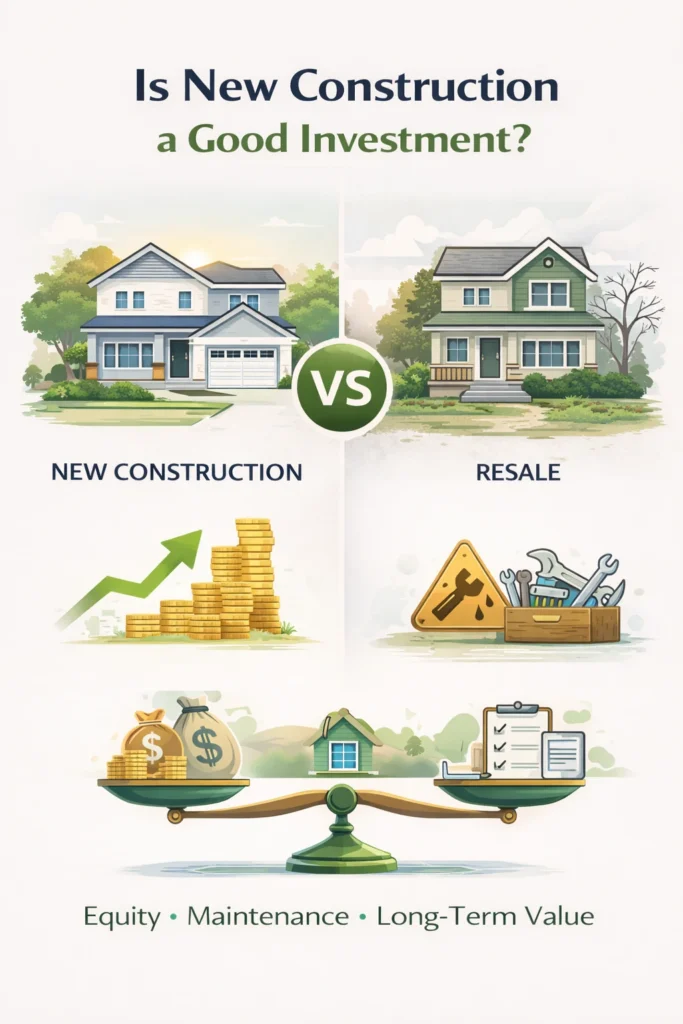

For many buyers, a new construction home feels like a smart move. Everything is fresh, the layout fits modern living, maintenance should be lower in the early years, and energy efficiency may help reduce ongoing utility costs. That can make a newly built home appealing both as a place to live and as a long-term financial decision. The U.S. Department of Energy notes that efficient home design and energy-saving technologies can help reduce energy use and utility costs, which is one reason many buyers see newer homes as attractive over time.
Still, new construction is not automatically a better investment than resale. A home’s long-term value depends on more than whether it is brand new. Location, purchase price, lot quality, builder reputation, floorplan appeal, local supply, monthly carrying costs, and how long you keep the property all matter. That is why buyers should look at new construction as a case-by-case decision instead of assuming “new” always means “better investment.”
Why Buyers Often See New Construction as a Good Investment
One reason buyers like new construction is that the home starts with modern features that many future buyers may also want. Open layouts, larger kitchens, better storage, newer materials, energy-efficient systems, and updated design trends can all help a home stay competitive when it is time to sell.
There can also be fewer major repairs in the early years compared with an older resale home. That does not mean a new home will be maintenance-free, but the roof, HVAC systems, plumbing, electrical systems, and major appliances are generally newer. For buyers who want predictability, that can be a real advantage.
Another factor is long-term appreciation. The FHFA House Price Index tracks changes in single-family home values using repeat-sales data dating back to the 1970s, and FHFA reported U.S. house prices rose 1.8% from Q4 2024 to Q4 2025. That does not guarantee future gains for any individual property, but it does reinforce that housing has historically appreciated over long periods, even though growth can vary widely by market and timing.
Why New Construction Is Not Always the Best Investment
The biggest issue is price. New homes often come with a premium simply because they are new, and buyers may also pay more for lot premiums, structural options, design upgrades, and builder-related fees. The U.S. Census Bureau reported the median sales price of new houses sold in January 2026 was $400,500, which shows how significant the financial commitment can be before upgrades and closing costs are layered in.
That matters because a home is not just an “investment” on paper. Buyers have to carry the monthly payment, taxes, insurance, HOA dues, and maintenance over time. If someone stretches too far financially to buy new, the pressure of the monthly payment can outweigh some of the theoretical long-term upside.
There is also a difference between buying a home as a place to live and buying one purely for return. A primary residence can build equity and may qualify for favorable tax treatment when sold. The IRS says eligible homeowners may exclude up to $250,000 of gain from income, or up to $500,000 for certain married couples filing jointly, if they meet the ownership and use rules for a main home. That tax treatment can make homeownership more attractive, but it still does not turn every purchase into a winning investment.
What Actually Makes a New Construction Home a Better Investment
The homes that tend to perform best over time usually have more going for them than just being new. They are in strong locations, close to job centers, major roads, shopping, schools, or areas with steady demand. They also tend to have floorplans and features that appeal to a broad range of future buyers.
Builder quality matters too. A home from a builder with a strong reputation for construction quality, livability, and resale appeal may hold value better than one in the same price range built with weaker materials or less thoughtful design. Buyers should also think about where the home sits within the community. A better lot, more privacy, a usable backyard, or a stronger streetscape can matter just as much at resale as upgraded countertops.
It is also smart to think ahead about over-improving. Some upgrades make sense because they improve daily living and future resale appeal. Others cost a lot but may not deliver the same return. A practical kitchen layout, good flooring, and a desirable lot often matter more than highly personalized finishes that future buyers may not value the same way.
How Long-Term Ownership Changes the Answer
The longer you plan to stay, the more likely new construction can make sense. That is because the upfront premium and transaction costs are spread over a longer ownership period. If you buy a new home and sell again quickly, the added cost of upgrades, closing expenses, and moving costs can make it harder to come out ahead.
For buyers planning to stay for several years, the picture often looks better. They may benefit from living in a home that fits their needs, avoiding major early repair costs, building equity over time, and potentially selling later into a market where their once-new home still feels relatively modern.
That is one reason the investment question should always be tied to the buyer’s timeline. A home that is a weak short-term financial move could still be a strong long-term ownership decision.
New Construction vs. Resale as an Investment
Resale homes sometimes offer a better value at the starting price, especially if they are in established neighborhoods with mature landscaping, larger lots, and fewer mandatory upgrade decisions. Buyers may also avoid some of the premium attached to brand-new homes.
On the other hand, a resale home may need repairs, renovations, or ongoing maintenance sooner. A lower purchase price does not always mean lower total cost of ownership. In some cases, a well-chosen new home may be easier to budget for and easier to sell later because the floorplan and finishes feel more current.
That is why the better question is often not “Is new construction a good investment?” but “Is this specific new construction home a better investment than the resale alternatives I could buy for the same money?”
Questions Buyers Should Ask Before Deciding
Before deciding whether a new construction home is a good investment, buyers should ask whether the total price makes sense for the location, how the home compares with nearby resale options, whether the lot is desirable, how much of the budget is going toward upgrades that may not improve resale value, and how long they realistically plan to stay.
They should also look at the builder’s reputation, the surrounding area’s growth prospects, the community’s HOA structure, and whether the home will still appeal to future buyers when it is time to sell. In many cases, the investment outcome has more to do with these fundamentals than with the simple fact that the home is newly built.
Final Thoughts
New construction can absolutely be a good investment, but it is not a guaranteed one. A well-located home with strong resale appeal, smart upgrade choices, reasonable monthly costs, and a longer ownership timeline often has a better chance of being a solid financial move.
For buyers in the Charlotte area, the smartest approach is usually to compare new construction against resale options carefully, look beyond the base price, and focus on long-term value rather than just the excitement of buying something brand new. In the right situation, new construction can be a great purchase. In the wrong situation, it can be an expensive way to buy features that do not fully pay you back later.
Trying to Decide if New Construction Is the Right Move?
We can help you compare Charlotte-area builders, communities, pricing, and resale factors so you can make a smarter buying decision.
Helpful Next Steps
Frequently Asked Questions
Is new construction a better investment than resale?
Not always. New construction may offer lower early maintenance and modern features, while resale may offer a better purchase price or more established location. The better investment depends on the specific property, price, and timeline.
Does a new construction home appreciate faster?
Not necessarily. Appreciation depends more on location, market demand, and what you paid than on whether the home was new when you bought it.
Are builder upgrades a good investment?
Some are, especially upgrades that improve daily livability and broad resale appeal. Others are more personal and may not add equivalent resale value.
Is new construction better for long-term ownership?
It often can be, especially for buyers planning to stay several years and benefit from newer systems, modern layouts, and lower early maintenance.
What matters most when buying a new construction home as an investment?
Location, builder quality, lot desirability, total price, monthly carrying cost, upgrade choices, and how long you plan to keep the home matter more than the fact that it is new.
Sources
Stay Updated and Get Expert Help With Your New Home Search
Sign up to receive updates on Charlotte-area communities, builders, and market trends, and let us know if you’d like to be contacted by a real estate professional for personalized guidance.