
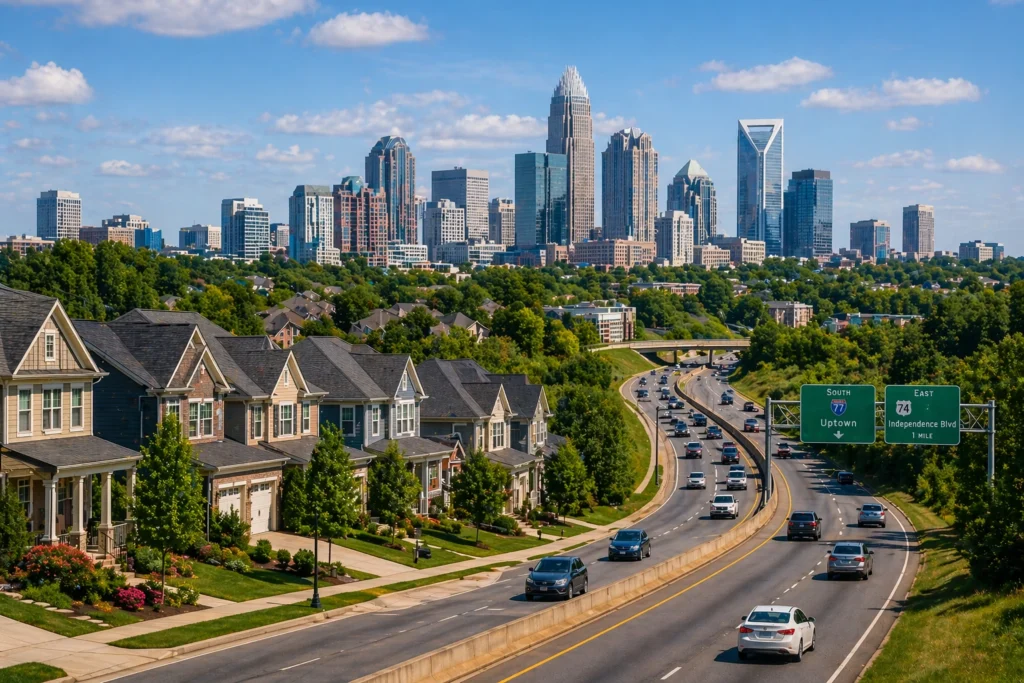
For many Charlotte-area buyers, the best suburb is not just the one with the nicest neighborhood feel or the newest homes. It is the one that works on a Tuesday morning. Commute-friendly living around Charlotte is highly corridor-specific, which means the best answer depends on whether you are driving to Uptown, SouthPark, Ballantyne, the airport, University City, or north toward Huntersville and Mooresville. Charlotte’s transportation network is shaped by major routes like I-77, I-85, I-485, and US-74, while CATS rail service still gives a real advantage to buyers who want transit-connected access to the center city.
That is why there is no one universal “best suburb for commuting” near Charlotte. Matthews may make more sense for one buyer, Huntersville for another, Fort Mill for someone else, and Ballantyne-area living for someone whose work is already in south Charlotte. The right answer comes from matching the suburb to the job hub, not from assuming every outer-ring suburb functions the same way.
If you work in Uptown, closer-in Mecklenburg suburbs usually make the most sense
For buyers commuting into Uptown, the best suburbs are usually the ones that keep you reasonably close to the urban core or tied into transit options. Matthews, Mint Hill, parts of southwest Charlotte, and some close-in north Mecklenburg locations often make more sense than pushing too far out. CATS remains a major part of that equation because the LYNX Blue Line connects south Charlotte and South End into Uptown, and the broader transit system continues to be centered around access to downtown job hubs.
This is also why rail-adjacent living matters more than many buyers expect. If you can live in a suburb or area with easier access to a Blue Line station, the daily routine can feel much different than a drive-dependent commute. For fully in-person workers, that distinction can be a major quality-of-life factor. For hybrid workers, it may matter a little less, but it still shapes how often a suburb feels convenient versus frustrating.
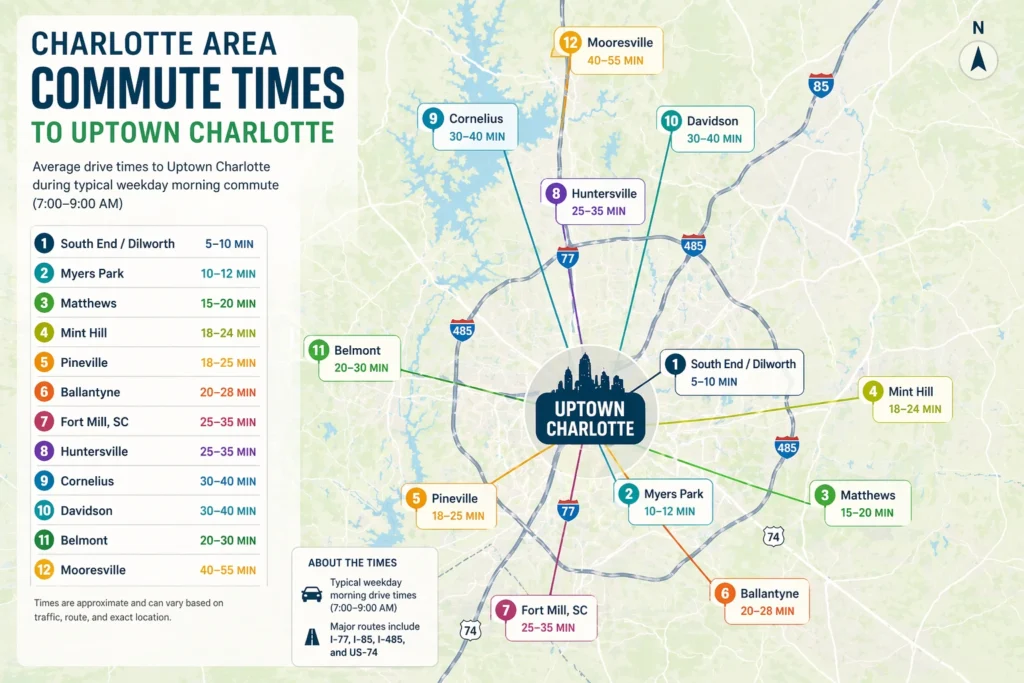
Which Charlotte-Area Suburbs Tend to Fit Which Commutes?
The best suburb usually depends on where you work most often, not just where you want to spend weekends.
Best for Uptown
Matthews, closer-in Mecklenburg locations, and rail-connected areas usually make the most sense for buyers who need regular access to the center city.
Best for Ballantyne
Fort Mill, Ballantyne, and nearby south Charlotte areas are often the strongest fit for buyers whose work is already in the south corridor.
Best for North Corridor Jobs
Huntersville, Cornelius, Davidson, and Mooresville are usually the more practical answer for jobs north of Charlotte.
Best for Airport Access
Belmont and west-side locations deserve a closer look for buyers who travel often or want easier access to Charlotte Douglas.
Matthews is a strong commute suburb for southeast-side buyers
Matthews deserves to be near the top of the list for buyers who want a more established southeast suburb without moving too far from Charlotte. It gives buyers access to parks, events, and a real downtown identity while still functioning as a practical launch point toward Uptown, SouthPark, and other close-in work hubs. The town’s official parks and events pages also reinforce that Matthews is more than just a bedroom suburb, which matters for buyers who want weekday commute convenience without giving up a town feel.
Matthews is strongest for people whose jobs are in Uptown or the southeast side of Charlotte and who want an easier balance of access and everyday livability. The tradeoff is that it is not the cheapest or most purely suburban option, but for commute-driven buyers that is often exactly the point.
Fort Mill is one of the best commute choices for south Charlotte workers
For buyers working in Ballantyne or south Charlotte, Fort Mill is one of the most common and logical answers. Fort Mill gives you South Carolina access, a strong suburban identity, and a practical route to the south side of the metro. It also has an active parks and recreation system and community amenities that make it attractive beyond the workweek.
This matters because Ballantyne is no longer just a suburban office cluster. Ballantyne’s official campus materials describe a 535-acre district with about 4.4 million square feet of office space, plus expanding amenities and mixed-use growth. That means buyers who work there often benefit more from a south-corridor commute than from trying to stay close to Uptown nightlife and driving across town every morning.
Ballantyne-area living can be the smartest answer if your office is already there
Some buyers search for the “best suburb” around Charlotte when the more direct answer is simply Ballantyne itself or nearby south Charlotte. Ballantyne continues to grow as one of the region’s biggest live-work-play business districts, and recent official updates emphasize both the office footprint and newer amenity investments like The Bowl and The Amp. For a buyer whose job is already in that corridor, living nearby often beats optimizing for some other lifestyle district and absorbing the daily commute penalty.
This is especially true for young professionals and move-up buyers who want a shorter drive, easier errands, and a more predictable daily routine. SouthPark, Ballantyne, Pineville, Fort Mill, and Indian Land all become more relevant once the job hub shifts south.
Huntersville, Cornelius, and Davidson are best for north-corridor commutes
If your work is in north Charlotte, Huntersville, Cornelius, and Davidson often become much more logical than south Charlotte or southeast suburbs. These towns align better with the I-77 corridor and Lake Norman side of the region. The main tradeoff is obvious to anyone who lives here: I-77 traffic is a real factor, so the right choice depends on how far north you need to go and how often.
Even so, for buyers working in north Mecklenburg or nearby employment corridors, these towns are usually far more practical than forcing a cross-metro drive. They also bring real lifestyle appeal with parks, greenways, and town-centered activity. Davidson officially emphasizes parks, recreation, and community programs, while Huntersville continues to build out recreational assets and greenway connections.
Mooresville makes the most sense when your commute is already north of Charlotte
For buyers working in Mooresville or the broader north corridor, the smartest answer is often not a Charlotte suburb at all. It is Mooresville. Once your daily routine is centered that far north, trying to hold onto a south-of-center location just for city access can create a commute that wears out its appeal quickly. Mooresville’s identity as a major north-corridor employment center is reinforced by both its official town materials and its longstanding reputation as Race City USA.
That does not mean every buyer should live as close as possible to the office, but it does mean north-side workers should think hard before choosing a suburb based only on weekend preferences. If you work in Mooresville most days, Huntersville, Cornelius, Davidson, and Mooresville itself usually deserve the strongest look.
Belmont is worth a look for airport commuters and west-side access
Belmont often gets overlooked in commute conversations, but it can make real sense for buyers who want west-side access, airport convenience, or a different launch point toward both Charlotte and the mountains. Charlotte Douglas is one of the region’s biggest transportation assets, and for frequent flyers or airport-based workers, where you live relative to CLT can matter a lot more than people first assume. CLT is continuing long-term expansion and capacity work through 2035, underscoring its role as a major regional mobility hub.
Belmont’s appeal is that it offers some town character without putting you on the far edges of the metro. If your commute centers on the airport, west Charlotte, or a more west-oriented schedule, Belmont can be a smarter choice than pushing deep into other suburban corridors that look good on paper but add drive time in practice.
Explore Charlotte-Area Cities by Commute Fit
Use these pages to compare suburbs and nearby cities based on work hubs, commute corridors, and overall lifestyle fit.
Transit, airport access, and road corridors should shape the decision
Charlotte commuters should think in corridors, not just town names. If you rely on rail, the Blue Line matters. If you travel often, CLT access matters. If you work in Ballantyne, the south corridor matters. If you work north, I-77 matters. And if you are hybrid, you can often afford to prioritize lifestyle more than a daily commuter can. CATS’ current and future planning continues to emphasize expanded bus and rail service, but the system today still works best when your housing search matches the existing transit map.
That is why the best Charlotte suburb for commuting is usually the one that lines up with your real weekly pattern. Five in-office days creates one answer. Two hybrid days creates another. A travel-heavy schedule creates another. The suburb has to fit the routine you actually have.
Final takeaway
For Uptown commuters, closer-in Mecklenburg options and transit-connected living usually make the most sense. For Ballantyne and south Charlotte workers, Fort Mill, Ballantyne, and nearby south-corridor locations often rise to the top. For north-corridor jobs, Huntersville, Cornelius, Davidson, and Mooresville usually make the strongest shortlist. And for airport-focused buyers, west-side access and places like Belmont deserve more attention than they often get.
The best suburb for commuting near Charlotte is not the one with the best reputation in the abstract. It is the one that gets you where you need to go with the least daily friction while still giving you a lifestyle you want when you get home.
How We Can Help
At HomeBuildersCLT.com, we help buyers compare Charlotte-area suburbs in a more practical way by looking at commute corridors, builder activity, community style, and how each area actually works for the places you need to go most often. If you are trying to balance home search goals with a realistic daily commute, we can help you narrow the search to the suburbs that fit your routine best.
Need Help Finding a Charlotte Suburb That Actually Works for Your Commute?
Some suburbs look great on paper but feel very different once the daily drive starts. HomeBuildersCLT.com helps buyers compare Charlotte-area locations based on commute patterns, builder activity, lifestyle fit, and the places you need to get to most often.
Frequently Asked Questions
What are the best Charlotte suburbs for commuting?
The best suburb depends on your destination. Matthews and closer-in Mecklenburg areas often make sense for Uptown, Fort Mill and Ballantyne-area locations work well for south Charlotte jobs, and Huntersville, Cornelius, Davidson, and Mooresville usually make more sense for north-corridor commutes.
Is Fort Mill a good commute suburb for Charlotte jobs?
Yes, especially for buyers working in Ballantyne or south Charlotte. Fort Mill combines a suburban setting with practical south-corridor access and an active parks and recreation system.
Is Matthews a good suburb for commuting to Uptown?
For many buyers, yes. Matthews offers a close-in southeast location, community amenities, and a more practical route into Charlotte than many farther-out suburbs.
What suburbs are best for commuting to Mooresville or north Charlotte?
Huntersville, Cornelius, Davidson, and Mooresville usually make the most sense for jobs in the north corridor because they align better with I-77 and the Lake Norman side of the market.
Does transit matter when choosing a Charlotte suburb?
Yes. Rail access can materially change the day-to-day commute for buyers working in Uptown or along the Blue Line corridor, and CATS continues to center regional transit planning around those connections.
Sources
- Charlotte Area Transit System (CATS)
- CATS: Blue Line Pineville-Ballantyne Extension
- CATS Transit System Plan Update
- Charlotte Douglas International Airport
- CLT Airport Construction Projects
- Ballantyne Campus Overview
- Ballantyne Reimagined
- Matthews Parks, Recreation and Cultural Resource
- Matthews Special Events
- Stumptown Park
- Fort Mill Parks & Recreation
- Fort Mill Facilities & Parks
- Huntersville Parks & Recreation
- Axios Charlotte: New stretch of Torrence Creek Greenway opens in Huntersville
Stay Updated and Get Expert Help With Your New Home Search
Sign up to receive updates on Charlotte-area communities, builders, and market trends, and let us know if you’d like to be contacted by a real estate professional for personalized guidance.