
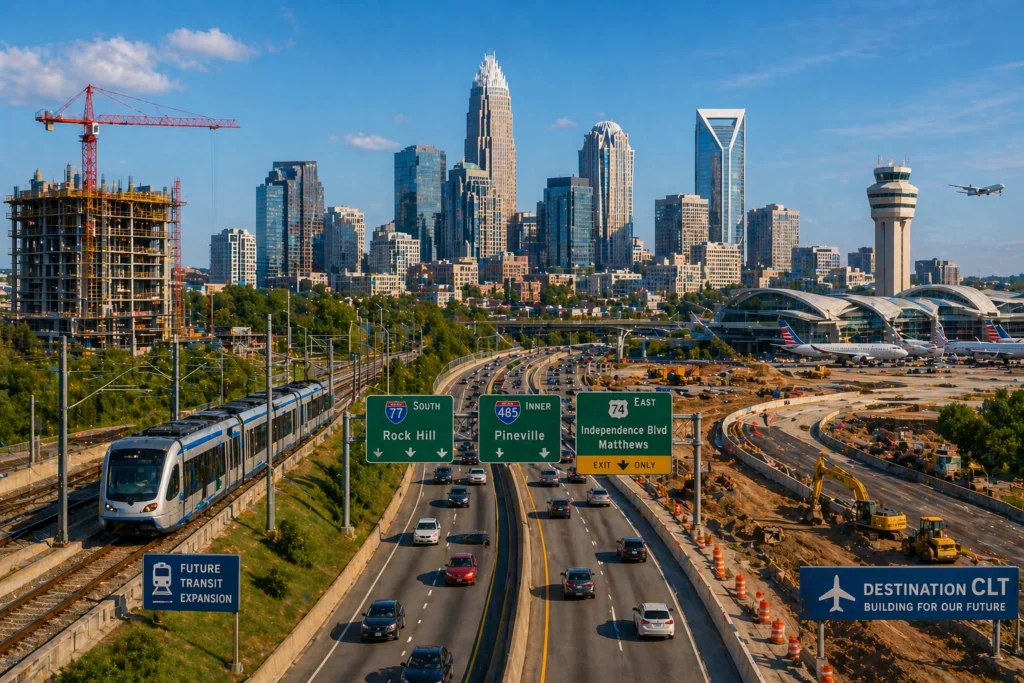

Charlotte’s growth story is not just about new homes and new neighborhoods. It is also about infrastructure. Roads, transit, airport projects, passenger rail, and local mobility improvements all shape which parts of the region feel more connected, more convenient, and more attractive for future development. For buyers, that matters because infrastructure can influence commute patterns, quality of life, and even which suburbs feel practical over the next several years. For builders and developers, it can help explain why certain corridors keep getting attention.
Right now, Charlotte’s infrastructure conversation is happening on several levels at once. CATS has adopted a 2055 Transit System Plan that calls for a 50% increase in bus service and 43 additional miles of rail. The city is also advancing a broader mobility strategy through Strategic Investment Areas and the Blueprint for Mobility Investment. At the same time, NCDOT is moving forward on major highway projects around I-77, I-485, U.S. 74, and N.C. 73, while Charlotte Douglas International Airport continues work through its $4 billion Destination CLT capital program.
Transit expansion remains one of the biggest long-term growth stories
If you want to understand where Charlotte may feel more connected in the future, transit is one of the first places to look. CATS’ adopted 2055 Transit System Plan prioritizes the Better Bus Program, microtransit, and phased rapid transit corridors. The official plan says it would expand transit service with a 50% increase in bus service and 43 additional miles of rail. That does not mean everything arrives at once, but it does show how strongly Charlotte’s long-term mobility thinking is tied to expanded transit options.
Two of the most watched transit pieces are the Silver Line and the Red Line. The Red Line is described by CATS as a 25-mile commuter rail project using the existing Norfolk Southern line to connect Uptown Charlotte with Huntersville, Cornelius, and Davidson, with potential to extend to Mt. Mourne in Mooresville. That makes it especially important for buyers watching the north corridor. The Silver Line remains one of the most discussed east-west transit concepts in the region, and CATS is still holding public meetings in 2026 related to proposed changes.
Charlotte Gateway Station is another project with long-term regional importance
Charlotte Gateway Station deserves its own mention because it is not just another transit stop. CATS describes it as a comprehensive multimodal transportation facility at West Trade and Graham Streets in Uptown Charlotte that will connect long-distance travelers and daily commuters to regional transportation links and center-city destinations. That kind of project can have ripple effects for accessibility, redevelopment, and the appeal of nearby districts.
Related rail-support work is also underway through the Charlotte Passenger Rail Facility project, which NCDOT says is being planned and developed southwest of Uptown. The proposed facility would replace the existing maintenance facility and support future passenger rail repairs and the Southeast High Speed Rail Corridor. That may not be the kind of project most homebuyers follow closely, but it is part of the broader rail infrastructure picture around Charlotte.
Airport expansion continues to matter far beyond frequent flyers
Charlotte Douglas International Airport is one of the biggest infrastructure drivers in the region, and it affects more than air travel. It influences business access, employment patterns, and the attractiveness of west and southwest Charlotte for both residents and development. CLT’s Destination CLT program is a $4 billion capital investment effort. The airport says the recently completed Terminal Lobby Expansion was the signature project of that program, and ongoing work also includes concourse renovations, expansions, and a new Fourth Parallel Runway.
As of early 2026, the airport said the Fourth Parallel Runway was approaching its halfway point and was scheduled to open in fall 2027. That is a meaningful long-range project because airport capacity and efficiency are directly tied to how Charlotte functions as a regional hub. Buyers who travel often or want easier airport access may not choose a neighborhood based only on runway work, but these projects strengthen the long-term case for west-side and airport-adjacent locations staying important.
Highway projects could reshape how some corridors feel
Road infrastructure is still a huge part of Charlotte’s future, especially because so much of the region remains commute-driven. One of the most visible recent projects is the I-485 Express Lanes, which NCDOT says run from I-77 to U.S. 74 and opened to traffic in February 2026. The project added one express lane in each direction for about 17 to 18 miles, along with a new general-purpose lane in each direction between Rea Road and Providence Road. For south Charlotte and southeast commuters, that is a major corridor story.
Looking farther ahead, the I-77 South Express Lanes project is another major watch item. NCDOT says the proposed project would extend 11 miles from I-277 to the South Carolina state line and include express lanes, interchange reconstruction, and direct connectors. The project is still early in design, with NCDOT saying final design is expected by the end of 2027 and construction in the early 2030s. That makes it more of a future-facing corridor story than an immediate commute fix, but it is still very relevant for south Charlotte and Fort Mill–bound traffic planning.
U.S. 74 is another corridor buyers should keep on the radar. NCDOT’s U.S. 74 Express Lanes project from west of Idlewild Road to I-485 in Matthews would widen Independence Boulevard and add both general-purpose and express lanes. That matters for east Charlotte, Matthews, and commuters using the southeast side of the region.
Northern and northeast growth corridors are also tied to road upgrades
Not every future infrastructure story is about the urban core or the south side. N.C. 73 improvements across Mecklenburg and Cabarrus are highly relevant for buyers and builders looking north and northeast. NCDOT says the project would widen sections of N.C. 73, with one Mecklenburg segment scheduled to begin construction in summer 2026, and other sections continuing through later phases. Because N.C. 73 touches areas tied to Davidson, Concord, and broader north-corridor growth, this is one of those projects that can quietly matter a lot over time.
There are also more localized road projects with quality-of-life implications. For example, NCDOT announced in March 2026 that it awarded a project to extend Bailey Road between Statesville Road and Poole Place Drive, including a roundabout and a future greenway connection. Smaller projects like that may not get the same attention as toll lanes or rail lines, but they often matter a great deal at the neighborhood level.
Local mobility projects may matter more to day-to-day life than buyers expect
One of the more overlooked parts of Charlotte’s future infrastructure story is the city’s local mobility work. Charlotte’s Mobility+ effort says transit and road projects are meant to work together, and the city’s Strategic Investment Areas are designed to focus upgrades such as new streets, increased road capacity, sidewalks, pedestrian crossings, lighting, streetscapes, intersection improvements, and traffic signal synchronization in targeted geographic zones. The city says there are 22 Strategic Investment Areas, with pilot areas including Far East-Harrisburg and Arrowood.
For homebuyers, this matters because not every important infrastructure project is a headline project. Sidewalk gaps, intersection redesigns, street lighting, and traffic synchronization can all make an area feel easier to live in, even if they do not make the nightly news. In some cases, those smaller-scale investments are what help a corridor become more attractive for new development over time.
Which Types of Infrastructure Projects Matter Most to Buyers?
Different projects affect different kinds of buyers and corridors around Charlotte.
Transit Projects
Most important for buyers who care about Uptown access, future rail connectivity, and areas tied to long-term urban growth.
Airport Projects
Most relevant for frequent travelers, west-side buyers, and people who value business connectivity and easier access to CLT.
Highway Projects
Most important for buyers making daily drive-based decisions, especially along I-77, I-485, U.S. 74, and north or south commuter corridors.
Local Mobility Upgrades
Most useful for buyers who care about sidewalks, streetscapes, safer intersections, and the day-to-day feel of a specific neighborhood or corridor.
Why these projects matter to homebuyers and long-term growth
Infrastructure does not automatically guarantee that home values rise or that one suburb will outperform another. But it can change how practical, connected, and attractive a location feels over time. Transit expansion can make more areas feel accessible. Airport upgrades can reinforce west-side and business-travel appeal. Highway projects can reshape commute reliability. Local mobility investments can improve day-to-day usability in ways buyers notice quickly.
That is why future infrastructure projects are worth paying attention to if you are buying new construction around Charlotte. You do not need to buy based on a map of proposed projects alone, but it is smart to understand what is planned in the corridors you are considering. In a fast-growing region, today’s “farther out” area can feel very different once roads, transit, and services catch up.
Major Charlotte-Area Infrastructure Projects to Watch
Final takeaway
Future infrastructure projects around Charlotte are one of the clearest signals of where the region expects growth and pressure to continue. The biggest long-term stories include the 2055 Transit System Plan, the Red and Silver Line discussions, Charlotte Gateway Station, the Destination CLT airport program, I-77 South Express Lanes, U.S. 74 upgrades, I-485 corridor changes, and the city’s Strategic Investment Areas.
For buyers, the key is not to assume every future project will affect every area equally. The better move is to look at the corridor you care about most, then ask how transit, airport access, roads, and local improvements may change the way that area works over the next five to ten years.
How We Can Help
At HomeBuildersCLT.com, we help buyers look beyond the house itself and understand how infrastructure, commute patterns, builder activity, and long-term growth plans can shape a location over time. If you are trying to compare Charlotte-area corridors with future transit, airport, or highway improvements in mind, we can help you focus on the places that fit both your lifestyle and your long-term goals.
Need Help Comparing Charlotte-Area Locations With Future Growth in Mind?
Road projects, transit plans, airport expansion, and local mobility upgrades can all shape how a location feels over time. HomeBuildersCLT.com helps buyers compare Charlotte-area communities, builders, and growth corridors more strategically.
Contact Us Browse Communities Compare Commute-Friendly Areas
FAQ Section
What are the biggest future infrastructure projects around Charlotte?
Some of the biggest projects include the CATS 2055 Transit System Plan, the Red Line, the Silver Line, Charlotte Gateway Station, Destination CLT airport projects, I-77 South Express Lanes, U.S. 74 Express Lanes, and Strategic Investment Areas.
Will transit expand around Charlotte?
CATS has adopted a 2055 Transit System Plan that calls for a 50% increase in bus service and 43 additional miles of rail, although timing depends on funding and phased delivery.
Is the Red Line still part of Charlotte’s future plans?
Yes. CATS describes the Red Line as a 25-mile commuter rail project connecting Uptown Charlotte with Huntersville, Cornelius, and Davidson, with potential extension to Mt. Mourne in Mooresville.
What airport improvements are happening at CLT?
CLT’s Destination CLT capital program includes terminal, concourse, and runway projects. The airport says the Terminal Lobby Expansion was completed in 2025, and the Fourth Parallel Runway is scheduled to open in fall 2027.
What highway projects should Charlotte-area buyers watch?
Major projects include I-77 South Express Lanes, the completed I-485 Express Lanes corridor, U.S. 74 Express Lanes, and N.C. 73 improvements in Mecklenburg and Cabarrus counties.
Sources
- CATS 2055 Transit System Plan
- CATS Governing Board Approves Transit System Plan
- Red Line Commuter Rail
- Silver Line
- Charlotte Gateway Station
- Charlotte Passenger Rail Facility
- Destination CLT Construction Projects
- CLT: What’s on the Horizon in 2026
- I-77 South Express Lanes
- I-485 Express Lanes
- U.S. 74 Express Lanes
- N.C. 73 Improvements
- Strategic Investment Areas
- Charlotte Strategic Mobility Plan
- Charlotte Capital Investment Plan
Stay Updated and Get Expert Help With Your New Home Search
Sign up to receive updates on Charlotte-area communities, builders, and market trends, and let us know if you’d like to be contacted by a real estate professional for personalized guidance.