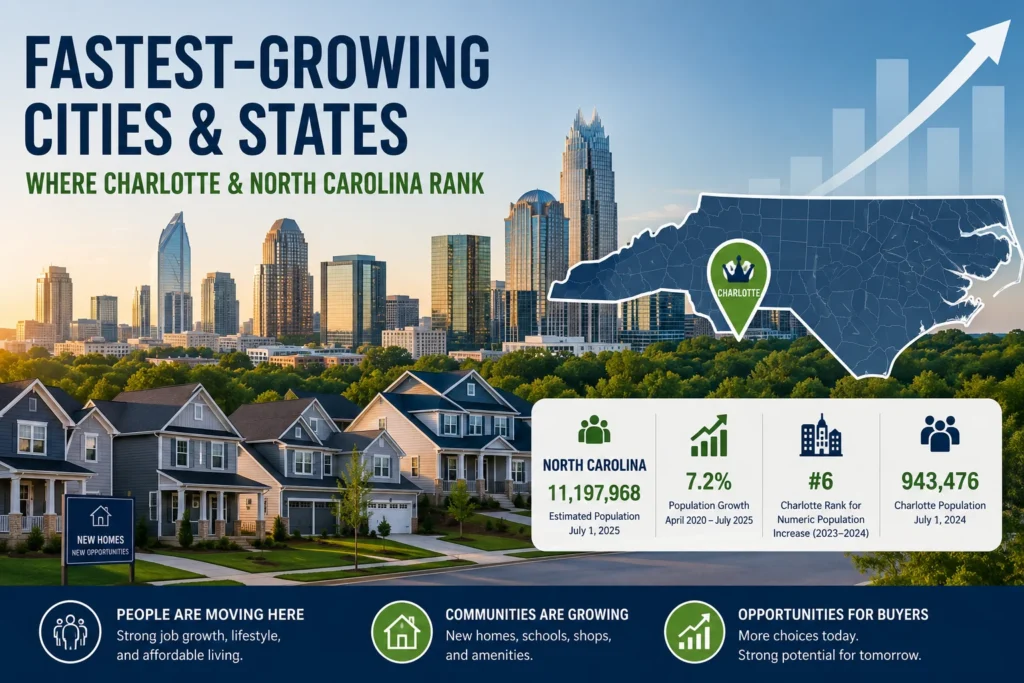

New Census Bureau estimates released in 2026 show something many local residents have already felt firsthand: the Charlotte region continues to grow at an extraordinary pace. The Charlotte-Concord-Gastonia metro area added more than 278,000 residents since 2020, ranking among the nation’s fastest-growing metropolitan areas.
Charlotte Added More Than 278,000 Metro Residents Since 2020
The broader Charlotte-Concord-Gastonia metro area added more than 278,700 residents between 2020 and 2025, ranking seventh nationally for total metro population growth according to new Census Bureau estimates.
Charlotte added more residents than any other city in the United States between 2024 and 2025 according to newly released Census Bureau estimates reported by the Charlotte Business Journal and other regional outlets.
The story is not just about Charlotte itself. Much of the region’s growth is spreading into surrounding towns and suburbs throughout both North Carolina and South Carolina. Communities like Monroe, Fort Mill, Lancaster, Kannapolis, and Clover continue attracting buyers searching for newer homes, more space, and relative affordability compared to many larger metro areas across the country.
For buyers considering a move to the Carolinas, the latest growth numbers reinforce what has become one of the biggest trends in American real estate: the Charlotte region remains one of the country’s top relocation destinations.
Additional Growth Trends Buyers Should Watch
The latest Census estimates show that growth across the Charlotte region continues spreading well beyond the urban core.
The Charlotte-Concord-Gastonia metro added more than 278,000 residents between 2020 and 2025, placing it among the nation’s fastest-growing metropolitan areas. Mecklenburg County alone added more than 26,000 residents in the past year, helping fuel continued demand for housing, infrastructure, and commercial development.
At the same time, many of the region’s fastest percentage growth rates are happening in suburban and outer-ring communities.
Iredell County has emerged as one of the region’s fastest-growing counties, driven largely by continued expansion around Mooresville, Troutman, and the Lake Norman corridor.
Iredell County Is Emerging as a Major Growth Corridor
Iredell County posted one of the highest growth rates in the Charlotte region, reinforcing continued demand throughout the Lake Norman and north I-77 corridor.
On the South Carolina side of the metro, Fort Mill continues ranking among the nation’s fastest-growing suburban communities, while areas like Clover, York, and Tega Cay continue attracting relocating buyers.
Meanwhile, Monroe has become one of the region’s biggest emerging growth stories as buyers continue pushing farther southeast in search of newer homes and more attainable pricing.
The data also suggests some previously explosive-growth communities like Waxhaw may be beginning to stabilize as pricing rises and development matures.
Overall, the latest Census estimates reinforce that Charlotte’s growth story is increasingly becoming a suburban growth story.
More Than 150 New Residents Per Day From Migration
According to the Charlotte Regional Business Alliance, the region averaged roughly 157 new residents per day from migration alone between 2023 and 2024.
Why the Charlotte Area Keeps Growing
Population growth in the Charlotte area is being driven by a combination of economic opportunity, lifestyle advantages, and housing availability.
Compared to many Northeast and West Coast metro areas, Charlotte still offers:
- Lower overall housing costs
- Lower property taxes in many areas
- A relatively mild four-season climate
- Expanding job opportunities
- A growing airport and transportation network
- Access to both mountains and beaches within a day’s drive
Charlotte’s Growth Story Is Becoming a Suburban Growth Story
While Charlotte continues leading in total population growth, many outer-ring suburbs are growing faster on a percentage basis as buyers continue searching for newer homes, larger lots, and more attainable pricing outside the urban core.
The region also continues attracting corporate investment and job growth across industries including finance, healthcare, technology, logistics, and advanced manufacturing.
Many buyers relocating from states like New York, New Jersey, Illinois, California, and Florida are also discovering that suburban communities around Charlotte often provide newer homes and larger lots at price points that can still feel relatively competitive compared to other major metros.
That demand has fueled significant new construction activity throughout the region.
The Growth Is Expanding Beyond Charlotte
One of the biggest shifts over the last several years has been how growth has spread outward from Charlotte’s urban core into surrounding counties and neighboring South Carolina communities.
While Charlotte itself continues adding residents rapidly, many buyers are increasingly focusing on suburban and exurban areas where new construction inventory remains more available.
Monroe
Monroe continues emerging as one of the fastest-growing areas southeast of Charlotte. Improved roadway access, expanding retail development, and a growing supply of new communities have made the area increasingly attractive to buyers seeking more home for the money.
Union County overall continues seeing strong demand from families relocating to the region, particularly buyers searching for newer single-family homes with larger homesites.
Fort Mill
Fort Mill remains one of the most sought-after relocation destinations in the Charlotte metro area. Its proximity to Charlotte, strong school reputation, and continued commercial development have helped drive substantial population growth.
The area has also become a major hub for new construction communities, particularly among move-up buyers and relocating families.
Kannapolis
Kannapolis has continued transforming over the last decade through downtown redevelopment, infrastructure investment, and new housing growth.
Its location along the I-85 corridor and expanding employment opportunities throughout Cabarrus County continue drawing both first-time buyers and commuters looking outside Mecklenburg County pricing.
Lancaster and Clover
South Carolina communities south of Charlotte continue seeing substantial growth as buyers search for lower taxes, expanding suburban development, and newer housing options.
York and Lancaster County communities have become especially attractive to buyers relocating from out of state who want suburban living while remaining connected to the Charlotte job market.
York and Lancaster County Communities Continue Growing
Several South Carolina communities surrounding Charlotte continue posting some of the region’s fastest percentage growth rates, particularly throughout York and Lancaster counties.
Why New Construction Continues to Surge
The Charlotte region’s growth has created sustained demand for new housing inventory.
Many buyers relocating into the area specifically prefer:
- Modern floorplans
- Larger kitchens and open layouts
- Home office flexibility
- Energy-efficient construction
- Community amenities
- Builder warranty coverage
That has helped fuel rapid expansion among national and regional builders throughout the Carolinas.
New construction growth has become especially noticeable in outer-ring suburbs where larger undeveloped tracts remain available for master-planned communities.
For many relocating buyers, newer suburban communities can offer:
- More square footage for the price
- Larger garages and yards
- Community pools and amenities
- New schools and infrastructure
- Lower maintenance compared to older resale homes
The continued expansion of highways like I-485, I-77, US-74, and NC-540-style bypass projects throughout the region has also helped open additional areas to residential growth.
Challenges That Come With Rapid Growth
While population growth can create economic opportunity, it also brings challenges.
Many longtime residents throughout the Charlotte area have noticed:
- Heavier traffic congestion
- Rising home prices
- Increased competition for housing
- School crowding concerns in some districts
- Infrastructure strain
- Faster suburban development
Some communities that experienced explosive growth earlier in the decade are also beginning to see land constraints and affordability pressures emerge.
For buyers, that means location selection is becoming increasingly important.
Commute patterns, future road projects, school assignments, resale potential, and builder quality all play major roles when evaluating rapidly growing areas.
What Buyers Should Consider Before Moving to the Charlotte Area
Not every fast-growing suburb is the right fit for every buyer.
Some buyers prioritize:
- Top-rated schools
- Larger lots
- Walkability
- Lower taxes
- Commute convenience
- Amenity-rich communities
- Ranch floorplans
- 55+ neighborhoods
- Future appreciation potential
Others may prioritize maximizing square footage or finding newer homes at more approachable price points farther from Uptown Charlotte.
One of the advantages of the Charlotte region is the wide variety of community types available across both North and South Carolina.
Areas Many Buyers Are Watching Closely
Several Charlotte-area towns continue drawing strong attention from relocating buyers comparing lifestyle, commute, schools, and new construction options.
Each area offers a different balance of pricing, commute access, schools, amenities, and housing styles.
The Bottom Line
The newest Census estimates reinforce that the Charlotte region remains one of the country’s strongest growth markets.
For buyers, that growth creates both opportunity and competition.
The region still offers a wide range of new construction communities, suburban growth corridors, and relocation-friendly areas — but inventory, pricing, and commute dynamics can vary significantly depending on location.
As growth continues expanding across the Carolinas, buyers who carefully compare communities, builders, and long-term area trends may be better positioned to find the right fit for both lifestyle and future resale value.
Planning a Move to the Charlotte Area?
The Charlotte region offers a wide range of communities, builders, and housing styles across both North and South Carolina. Comparing commute times, schools, builder reputations, and long-term growth trends can make a major difference when choosing where to buy.
Browse Charlotte-Area Communities
Compare Home Builders
Contact HomeBuildersCLT.com
HomeBuildersCLT.com is an independent local resource and is not affiliated with builders or developers. Builder information, pricing, incentives, and availability can change without notice.
Frequently Asked Questions
Is Charlotte still one of the fastest-growing cities in the U.S.?
Yes. Recent Census Bureau estimates showed Charlotte added more residents than any other U.S. city between 2024 and 2025.
Why are so many people moving to the Charlotte area?
Many buyers are attracted by job growth, relatively lower housing costs compared to larger metros, climate, and the availability of newer homes throughout the region.
Which Charlotte suburbs are growing the fastest?
Areas including Fort Mill, Monroe, Lancaster, Kannapolis, and several Union and York County communities continue seeing significant growth.
Is new construction still booming around Charlotte?
Yes. New construction remains a major part of the region’s housing market, especially in suburban growth corridors surrounding Charlotte.
Stay Updated and Get Expert Help With Your New Home Search
Sign up to receive updates on Charlotte-area communities, builders, and market trends, and let us know if you’d like to be contacted by a real estate professional for personalized guidance.