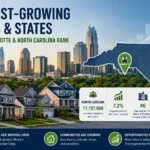


Charlotte’s rise has been one of the most important urban growth stories in the South, but the reason it matters is not just because more people are moving here. Charlotte has become a major growth market because population, jobs, business investment, airport access, and housing demand have been reinforcing each other at the same time. The City of Charlotte says more than 943,000 people now live in the city, making it the 14th-largest city in the U.S., while the Charlotte Region as a whole is home to about 2.9 million people.
That does not mean Charlotte is the single fastest-growing city in the country by percentage. It is not. The Census Bureau’s 2024 population release makes clear that some smaller Sun Belt cities posted faster percentage growth. But Charlotte remains one of the most consequential growth cities in the country because of its scale, the size of its metro, and the fact that its growth is supported by both employer expansion and continued in-migration.
Charlotte is growing because the metro is growing, not just the city limits
One of the biggest reasons Charlotte keeps showing up in national conversations is that the city is only part of the story. The Census Bureau reported that U.S. metro areas collectively grew by about 1.1% between 2023 and 2024, slightly faster than the nation overall at 1.0%. Charlotte fits into that larger metro-growth pattern, and the region’s population base now sits around 2.9 million according to the Charlotte Regional Business Alliance.
Inside the city itself, Census QuickFacts shows Charlotte at 943,476 residents and 7.9% population growth from the 2020 census base to the latest estimate shown there. That is not a small-market jump. It is significant growth happening at a scale that already places Charlotte among the country’s largest cities.
That matters for housing because large-city growth creates demand in multiple layers at once. It increases pressure not only on the city core, but also on nearby suburbs, outer-ring communities, attached housing, rental stock, and new construction corridors across the region.
Job growth is a major reason the region keeps attracting residents
Population growth without job growth is not nearly as durable. Charlotte’s story looks different because its labor market has kept expanding too. BLS reported that from November 2024 to November 2025, nonfarm employment in the Charlotte-Concord-Gastonia metro rose from 1,393,200 to 1,431,000, a 2.7% increase. That was stronger than several other large metros in the same BLS release.
The Charlotte Regional Business Alliance also points to a broad regional economic base rather than reliance on one industry. Its data highlights financial services, advanced manufacturing, IT and technology, logistics, life sciences, and corporate headquarters activity, along with more than 3,500 manufacturers and roughly 145,000 manufacturing workers across the region.
That diversity is a big part of why Charlotte has remained resilient. It is not only a banking city, even though financial services still matter enormously. It is also a logistics market, a manufacturing market, a headquarters market, and increasingly a technology and health-related growth market.
Charlotte’s corporate footprint is larger than many buyers realize
Charlotte’s growth is tied closely to employer concentration and headquarters activity. The Charlotte Region is home to 19 Fortune 1000 companies, including seven Fortune 500 companies in the 2025 list, according to the Charlotte Regional Business Alliance.
That corporate base matters because it helps create both direct jobs and secondary demand. Employers bring workers, but they also support vendors, contractors, office users, legal and financial services, hospitality, and the broader ecosystem of a growing metro. It also helps explain why Charlotte continues to attract educated workers and relocating professionals.
Airport scale is one of Charlotte’s biggest growth advantages
Charlotte Douglas International Airport is one of the strongest reasons Charlotte can keep growing at scale. CLT reported a record 58.8 million passengers in 2024, up 10% from the prior record of 53.4 million in 2023. The airport says it has set passenger records in five of the last eight years.
CLT also says Airports Council International ranked it the sixth-busiest airport in the world for arrivals and departures in 2024 and seventh in North America for passengers. In 2025, the airport still handled 53.6 million passengers and 574,193 aircraft operations, its second-busiest year on record.
For buyers and relocating households, that matters more than many people realize. Large airports are economic assets. They support business travel, company recruitment, tourism, logistics, and national connectivity. They also make Charlotte more practical for employers that need to move people efficiently.
The region’s demographic profile also supports long-term growth
Charlotte is not growing only because of raw population volume. It is also growing with a workforce and demographic profile that employers tend to value. Census QuickFacts shows 18.7% of Charlotte residents are foreign-born, 49.4% of adults age 25+ hold a bachelor’s degree or higher, median household income is $82,068, and median owner-occupied home value is $385,700. Mean travel time to work is 24.7 minutes.
Those numbers help explain Charlotte’s appeal. The city is large, increasingly diverse, relatively educated, and still more attainable than some coastal peer markets. That does not mean affordability is easy, especially for first-time buyers, but it does help explain why the metro remains attractive to both employers and households.
Talent and education pipelines help sustain the momentum
The regional talent story matters because population growth is easier to sustain when a metro can develop and attract workers. The Charlotte Regional Business Alliance says the region includes 25 colleges and universities, and the City of Charlotte has been emphasizing workforce initiatives such as Future Forward Charlotte to better align training and employer needs.
That talent pipeline is one reason growth is not just about who moves here next. It is also about whether the region can continue to educate, attract, and retain workers across industries.
Housing demand is part of the growth story, not a side effect
Charlotte’s growth has obvious housing implications. Census QuickFacts shows Charlotte’s owner-occupied housing rate at 51.0%, median gross rent at $1,612, and median owner costs with a mortgage at $1,821. Those numbers show why housing choices matter so much in this market.
At the same time, the City of Charlotte’s broader economic and housing materials have repeatedly tied population growth to housing pressure and development need. When a city adds people, jobs, and investment at the same time, housing demand becomes one of the clearest places where that growth shows up. That is part of why Charlotte continues to see strong interest in detached homes, townhomes, condos, and suburban new construction across the region.
Charlotte’s geography and industry mix make it more durable than a trend-driven boomtown
Some growth stories are built too heavily around one company type, one industry, or one short-term migration trend. Charlotte’s advantage is that its growth case is broader. The region has a large airport, a strong corporate base, diversified industry mix, regional manufacturing presence, higher education pipeline, and a metro footprint that gives buyers multiple housing choices depending on budget and lifestyle.
That makes Charlotte feel more durable than a city whose entire growth case depends on one sector. It also helps explain why the metro keeps drawing both relocation buyers and local move-up demand.
Charlotte Growth Snapshot
Charlotte’s growth story is strongest when you look at multiple indicators together, not just one headline ranking.
City Population
Charlotte’s population estimate is 943,476, and the city is the 14th largest in the U.S.
Regional Population
The Charlotte Region is home to about 2.9 million people.
Employment Growth
Metro nonfarm employment rose 2.7% year over year from November 2024 to November 2025.
Airport Scale
CLT handled a record 58.8 million passengers in 2024.
Corporate Footprint
The region is home to 19 Fortune 1000 companies, including 7 Fortune 500 firms in 2025.
Talent Base
About 49.4% of Charlotte adults age 25+ hold a bachelor’s degree or higher.
So why is Charlotte one of the fastest-growing cities in the U.S.?
Because it checks more than one box at the same time. Charlotte is large and still growing. Its metro is expanding. Jobs are being added. Employers keep investing. The airport gives the city unusual national and global connectivity. The workforce is broad and increasingly educated. And housing demand remains strong because people can still find multiple ways to live in the region, from urban neighborhoods to suburban new construction communities.
Charlotte is not just growing because people like it. It is growing because the city and region continue to function as a practical place to live, work, hire, travel, and build. That is what makes the growth story more than a headline.
Related Charlotte Market Guides
How We Can Help
At HomeBuildersCLT.com, we help buyers connect the big-picture Charlotte growth story to real housing decisions on the ground. If you are trying to understand how job growth, population gains, commute patterns, and regional expansion affect where to buy, we can help you compare the communities, builders, and locations that make the most sense for your goals.
Want Help Turning Charlotte Growth Trends Into a Smarter Home Search?
Population growth, job expansion, airport access, and housing demand all affect where buyers focus in the Charlotte area. HomeBuildersCLT.com helps you compare communities, builders, and locations so you can make a more informed decision.
FAQ Section
Is Charlotte really one of the fastest-growing cities in the U.S.?
Charlotte is one of the country’s most important large-city growth stories, though it is not the single fastest-growing city by percentage. Its significance comes from large-scale population gains, metro growth, job expansion, and continued corporate investment.
How big is Charlotte now?
Charlotte’s population estimate is 943,476, and the city says it is the 14th-largest city in the United States.
Why do so many companies choose Charlotte?
Charlotte offers a large regional workforce, a major airport, diversified industries, and a significant corporate footprint. The Charlotte Region is home to 19 Fortune 1000 companies, including 7 Fortune 500 firms in 2025.
Is job growth part of Charlotte’s population growth story?
Yes. BLS reported that metro nonfarm employment rose 2.7% from November 2024 to November 2025, which helps explain why the region keeps attracting residents.
Why is Charlotte Douglas such a big deal for growth?
CLT is one of the busiest airports in the world and handled a record 58.8 million passengers in 2024. That level of connectivity supports business growth, relocation, and regional economic activity.
What does Charlotte’s growth mean for housing?
It means sustained demand across the city and metro. As population and employment rise together, buyers see pressure across detached homes, attached homes, rentals, and new construction communities.
Sources
- U.S. Census Bureau: Population Growth Reported Across Cities and Towns in 2024
- U.S. Census Bureau: U.S. Metro Areas Experienced Population Growth Between 2023 and 2024
- U.S. Census Bureau QuickFacts: Charlotte city, North Carolina
- City of Charlotte: Rankings and Accolades
- Charlotte Regional Business Alliance: Industries and Major Employers
- Charlotte Regional Business Alliance: Fortune 500 & 1000 List
- Charlotte Regional Business Alliance: 19 Companies in the Charlotte Region Make 2025 Fortune 1000 List
- Charlotte Douglas International Airport: CLT Breaks Passenger Record with 58.8 Million in 2024
- Charlotte Douglas International Airport: About CLT
- Charlotte Douglas International Airport: CLT Welcomes 53.6 Million Passengers in 2025
- BLS: Employment Up in 4 Large Metro Areas Over Year Ended November 2025
- City of Charlotte: Talent Development
Stay Updated and Get Expert Help With Your New Home Search
Sign up to receive updates on Charlotte-area communities, builders, and market trends, and let us know if you’d like to be contacted by a real estate professional for personalized guidance.