
For many Charlotte-area buyers, pets are part of the home search from the beginning. A home may have the right number of bedrooms, a good kitchen, and a reasonable commute, but if it does not work for the dog, cat, or other household pets, it may not feel like the right fit.
New construction can be appealing for pet owners because many communities are designed with sidewalks, walking trails, open space, dog parks, pocket parks, and outdoor living areas. Buyers may also have more opportunity to choose a floor plan, homesite, flooring, yard size, or fence-friendly lot that fits daily life with pets.
But “pet-friendly” can mean different things depending on the community. One neighborhood may allow pets but have strict HOA rules about fencing, leashes, waste cleanup, or the number of animals. Another may feel more pet-friendly because of trails, green space, wider sidewalks, or a nearby dog park. The best choice depends on your pet, your routine, and the rules that come with the home.
For buyers comparing new construction communities around Charlotte, it helps to look beyond the marketing language and think about how the community will actually work every day.
What Makes a Community Pet-Friendly?
A pet-friendly community is not just a place where pets are allowed. It is a place where daily life with pets feels practical.
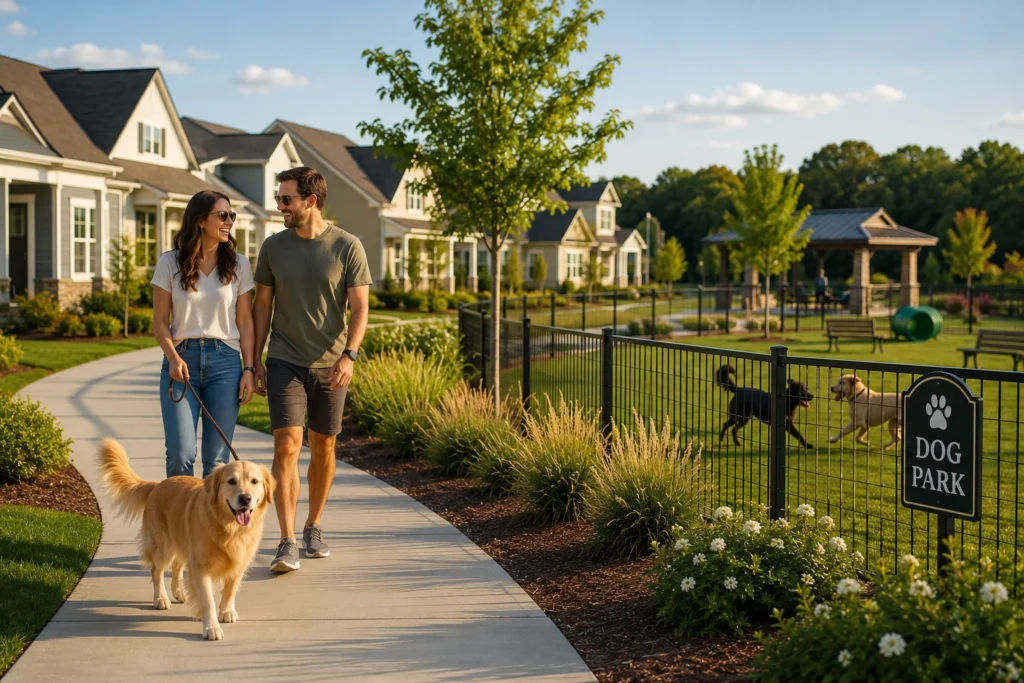
For dog owners, that often starts with walkability. Sidewalks, low-traffic streets, trails, shaded walking areas, and nearby open space can make a big difference. If you walk your dog early in the morning or after work, the layout of the community matters almost as much as the home itself.
For cat owners or owners of smaller indoor pets, the home design may matter more than the neighborhood layout. Natural light, quiet spaces, screened porches, secure windows, and flexible rooms can all help a home feel more comfortable for pets.
The most pet-friendly communities usually combine practical home features with outdoor access, clear rules, and nearby services such as veterinarians, groomers, boarding facilities, pet supply stores, and parks.
Why New Construction Can Work Well for Pet Owners
New construction often gives pet owners a cleaner starting point. The flooring, carpet, yard, HVAC filters, doors, trim, and outdoor spaces are new, which can be appealing if you are worried about previous pet odors, older carpet, or unknown wear from prior owners.
A newly built home may also let you choose finishes that work better for pets. Buyers may prefer durable flooring, stain-resistant carpet, easy-to-clean surfaces, mudrooms, drop zones, washable paint, or a floor plan that gives pets a comfortable place to rest without being in the middle of every activity.
In some communities, buyers can choose a homesite with a larger backyard, better privacy, or easier fence potential. That can matter for dog owners who want outdoor space but do not want to give up the benefits of a planned community.
New construction does not automatically mean pet-friendly, but it can give buyers more control over the details that affect everyday life with pets.
Charlotte-Area New Construction Communities With Dog Parks
The communities below include dog parks as a listed amenity and are organized by city to make comparison easier. Availability, HOA rules, amenity access, and community details can change, so buyers should verify current information directly with the builder or community before making a decision.
| Community | Builder | Pet-Friendly Feature |
|---|---|---|
| Belmont, NC | ||
| Redhawk | Lennar | Dog Park |
| Charlotte, NC | ||
| Cardinal Creek | D.R. Horton | Dog Park |
| River District Pioneer Collection | David Weekley Homes | Dog Park |
| Brightside Townes | David Weekley Homes | Dog Park |
| Byrds Landing Townhomes | Eastwood Homes | Dog Park |
| Cresswind | Kolter Homes | Dog Park |
| The Enclave at Alexander Road | Linnane Homes | Dog Park |
| Lakeview Village | Mungo Homes | Dog Park |
| Nichols Landing | Mungo Homes | Dog Park |
| Ryder Park | Mungo Homes | Dog Park |
| Sloan Station | Mungo Homes | Dog Park |
| Mallard Park | Pulte Homes | Dog Park |
| Parkside Crossing | Pulte Homes | Dog Park |
| Blueberry Farms | Red Cedar Homes | Dog Park |
| Paw Creek | Smith Douglas Homes | Dog Park |
| Griffith Lakes | Toll Brothers | Dog Park |
| Toll Brothers at The River District | Toll Brothers | Dog Park |
| Archer Row | Tri Pointe Homes | Dog Park |
| Bellflower | Tri Pointe Homes | Dog Park |
| Ellis Townes | Tri Pointe Homes | Dog Park |
| Fifteen 15 Cannon | Tri Pointe Homes | Dog Park |
| Village at Reedy Creek | True Homes | Dog Park |
| China Grove, NC | ||
| Kensington | True Homes | Dog Park |
| Clover, SC | ||
| Edmunds Farm | Knotts Builders | Dog Park |
| Arbor Chase | Mattamy Homes | Dog Park |
| Concord, NC | ||
| Cumberland | Niblock Homes | Dog Park |
| Davidson, NC | ||
| Davidson Woods | Linnane Homes | Dog Park |
| Fort Mill, SC | ||
| Brooks Run | DRB Homes | Dog Park |
| Gastonia, NC | ||
| Avalon of Gastonia | D.R. Horton | Dog Park |
| Robinson Oaks | Eastwood Homes | Dog Park |
| Carolina North | Knotts Builders | Dog Park |
| Harrisburg, NC | ||
| Harrisburg Village | Eastwood Homes | Dog Park |
| Blume Estates | Pulte Homes | Dog Park |
| Huntersville, NC | ||
| Spring Grove | M/I Homes | Dog Park |
| Whitaker Pointe | M/I Homes | Dog Park |
| Lachlan Park | Shea Homes | Dog Park |
| Lancaster, SC | ||
| Roselyn | Lennar | Dog Park |
| Lincolnton, NC | ||
| The Trails at Carpenter Farms | Century Communities | Dog Park |
| Clark Creek Landing | D.R. Horton | Dog Park |
| Locust, NC | ||
| Amber Glen | M/I Homes | Dog Park |
| Marvin, NC | ||
| Hunters Reserve at Marvin | Linnane Homes | Dog Park |
| Matthews, NC | ||
| Cadia Village | David Weekley Homes | Dog Park |
| Midland, NC | ||
| Del Webb Carolina Ridge | Pulte Homes | Dog Park |
| Mint Hill, NC | ||
| Alton Creek | Tri Pointe Homes | Dog Park |
| Monroe, NC | ||
| Blue Sky Meadows | Century Communities | Dog Park |
| Twinleaf Meadows | D.R. Horton | Dog Park |
| Cresswind at Wesley Chapel | Kolter Homes | Dog Park |
| Willoughby Park | M/I Homes | Dog Park |
| Cedar Meadows | Smith Douglas Homes | Dog Park |
| Mooresville, NC | ||
| Logan Farms | D.R. Horton | Dog Park |
| Shepherd’s Farm | D.R. Horton | Dog Park |
| Summerlin | Eastwood Homes | Dog Park |
| Harris Farms | Empire Communities | Dog Park |
| Norman Station | Lennar | Dog Park |
| Rock Hill, SC | ||
| Stoneridge Hills | LGI Homes | Dog Park |
| Allison Meadows | Pulte Homes | Dog Park |
| Salisbury, NC | ||
| Silverstein | D.R. Horton | Dog Park |
| Alexander Court | Lennar | Dog Park |
| Troutman, NC | ||
| Reverie at Lake Norman | Dream Finders Homes | Dog Park |
| Waxhaw, NC | ||
| Encore at Streamside | David Weekley Homes | Dog Park |
| Blythe Mill | Eastwood Homes | Dog Park |
| McCoy Farm | Pulte Homes | Dog Park |
| Weddington, NC | ||
| Twin Lakes | Linnane Homes | Dog Park |
| York, SC | ||
| Fergus Crossing | D.R. Horton | Dog Park |
| Handsmill on Lake Wylie | Kolter Homes | Dog Park |
| Cresswind at Rocky River | Kolter Homes | Dog Park |
Yard Size and Lot Choice Matter
For many pet owners, the lot is one of the most important parts of the decision.
A small yard may be fine for a low-energy dog if the community has sidewalks and nearby parks. A larger or more active dog may need more outdoor space, a flatter backyard, or easier access to trails. Some buyers may care less about yard size and more about whether the community has safe walking routes.
Lot shape also matters. A backyard that looks large on paper may not be very usable if it is steep, narrow, heavily sloped, or interrupted by drainage areas. Buyers should look at how the home sits on the lot, where the usable backyard begins, and whether future fencing will be allowed.
For pet owners, the best lot is often not the biggest one. It is the one that works for the way the pet and owner actually live.
Fencing Rules Can Make or Break the Fit
Many buyers assume they can add a fence after closing. In an HOA community, that may not be true.
New construction communities often have architectural guidelines that control fence height, material, color, placement, and approval timing. Some communities may allow black aluminum fencing but not wood privacy fencing. Others may restrict fencing on corner lots, front-facing side yards, easements, drainage areas, or lots near common open space.
This is one of the most important things pet owners should check before signing a contract. If a fenced yard is essential, do not rely on a verbal answer. Ask to review the HOA documents, architectural guidelines, and site plan. A home that seems perfect may not work if the lot cannot be fenced the way you need.
HOA Pet Rules Are Important
Most new construction communities have some type of HOA or community association. Pet rules may address leash requirements, noise, waste cleanup, common areas, number of pets, breed restrictions, size restrictions, or where pets can be walked.
These rules are not always the same from one community to another. They may also differ between single-family neighborhoods, townhome communities, condo-style communities, and 55+ communities.
In North Carolina, HOA pet rules are commonly used to manage everyday community issues such as leash requirements, pet limits, and use of common areas. Buyers should review the actual governing documents before assuming a pet will be allowed under the terms they expect.
If you have multiple pets, a large dog, a restricted breed, or a pet that needs a particular outdoor setup, HOA rules should be reviewed early in the process.
Sidewalks, Trails, and Open Space
Sidewalks and trails can make a community feel much more pet-friendly. They give pet owners a predictable way to walk dogs, meet neighbors, and build daily routines without relying entirely on the backyard.
Some Charlotte-area new construction communities include internal trails, greenways, pocket parks, dog parks, or access to nearby open space. Others may have sidewalks but limited shade or limited connectivity outside the neighborhood.
Buyers should think about when and how they walk their pets. A community may feel very different in the summer heat, after dark, during school pickup, or on weekends when traffic patterns change. A shaded trail or quieter loop street may be more valuable than it appears during a quick model-home visit.
Dog Parks and Pet Amenities
Some newer communities include dog parks or pet-focused amenities. These can be a nice bonus, especially for buyers who want social space for their dogs or who are moving from a more urban area where dog parks were part of their routine.
But a dog park should be viewed as a benefit, not the only reason to choose a community. The size, maintenance, drainage, shade, fencing, rules, and crowding of the dog park all matter. A small dog park may be helpful for quick play, but it may not replace daily walks or a usable yard.
Pet wash stations, nearby groomers, boarding facilities, and access to veterinary care can also add convenience. For relocation buyers, these everyday services may matter more than expected once the move is complete.
Townhomes, Low-Maintenance Homes, and Pets
Townhomes and low-maintenance communities can work well for pet owners, but they require a closer look at the rules and layout.
A townhome may offer less yard space, but it may also include sidewalks, shared green space, and exterior maintenance that reduces the owner’s workload. For smaller dogs, older pets, or buyers who prefer lower maintenance, this can be a good fit.
The tradeoff is that pet rules may be stricter. Some townhome or attached-home communities may have limits on pet size, number of pets, leash rules, common-area use, or waste stations. Noise can also be a bigger consideration when homes are attached or close together.
For pet owners considering townhomes, the question is not simply whether pets are allowed. The better question is whether the layout, rules, and daily routine will work comfortably.
55+ Communities and Pets
Many 55+ and active adult communities can be very pet-friendly because they often emphasize walkability, social activity, trails, clubs, and lower-maintenance living. For buyers with dogs, that can be a strong combination.
However, 55+ communities may also have detailed HOA rules. Pet policies, fencing guidelines, common-area restrictions, and architectural controls should be reviewed carefully. Buyers should also think about long-term convenience, especially for older pets. A floor plan with fewer stairs, easy outdoor access, and nearby walking areas may be more practical over time.
For many downsizers, pets are a major part of the decision. The right community should support both the buyer’s lifestyle and the pet’s routine.
Local Pet Rules Still Apply
Community rules are only part of the picture. Local animal ordinances still matter.
In Charlotte and Mecklenburg County, Animal Care & Control provides local pet law information, including leash law and tethering requirements. Charlotte-Mecklenburg licensing rules also require dogs, cats, and ferrets four months of age and older to be vaccinated for rabies and licensed annually or triennially through the appropriate local licensing program.
Buyers moving from another city or state should confirm pet licensing, leash rules, vaccination requirements, and local ordinances for the specific town or county where they buy. Rules can vary depending on whether the home is in Charlotte, Matthews, Mint Hill, Pineville, unincorporated Mecklenburg County, or another Charlotte-area municipality.
Pet Waste and Community Living
Pet-friendly communities work best when owners are considerate. Waste cleanup is one of the biggest everyday issues in neighborhoods with many dogs.
The EPA notes that pet waste in waterbodies can make people and animals sick, contribute to weed and algae growth, and damage nearby ecosystems. Stormwater runoff can also carry pollutants from pet and yard waste into local waterways.
This is one reason many communities provide pet waste stations, common-area rules, and cleanup reminders. For buyers, it is worth noticing whether the community is set up to support responsible pet ownership with trash stations, walking areas, and clear expectations.
Flooring and Interior Finishes
The inside of the home matters just as much as the outside.
Pet owners often prefer durable flooring in main living areas, easy-to-clean surfaces, and layouts that reduce wear in high-traffic areas. Luxury vinyl plank, engineered hardwood, tile, or other hard-surface flooring may be more practical than carpet in certain rooms, depending on the pet.
Mudrooms, drop zones, laundry rooms, and garage entries can also be helpful. A good everyday pet setup may include a place for leashes, food storage, towels, crates, litter boxes, pet beds, and cleaning supplies.
If you are building from the ground up or buying early enough to choose finishes, think about pets before making design selections. The best-looking option in the design center may not always be the easiest option to live with.
Outdoor Living With Pets
Outdoor living is one of the reasons many buyers choose new construction in the Charlotte area. Screened porches, patios, covered decks, and fenced yards can all improve daily life with pets.
For dog owners, direct access from the main living area to the backyard can be helpful. For cat owners, a screened porch may become a favorite safe outdoor space. For all pet owners, shade, drainage, and durable landscaping are worth considering.
Buyers should also think about sun exposure. A backyard that is comfortable in spring may feel very hot in July. Shade trees, covered patios, and porch orientation can all affect how useful the outdoor space feels for both people and pets.
Questions to Ask Before Choosing a Pet-Friendly Community
Buyers do not need to overcomplicate the process, but they should ask a few important questions before committing. The most important issues are whether pets are allowed under the HOA rules, whether fencing is permitted, whether the lot works for the pet, and whether the community supports daily walking or outdoor routines.
It is also smart to ask how common areas are maintained, whether there are pet waste stations, whether there are restrictions on dog size or number of pets, and whether nearby services such as veterinarians, groomers, and boarding facilities are convenient.
For buyers with pets, these questions should come early. It is much better to find out before signing a contract than after closing.
What Pet Owners Should Compare
A pet-friendly community should work for your daily routine, not just allow pets in the rules.
Look at yard usability, lot slope, fence options, shade, drainage, and access to walking areas.
Review HOA pet policies, leash expectations, fencing guidelines, waste rules, and common-area restrictions.
Consider sidewalks, trails, dog parks, veterinarians, groomers, boarding, and nearby pet supply options.
The Bottom Line
Pet-friendly new construction is about more than finding a home that allows animals. It is about choosing a home, lot, community, and location that fit your everyday routine.
For some buyers, that means a fenced backyard and durable flooring. For others, it means sidewalks, trails, dog parks, nearby groomers, or a low-maintenance home with easy outdoor access. The best choice depends on your pet, your lifestyle, and the rules that come with the community.
Charlotte-area buyers should review HOA documents, local pet ordinances, fencing rules, lot conditions, and nearby amenities before choosing a new construction home. A community that works well for pets can make daily life easier for the whole household.
Helpful Lifestyle and New Construction Guides
- Browse Charlotte-area new construction communities
- Compare Charlotte-area home builders
- Best Charlotte suburbs for commutes
- Benefits of new construction homes
- New construction mistakes to avoid
- Hidden costs of building a new construction home
- Working with a relocation company when moving to Charlotte
How HomeBuildersCLT.com Can Help
HomeBuildersCLT.com helps buyers compare new construction communities, builders, towns, and lifestyle considerations across the Charlotte area. If pets are part of your home search, we can help you think through fencing, yard size, sidewalks, trails, HOA rules, lot choice, and nearby services before you register with a builder or choose a community.
HomeBuildersCLT.com is not affiliated with any builder. Builder names, community names, and logos belong to their respective owners. Pricing, incentives, availability, HOA dues, pet policies, fencing rules, floor plans, school assignments, and community details can change quickly and should always be verified directly with the builder, HOA, local government, and appropriate professionals.
Looking for a Pet-Friendly New Construction Community?
Pet-friendly living depends on more than the home itself. HomeBuildersCLT.com can help you compare Charlotte-area communities by yard size, sidewalks, trails, fencing rules, HOA policies, and daily convenience before you choose a builder or neighborhood.
Frequently Asked Questions
What makes a new construction community pet-friendly?
A pet-friendly community usually offers more than permission to own pets. Sidewalks, trails, usable yards, fencing options, open space, dog parks, nearby veterinarians, and clear HOA rules can all make daily life easier for pet owners.
Do new construction communities allow fences?
Many new construction communities allow fences, but the HOA may control the height, material, color, placement, and approval process. Buyers should review the community’s architectural guidelines before assuming a lot can be fenced.
Can an HOA restrict pets?
HOAs may have pet-related rules involving leash requirements, waste cleanup, common areas, number of pets, dog size, or other community standards. Buyers should review the actual HOA documents before buying, especially if they have multiple pets or a large dog.
Are townhomes a good option for pet owners?
Townhomes can work well for some pet owners, especially if the community has sidewalks, green space, or low-maintenance living. However, pet owners should review rules carefully because attached-home communities may have stricter pet, noise, and common-area policies.
What should pet owners ask before buying new construction?
Pet owners should ask about HOA pet rules, fencing guidelines, yard usability, sidewalks, trails, dog parks, waste stations, leash rules, and nearby pet services. Local licensing and leash laws should also be confirmed for the specific city or county.
Sources
Stay Updated and Get Expert Help With Your New Home Search
Sign up to receive updates on Charlotte-area communities, builders, and market trends, and let us know if you’d like to be contacted by a real estate professional for personalized guidance.