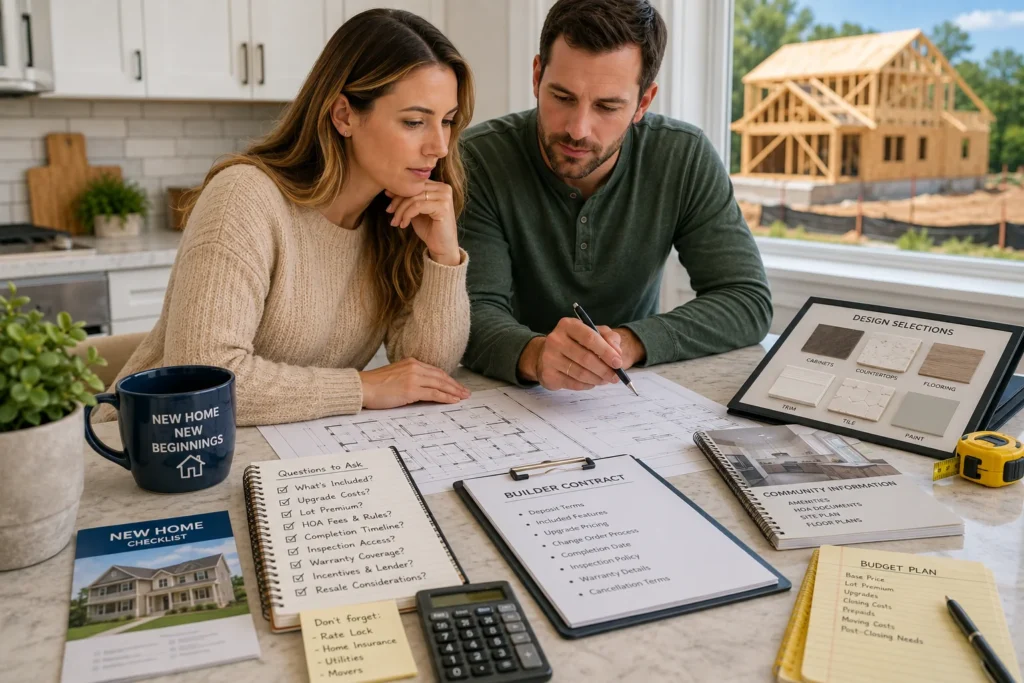

Buying a new construction home can feel easier than buying a resale home. Everything is new, the floor plans are modern, and the builder may offer incentives that make the numbers look attractive. In some cases, you can choose finishes, structural options, and design details before the home is complete.
But new construction is still a major real estate purchase, and the process is not always as simple as it appears. Builder contracts, deposits, upgrade pricing, inspections, financing, timelines, HOA rules, lot premiums, and agent registration policies can all affect the final decision.
The biggest mistakes usually do not happen because buyers are careless. They happen because buyers do not know how different the builder process can be from a traditional resale purchase.
For Charlotte-area buyers, that matters even more. Many buyers are comparing communities across Mecklenburg, Union, Cabarrus, Gaston, Iredell, York, and Lancaster counties. A home that looks great online may be in a different school system, tax area, commute pattern, or long-term growth corridor than the buyer expected.
Here are the new construction mistakes to avoid before choosing a builder, signing a contract, or visiting a design center.
Mistake 1: Visiting a Builder Before Understanding Agent Registration Rules
Many buyers begin by walking into a model home or filling out a form on a builder’s website. That may seem harmless, but it can matter if you want buyer representation.
Some builders require your real estate agent to be registered at the first visit or first meaningful contact. Rules vary by builder, community, and market. If you visit alone first, your ability to have an agent recognized by the builder may be affected.
This does not mean you can never tour a model home casually. It means you should decide whether you want your own agent involved before your first visit, online inquiry, or registration. If you do want representation, it is better to bring that agent into the process early.
Related guide:
Should You Use an Agent for New Construction?
Mistake 2: Assuming the Builder Sales Representative Represents You
Builder sales representatives can be helpful, friendly, and knowledgeable. They know the community, floor plans, available lots, incentives, and construction timeline. Many do a great job explaining the builder’s process.
But the builder sales representative works for the builder.
That does not make the relationship negative. It simply means buyers should understand the roles. A buyer’s agent is focused on the buyer’s interests, questions, comparisons, and decision-making process. That can be especially important when reviewing builder contracts, comparing communities, evaluating incentives, or thinking through resale considerations.
Mistake 3: Comparing Only Base Prices
Base price is often just the starting point.
A home’s final price can increase because of lot premiums, structural options, elevation choices, design center upgrades, appliance packages, lighting, flooring, cabinetry, countertops, outdoor living areas, garage extensions, and other selections.
This is one of the most common ways buyers get surprised. A model home may include many upgrades that are not included in the base price. Another builder may appear more expensive at first but include more features up front.
Before assuming one builder is a better deal than another, ask what the home would realistically cost with the lot, options, and finishes you actually want. The right comparison is not base price versus base price. It is final expected cost versus final expected cost.
Mistake 4: Not Asking What Is Included
Builders vary widely in what they include.
One builder may include features that another builder treats as upgrades. This can apply to countertops, flooring, shower tile, cabinet hardware, lighting, appliances, gutters, smart home features, sod, irrigation, garage door openers, screened porches, and other details.
Ask for the included features sheet and review it carefully. If something matters to you, get clarification in writing. Two homes with similar square footage can feel very different once you account for included finishes and upgrade costs.
This is especially important if you are comparing several Charlotte-area communities at once. A lower starting price may not mean a lower finished price.
Mistake 5: Overlooking the Lot
The lot can be just as important as the floor plan.
Lot premiums may be higher for cul-de-sac lots, wooded lots, larger homesites, private lots, corner lots, basement lots, or homesites with better positioning in the community. But the premium is only part of the decision.
Buyers should also think about slope, drainage, driveway grade, backyard usability, utility easements, retaining walls, future neighboring homes, road noise, sidewalks, mailboxes, and streetlights. A floor plan that looks perfect on paper may not feel the same on every homesite.
Before choosing a lot, ask how the home will sit on the property and what will be around it. A great floor plan on the wrong lot can become a long-term frustration.
Mistake 6: Skipping an Independent Inspection
Some buyers assume a new home does not need an inspection because everything is new. That is a mistake.
New does not automatically mean perfect. Construction involves many trades, materials, schedules, inspections, and handoffs. Even good builders can miss items.
Many buyers choose to have an independent inspection before closing. Some also choose a pre-drywall inspection if the builder allows it. A pre-drywall inspection may give buyers a chance to review framing, plumbing, electrical, mechanical systems, and other components before the walls are closed.
The Consumer Financial Protection Bureau notes that buyers should be prepared during the closing process to handle inspections, insurance, lender requests, and final document review. For new construction buyers, those inspection and closing steps are still important even though the home is newly built.
Ask the builder which inspections are allowed, when they can happen, and how repair requests are handled.
Mistake 7: Assuming the Builder Warranty Covers Everything
Builder warranties can be valuable, but they are not unlimited.
The Federal Trade Commission explains that most newly built homes come with a builder warranty, which typically covers permanent parts of the home such as concrete, plumbing, or electrical components. A separate home warranty is generally a service contract for items such as appliances or air conditioning.
Buyers should review the warranty before closing and understand what is covered, what is excluded, how long each coverage period lasts, and how warranty claims are submitted.
A warranty is helpful, but it should not replace careful inspections, documentation, and follow-up. If an issue appears after closing, photos, written requests, and a clear timeline can make the warranty process much smoother.
Related guide:
Understanding Builder Warranties
Mistake 8: Not Understanding Builder Deposits
Builder deposits can work differently than resale earnest money.
Depending on the builder and contract, buyers may pay a contract deposit, lot deposit, design center deposit, upgrade deposit, or other funds at different stages. Some deposits may be nonrefundable. Some may be credited at closing. Some may depend on loan approval, construction status, cancellation terms, or the builder’s specific contract.
In North Carolina, buyers also need to understand that resale transactions often involve due diligence money and earnest money, but builder contracts may not follow the same structure as a standard resale contract.
Before signing, ask what each deposit is for, whether it is refundable, when it is due, and what happens if the buyer cannot close. This is not an area where buyers should rely on assumptions.
Mistake 9: Focusing Only on Builder Incentives
Builder incentives can be valuable. They may include closing cost credits, design center credits, rate buydowns, appliance packages, blinds, refrigerator promotions, or other offers.
But incentives should be reviewed as part of the full purchase, not in isolation.
An incentive may require using the builder’s preferred lender, title company, or closing attorney. The interest rate, lender fees, points, APR, lock terms, mortgage insurance, and total cash to close still matter. A large incentive is not automatically the best deal if the total financing package is weaker.
The Consumer Financial Protection Bureau recommends comparing Loan Estimates from different lenders to understand loan options. For new construction buyers, that comparison is especially useful when a builder lender incentive is involved.
Related guide:
Should You Pre-Qualify Before Buying New Construction?
Mistake 10: Forgetting About Rate Locks and Construction Delays
Rate locks are especially important in new construction because the closing date may be months away.
If rates rise before closing, your payment can increase. If you lock too early and the home is delayed, your lock may expire. Some lenders offer extended locks or float-down options, but the details vary.
The goal is not to perfectly predict mortgage rates. The goal is to protect your budget while understanding the risks. Ask what happens if construction is delayed, who pays for a lock extension, whether there is a float-down option, and whether the builder lender has a program designed for new construction timelines.
Related guide:
Should You Lock Your Mortgage Rate Early?
Mistake 11: Not Reading the HOA Documents
Many new construction communities have homeowners associations. HOA rules can affect fencing, parking, exterior changes, rentals, pets, landscaping, pools, sheds, trash cans, architectural approvals, and community amenities.
Buyers should review the HOA documents before committing. This is especially important in townhome communities, low-maintenance communities, 55+ communities, and neighborhoods with amenity centers or shared maintenance responsibilities.
HOA dues are also part of the real monthly cost of ownership. In some communities, dues may cover meaningful services. In others, they may be more limited. Buyers should understand what the HOA maintains, what the homeowner maintains, and whether future dues may change as the community grows.
Mistake 12: Not Thinking About Resale
Even if you plan to stay for a long time, resale still matters.
Some choices that feel personal during construction may affect future buyers. Unusual finishes, limited bedroom counts, difficult lot conditions, poor natural light, steep driveways, small backyards, or homes backing to less desirable features can all affect future appeal.
Location matters too. Buyers should think about future competition from later phases, nearby communities, school assignment changes, commute patterns, and whether the home’s layout fits broad buyer demand.
New construction can be a good long-term decision, but it is still real estate. The fundamentals matter.
Related guide:
Is New Construction a Good Investment?
Mistake 13: Choosing the Largest Home Instead of the Best Fit
Square footage is important, but layout often matters more.
A smaller home with better storage, natural light, bedroom placement, garage space, and everyday flow may live better than a larger home with wasted space. Buyers should think about how they actually live, not just how the floor plan looks online.
The best floor plan is the one that fits your daily routine. Pantry space, laundry location, garage storage, bedroom placement, office needs, kitchen layout, and future flexibility can matter more than simply choosing the biggest plan available.
A home should work on an ordinary Tuesday, not just look impressive during a weekend model-home tour.
Mistake 14: Assuming the Model Home Is Realistic
Model homes are designed to impress.
They often include premium flooring, upgraded lighting, custom trim, designer paint, built-ins, outdoor living upgrades, upgraded appliances, landscaping enhancements, and professional staging. The model can be useful for understanding layout and flow, but it may not represent the base version of the home.
A helpful question to ask is: “What would this model cost if built as shown?”
That answer can make the real budget much clearer. It can also help you decide which upgrades are truly worth it and which ones may not matter as much once you move in.
Mistake 15: Not Planning for Post-Closing Costs
Even after closing, buyers may have additional expenses.
Common post-closing costs can include window treatments, refrigerator, washer, dryer, fencing, gutters, landscaping, ceiling fans, light fixtures, garage storage, security systems, water softeners, furniture, pest control, and moving expenses.
Some of these may be included by the builder. Others may not. A new home can reduce some immediate maintenance concerns, but buyers should still keep cash available after closing.
This is especially important for buyers stretching to the top of their budget. The home may be new, but move-in costs can still add up quickly.
Mistake 16: Not Asking About Energy Efficiency and Indoor Air Quality
New homes are often more energy efficient than older homes, but buyers should still ask questions.
Energy efficiency can depend on insulation, windows, HVAC design, air sealing, ductwork, appliances, ventilation, and third-party certifications. Indoor air quality can also be affected by ventilation and HVAC design.
The EPA notes that many forced-air heating and air conditioning systems do not mechanically bring outdoor air into the home, and that some advanced home designs add mechanical ventilation through the HVAC system. ENERGY STAR also notes that certified homes and apartments include ventilation systems designed to deliver a consistent amount of fresh air into the living space.
Ask the builder about HVAC sizing, fresh air systems, filtration, insulation, air sealing, energy certifications, and maintenance requirements. These details can affect comfort as well as operating costs.
Mistake 17: Ignoring Commute and Daily Life
A beautiful home can still be frustrating if the daily routine does not work.
Charlotte-area buyers often compare communities across several counties and two states. A community may look close on a map but feel very different during rush hour, school drop-off, airport runs, or weekend errands.
Before choosing a home, test the commute if possible. Think about access to work, schools, grocery stores, healthcare, parks, restaurants, the airport, and major roads.
The home matters. The lifestyle around the home matters too.
Mistake 18: Not Getting Important Details in Writing
Verbal conversations are helpful, but written confirmation is better.
If something is important to your decision, ask for it in writing. That includes incentives, included features, upgrade pricing, completion estimates, lot premiums, closing cost credits, warranty details, repair promises, inspection timelines, and deposit terms.
New construction involves many moving parts. Written documentation helps prevent misunderstandings and gives everyone a clearer record of what was discussed.
Mistake 19: Waiting Too Long to Ask Questions
Some buyers are afraid to ask too many questions because they do not want to seem difficult. But buying a new construction home is a major financial decision.
Ask questions early.
It is much easier to clarify deposits, incentives, design center costs, closing timelines, inspection rules, and warranty procedures before signing than after the process is already underway.
A good builder should be willing to explain the process clearly. If the answer is vague, ask again or request clarification in writing.
Mistake 20: Not Comparing Communities Side by Side
Many buyers compare homes, but not communities.
Community differences can include amenities, HOA dues, tax rates, school assignments, commute patterns, future phases, builder reputation, lot sizes, architectural variety, price ranges, and nearby growth.
A home that looks like a great deal may be less appealing if the community fit is wrong. Another home may cost more but offer a better location, stronger long-term appeal, or a better daily routine.
Use the home search to compare the whole picture, not just the floor plan.
The Bottom Line
New construction can be a great option for Charlotte-area buyers, but it is not a process to rush.
The biggest mistakes usually come from assuming that new construction is automatically simple. Buyers still need to understand contracts, deposits, upgrades, inspections, financing, builder timelines, HOA rules, and resale value.
Before choosing a builder or signing a contract, slow down and compare the full picture. The right home is not just the one with the best model, biggest incentive, or lowest base price. It is the one that fits your budget, timeline, lifestyle, and long-term plans.
How HomeBuildersCLT.com Can Help
HomeBuildersCLT.com helps buyers compare new construction communities, builders, towns, and buyer considerations across the Charlotte area. We are not affiliated with any builder, which allows us to help buyers think through community options, builder differences, commute tradeoffs, resale considerations, and questions to ask before registering with a sales office.
If you are considering new construction in the Charlotte area, we can help you compare communities, understand builder timelines, and connect with guidance before you make a decision.
HomeBuildersCLT.com is not affiliated with any builder. Builder names, community names, and logos belong to their respective owners. Pricing, incentives, availability, HOA dues, taxes, school assignments, floor plans, and financing terms can change quickly and should always be verified directly with the builder, lender, HOA, school district, and appropriate professionals.
Thinking About Buying New Construction?
Builder contracts, incentives, upgrades, inspections, and timelines can be very different from a resale purchase. HomeBuildersCLT.com can help you compare Charlotte-area communities and ask better questions before you register with a builder or sign a contract.
Helpful New Construction Buyer Guides
- Should you use an agent for new construction?
- Do builders pay buyer real estate agents?
- Should you pre-qualify before buying new construction?
- Should you lock your mortgage rate early?
- Hidden costs of building a new construction home
- Understanding builder warranties
- Browse Charlotte-area new construction communities
- Compare Charlotte-area home builders
Frequently Asked Questions
What is the biggest mistake buyers make with new construction?
One of the biggest mistakes is assuming the builder sales representative represents the buyer. Builder sales reps can be helpful, but they work for the builder. Buyers should understand representation, registration rules, contracts, incentives, inspections, and upgrade costs before moving forward.
Should I use a buyer’s agent for new construction?
Many buyers benefit from having their own agent, especially when comparing builders, communities, incentives, contracts, inspections, and resale considerations. Buyers should involve an agent before their first builder visit or online registration because some builders have strict registration rules.
Do new construction homes need inspections?
Yes, many buyers still choose independent inspections. New homes can have construction issues, incomplete items, or mistakes from different trades. Buyers may consider a pre-drywall inspection, a final inspection before closing, and a warranty inspection before the first-year warranty period ends.
Are builder incentives always a good deal?
Builder incentives can be valuable, but buyers should compare the full package. Incentives may be tied to a preferred lender, specific loan program, rate lock, or closing terms. Compare the interest rate, APR, fees, credits, monthly payment, and cash to close.
What should I ask before signing a builder contract?
Before signing, ask about deposits, refundability, included features, upgrade pricing, lot premiums, construction timelines, inspection access, financing requirements, HOA rules, warranty coverage, closing delays, and what happens if the home is not completed on time.
Sources
- Consumer Financial Protection Bureau: Closing on Your New Home
- Consumer Financial Protection Bureau: Loan Estimate Explainer
- Consumer Financial Protection Bureau: Closing Disclosure Explainer
- Federal Trade Commission: Warranties for New Homes
- North Carolina Real Estate Commission: Earnest Money Deposits
- EPA: Improving Indoor Air Quality
- ENERGY STAR: Indoor Air Quality Features
Stay Updated and Get Expert Help With Your New Home Search
Sign up to receive updates on Charlotte-area communities, builders, and market trends, and let us know if you’d like to be contacted by a real estate professional for personalized guidance.