


Charlotte has long been known as one of America’s major banking centers, but describing the region as simply a “banking city” misses a much bigger story.
Today, the Charlotte regional economy spans financial services, technology, healthcare, advanced manufacturing, energy, logistics, retail, corporate headquarters, professional services, and life sciences. The Charlotte Regional Business Alliance identifies advanced manufacturing, financial services, IT and technology, life sciences, and logistics and distribution as major regional industry clusters.
That economic diversity is especially important for people considering a move to Charlotte. A strong job market is not only about whether one employer is hiring today. It is also about having multiple industries and career paths available within the same metro if your job, employer, or career direction changes later.
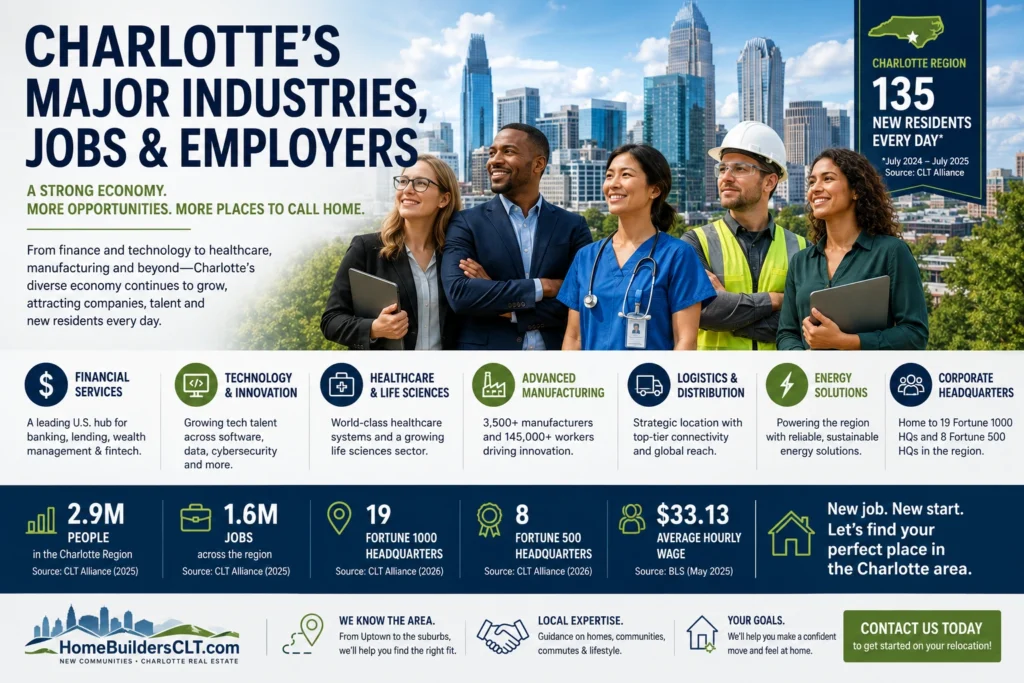
The Charlotte Region now has roughly 2.9 million residents and 1.6 million jobs, according to the Charlotte Regional Business Alliance. Its latest migration analysis found that the 16-county region gained 49,324 residents through migration alone between July 2024 and July 2025 — an average of about 135 new residents per day.
For relocating home buyers, those numbers tell an important story. Charlotte is not simply adding jobs; it is adding households. Population and employment growth influence where new communities are built, where roads and services expand, and which suburbs become increasingly practical for people working in different parts of the region.
Charlotte’s Economy at a Glance
The Charlotte Regional Business Alliance reports approximately 2.9 million residents, 1.6 million jobs, more than 3,500 manufacturers, and about 145,000 manufacturing workers across the region. The region is also home to 19 Fortune 1000 headquarters and, following the 2026 Fortune rankings, eight Fortune 500 headquarters. BLS reported an average hourly wage of $33.13 across Charlotte-area occupations in May 2025.
Financial Services Remain a Charlotte Cornerstone
Financial services remain one of Charlotte’s defining industries. Bank of America and Truist are headquartered here, while Wells Fargo maintains major operations in the region. The Charlotte Regional Business Alliance continues to identify financial services as one of the region’s core industry clusters.
But the opportunity extends well beyond traditional banking positions. Charlotte financial institutions hire people in technology, cybersecurity, data analytics, digital product management, marketing, communications, compliance, risk, operations, human resources, finance, and corporate strategy. Current Charlotte openings at Bank of America, Truist, and Wells Fargo illustrate that range, including technology, digital marketing, data, product, risk, and software-engineering positions.
That matters for relocation because someone moving here for one financial-services job may ultimately have several large employers within the same regional market.
Technology and Fintech Reach Across Industries
Charlotte’s banking base helped create a natural technology and fintech ecosystem, but technology jobs are no longer limited to financial companies.
Banks, retailers, healthcare systems, manufacturers, utilities, and other large employers increasingly need software engineers, cybersecurity professionals, data analysts, product managers, digital marketers, AI specialists, and technical project managers. Current Charlotte postings at major financial employers alone range from Microsoft technology management and software engineering to digital marketing, analytics, and cybersecurity program management.
For professionals with transferable digital or technical skills, that can be an advantage. Changing industries does not necessarily mean having to leave the Charlotte area.
Healthcare Is a Major Regional Employment Engine
Healthcare is another major component of Charlotte’s employment base. Atrium Health and Novant Health operate throughout the Charlotte region, creating opportunities in clinical care as well as administration, technology, finance, communications, operations, research, facilities, and management. Novant’s career platform, for example, maintains a dedicated Charlotte-region job search as well as separate corporate and support opportunities.
Healthcare employment is also geographically dispersed. That matters to home buyers because working at a medical facility outside Uptown can completely change which Charlotte-area suburb offers the most practical commute.
A buyer working in Pineville or Matthews may make a very different housing decision from someone working near Uptown or University City, even though all of those locations are part of the broader Charlotte employment market.
Advanced Manufacturing Is Bigger Than Many Newcomers Expect
Manufacturing may not be the first industry a newcomer associates with Charlotte, but the region has developed into a significant advanced-manufacturing hub.
The Charlotte Regional Business Alliance reports more than 3,500 manufacturers and approximately 145,000 manufacturing workers, with about 7,500 manufacturing jobs announced since 2020.
Growth has continued across several manufacturing categories. The Alliance reported that from 2024 to 2025, regional employment increased 6% in food and beverage manufacturing, 5% in aerospace, and 2% in pharmaceutical manufacturing.
These are not exclusively production-floor jobs. Modern manufacturing companies also employ engineers, automation professionals, supply-chain specialists, data analysts, quality teams, finance departments, marketers, technology professionals, and corporate managers.
That broader geographic footprint is important for home buyers because manufacturing employment extends well outside central Charlotte into surrounding counties and suburban employment corridors.
Energy Is Part of Charlotte’s Corporate Identity
Charlotte is also a major energy center, anchored by Duke Energy, which is headquartered in the city and is among the region’s Fortune 500 headquarters.
Energy-sector careers can include engineering, technology, project management, finance, customer operations, environmental work, grid infrastructure, and corporate functions. Charlotte’s energy economy also overlaps with manufacturing, engineering, and utility-related businesses across the Carolinas.
For relocation buyers, this is another reminder that Charlotte’s professional employment base extends beyond banking towers.
Logistics and Distribution Benefit From Charlotte’s Location
Transportation, logistics, and distribution are also major parts of the regional economy. The Charlotte Regional Business Alliance identifies logistics and distribution as one of its principal industry clusters, supported by the region’s interstate access, airport connectivity, and central East Coast location.
Charlotte’s growing logistics role is also attracting corporate operations. Maersk announced in late 2025 that it would establish its U.S. headquarters in Charlotte and create 520 jobs across logistics and supply, finance, legal, customer experience, human resources, business support, and operations.
For home buyers, logistics and distribution jobs can make west Charlotte, airport-area communities, and employment corridors outside the traditional Uptown office core much more relevant.
Charlotte Has Become a Corporate Headquarters City
One of Charlotte’s strongest economic advantages is the concentration of major corporate headquarters.
The City of Charlotte reported in 2026 that the region is home to 19 Fortune 1000 headquarters, and the latest Fortune 500 rankings increased the Charlotte Region’s Fortune 500 total to eight. Mecklenburg County alone includes headquarters for Bank of America, Honeywell, Nucor, Truist, Duke Energy, Sonic Automotive, and Albemarle.
Charlotte is also continuing to attract headquarters operations. Recent wins have included Maersk’s U.S. headquarters, Scout Motors, and Daimler Truck Financial Services.
That headquarters concentration creates opportunities beyond the companies themselves. Large corporate offices support demand for legal, accounting, marketing, consulting, technology, recruiting, communications, commercial real estate, and other professional services.
Life Sciences and Health Innovation Are Growing
Life sciences is smaller in Charlotte than finance or healthcare, but it is one of the industry clusters specifically targeted by the Charlotte Regional Business Alliance.
The opportunity is increasingly connected to the intersection of healthcare, research, technology, medical innovation, and advanced manufacturing. For professionals in biotechnology, healthcare analytics, pharmaceutical manufacturing, medical technology, or related disciplines, Charlotte represents another career category worth watching as the regional economy develops.
Retail, Consumer Businesses and Professional Services Add More Career Paths
Charlotte’s economy also benefits from major retail, consumer, industrial, and professional-services employers.
Lowe’s is headquartered in nearby Mooresville, while Honeywell, Sonic Automotive, and Albemarle add additional corporate depth to the region.
This is where industry labels can become misleading. A retailer needs software engineers. A bank needs marketers. A healthcare system needs analysts. A manufacturer needs accountants. An energy company needs project managers.
That crossover is one of the more useful aspects of Charlotte’s employment market for people thinking about making the region their long-term home.
What Charlotte Jobs Pay
Pay varies significantly by occupation, employer, and experience, but BLS data provides a useful regional benchmark.
Workers in the Charlotte-Concord-Gastonia metro had an average hourly wage of $33.13 in May 2025, compared with $33.54 nationally. Management occupations averaged $73.14 per hour, legal occupations averaged $63.35, and computer and mathematical occupations averaged $56.88.
Those figures should not be treated as expected salaries for every worker, but they demonstrate the range of higher-paying professional careers represented within the region.
Major Employers in Charlotte: Who Hires in the Region?
Charlotte has hundreds of employers, so there is no useful way to create one complete list. Instead, the companies below provide good starting points for anyone researching employment before relocating.
Several major employers currently maintain active Charlotte career listings. Bank of America is advertising Charlotte positions across areas including technology, marketing, product, credit, and project management; Truist has Charlotte openings spanning digital marketing, risk, technology, and analytics; Wells Fargo continues to list Charlotte banking, software, and corporate opportunities; and Novant Health maintains an entire job portal specifically for the Charlotte region.
Job openings change frequently, so use the links below to check each employer’s current career site.
Bank of America
Financial services, technology, analytics, product, operations, risk, marketing and corporate careers.
Search Bank of America Jobs →Truist
Banking, technology, digital, analytics, wealth management, operations and corporate roles.
Search Truist Jobs →Wells Fargo
Banking, technology, investment banking, operations, finance and professional careers.
Search Wells Fargo Jobs →Ally
Financial services, product, technology, analytics, customer experience and corporate careers.
Search Ally Jobs →Atrium Health
Clinical, administrative, technology, finance, operations and healthcare careers.
Search Atrium Health Jobs →Novant Health
Healthcare, nursing, technology, support, administration and corporate opportunities.
Search Novant Health Jobs →Duke Energy
Energy, engineering, technology, project management, operations and corporate roles.
Search Duke Energy Jobs →Lowe’s
Technology, digital, merchandising, marketing, finance, retail and corporate careers.
Search Lowe’s Jobs →Honeywell
Engineering, technology, product, operations and corporate careers.
Search Honeywell Jobs →Nucor
Manufacturing, engineering, technology, operations, finance and business careers.
Search Nucor Jobs →City of Charlotte
Aviation, transportation, utilities, technology, public service, finance and operations.
Search City of Charlotte Jobs →Mecklenburg County
Public health, technology, finance, social services, administration and government careers.
Search Mecklenburg County Jobs →Other Places to Search for Charlotte Jobs
Employer career sites are particularly useful when you already know which companies interest you. If you are still exploring, broader job platforms can help identify companies, job titles, and industries you may not have considered.
Charlotte Job Search Resources
Use these resources to search current opportunities across the Charlotte region.
Why Charlotte’s Job Diversity Matters When You Are Relocating
For someone considering a move, the value of Charlotte’s economy is not simply that there are jobs available today. It is the number of different directions a career can potentially go without requiring another major relocation.
One person in a household may work in banking while another works in healthcare. A marketer might move from financial services to retail. A data analyst could find opportunities with a bank, healthcare system, manufacturer, retailer, or energy company.
That kind of cross-industry mobility can matter when deciding whether Charlotte makes sense as a long-term home rather than simply a place to accept one particular job.
Charlotte has also continued attracting employers. Recent announcements include new headquarters and expansions from companies such as Maersk, Scout Motors, and other corporate and industrial employers, reinforcing the region’s ongoing business-recruitment momentum.
Your Job Location Should Be Part of Your Home Search
One of the biggest mistakes a buyer relocating to Charlotte can make is choosing a home first and thinking about the commute later.
Charlotte’s employment centers are spread throughout the region. Someone working Uptown or in South End may have a completely different list of practical communities than someone working in Ballantyne, University City, near Charlotte Douglas International Airport, in Mooresville, or along one of the region’s manufacturing and logistics corridors.
Mileage can also be misleading. Two communities may look similarly distant from an office on a map while producing very different everyday commutes.
That is why we recommend starting with where you expect to work, how often you need to be there, and how much commute time you are comfortable with before narrowing your home search too aggressively.
Where You Work Can Help Determine Where You Buy
If your job is based Uptown or in South End, you may prioritize neighborhoods and suburbs with practical access to central Charlotte and major commuter routes.
If you work in Ballantyne or South Charlotte, communities around Matthews, Pineville, Indian Land, Waxhaw, Weddington, Marvin, and surrounding areas may become more practical depending on your commute tolerance.
Someone working around University City or Concord may find northeast Charlotte, Harrisburg, Concord, Huntersville, or nearby communities worth exploring.
For jobs around Mooresville and the Lake Norman corridor, Huntersville, Cornelius, Davidson, Mooresville, and surrounding communities may make more sense than southern Charlotte suburbs.
And employment near Charlotte Douglas International Airport or west Charlotte can make Belmont, Gaston County, southwest Charlotte, and other west-side locations particularly interesting.
There is no universal “best suburb of Charlotte.” The better question is which community gives you the right balance of commute, home price, schools, housing style, and everyday lifestyle.
Buying a Home When Relocating for a Charlotte Job
A job offer can give you a reason to move to Charlotte, but it does not automatically tell you where you should buy.
Relocation buyers often have to make several big decisions at the same time: how close they want to live to work, whether they expect to commute every day, how much house they want, whether schools matter, whether they prefer new construction or an existing home, and how much of their monthly budget they want tied to housing.
Hybrid work can change the equation significantly. Someone commuting into Uptown five days per week may prioritize location very differently from someone who only needs to make that drive once or twice each week.
That additional flexibility can open up communities farther from central Charlotte where buyers may find newer construction, different home styles, larger lots, or a different price point.
It can also be smart to think beyond your current employer. Charlotte’s diversified economy means many professionals can change employers — and sometimes industries — without leaving the region. Choosing a home with reasonable access to more than one employment center may provide additional flexibility later.
How a Local Real Estate Agent Can Help With a Job-Related Move
For someone moving from another state, finding a house is only one part of the relocation process. Understanding how Charlotte’s employment centers connect to its towns, suburbs, school districts, highways, and new-construction corridors can be just as important.
A local real estate agent can help translate a job location into a realistic home search. Instead of simply drawing a 20-mile circle around an office, an agent can help you compare how different commute routes, community locations, and work schedules may affect your everyday routine.
That can be particularly useful if you have never lived in Charlotte and names like Waxhaw, Matthews, Belmont, Huntersville, Indian Trail, Fort Mill, Harrisburg, or Mooresville do not yet mean much to you.
An agent can also help you compare new-construction communities and builders, understand HOA costs, evaluate property-tax differences, research school assignments using objective resources, and think through the full monthly cost of ownership.
For buyers relocating from higher-cost markets, it can be tempting to focus primarily on how much more house Charlotte may offer for the money. The better approach is to consider the complete picture: commute, community, monthly costs, future resale, and how well the location fits the life you plan to have after you move.
You do not need to know exactly where you want to live before contacting an agent. In many cases, figuring that out is one of the most valuable parts of working with someone who understands the Charlotte region.
Relocating to Charlotte for Work?
Charlotte’s job market extends far beyond Uptown, and the right place to live can depend heavily on where you will work and how often you need to commute.
If you are moving to the Charlotte area for work, we can help you compare communities based on your employer location, commute preferences, budget, school considerations, home type, new-construction options, and lifestyle.
You do not have to know which Charlotte suburb is right for you before you start. Tell us what matters most, and we can help you narrow the region into a much more manageable home search.
Moving to Charlotte for Work?
Tell us where you’ll be working and what matters most in your home search. We can help you compare Charlotte-area communities based on commute, budget, schools, home type, new construction options, and lifestyle.
Bottom Line
Charlotte is still one of the country’s most important banking centers, but its employment story is much broader today.
Financial services remain a cornerstone of the economy, while technology, healthcare, advanced manufacturing, energy, logistics, retail, corporate headquarters, and professional services create additional layers of opportunity. The region now has approximately 2.9 million residents, 1.6 million jobs, 19 Fortune 1000 headquarters, eight Fortune 500 headquarters, and more than 3,500 manufacturers.
For someone thinking about relocating to Charlotte, that economic diversity can be an important part of the decision. Your first Charlotte job may be what brings you here. Having a broad employer base can give you more options for whatever comes next.
Related Charlotte Guides
- Moving to Charlotte: What New Residents Should Know
- Best Charlotte Suburbs for Commutes
- Best Suburbs for Young Professionals Near Charlotte
- Schools in the Charlotte Area
- Monthly Home Ownership Costs
- Costs of Homeownership
- Charlotte Townhomes and Condos: What Buyers Should Know
- Browse Charlotte-Area Communities
- Browse Charlotte-Area Builders
Frequently Asked Questions
What industries is Charlotte best known for?
Financial services remains one of Charlotte’s signature industries, but the regional economy also has major concentrations in advanced manufacturing, technology, healthcare and life sciences, logistics and distribution, energy, and corporate headquarters.
Is Charlotte only a banking city?
No. Banking remains important, but Charlotte has a much more diversified employment base. Healthcare systems, manufacturers, technology teams, energy companies, retailers, logistics companies, and major corporate headquarters employ workers throughout the region.
How many Fortune 500 companies are headquartered in the Charlotte region?
The Charlotte Region reached eight Fortune 500 headquarters with the release of the 2026 Fortune 500 rankings. The region also has 19 Fortune 1000 headquarters.
Is Charlotte a good place for technology jobs?
Charlotte has technology careers across multiple industries. Banks and other large employers currently advertise Charlotte positions in software engineering, digital product, cybersecurity, analytics, marketing technology, and related fields.
What is the average wage in Charlotte?
The U.S. Bureau of Labor Statistics reported an average hourly wage of $33.13 across all occupations in the Charlotte-Concord-Gastonia metro in May 2025. Pay varies substantially by occupation and experience.
Where should I look for jobs in Charlotte?
Official employer career sites are a good starting point because openings change frequently. Job seekers can also use broader platforms such as LinkedIn, Indeed, NCWorks, Charlotte Works, and the City of Charlotte and Mecklenburg County career sites.
Should my job location affect where I buy a home in Charlotte?
Yes. Charlotte-area employment centers are spread across a large region, so where you work and how often you commute can have a major impact on which towns and communities are practical for your home search.
Sources
- Charlotte Regional Business Alliance: Regional Population, Workforce and Economic Data
- Charlotte Regional Business Alliance: 135 People Move to the Charlotte Region Every Day
- Charlotte Regional Business Alliance: Industries and Major Employers
- Charlotte Regional Business Alliance: Advanced Manufacturing and Regional Business Data
- Charlotte Regional Business Alliance: Fortune 500 and Fortune 1000 Companies
- City of Charlotte: Charlotte Ranks No. 2 for Corporate Headquarters
- U.S. Bureau of Labor Statistics: Charlotte Area Economic Summary
- U.S. Bureau of Labor Statistics: Occupational Employment and Wages in Charlotte
- North Carolina Department of Commerce: Key Industries
Stay Updated and Get Expert Help With Your New Home Search
Sign up to receive updates on Charlotte-area communities, builders, and market trends, and let us know if you’d like to be contacted by a real estate professional for personalized guidance.