
Most buyers want to know the best time of year to buy a new construction home.
The honest answer is that it depends.
For resale homes, timing often comes down to seasonality, school calendars, and how many buyers are actively shopping. New construction works differently. Builders are also managing sales goals, construction timelines, finished inventory, lender incentives, lot releases, community phases, and year-end business targets.
That means the best time to buy new construction in the Charlotte area is not always spring, summer, fall, or winter. The better question is this:
When does the builder have a reason to be flexible?
That flexibility may show up in the form of closing-cost assistance, rate buydowns, design credits, appliance packages, price reductions, lot premium adjustments, or stronger incentives on quick move-in homes.
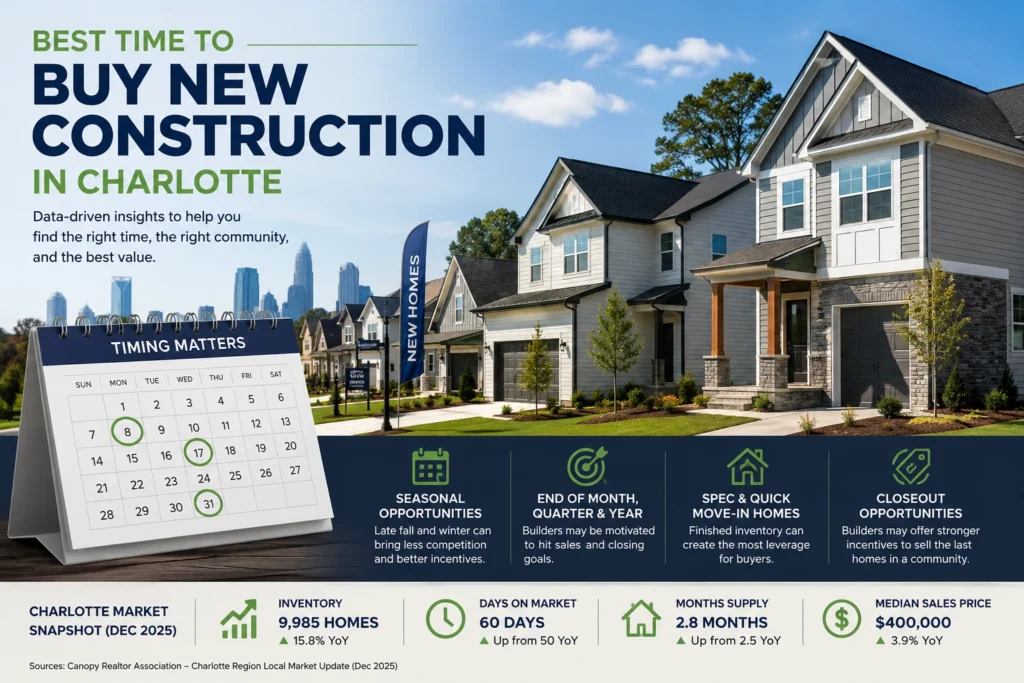
In the Charlotte region, timing can matter because the market has become more balanced than it was during the most competitive years, but demand has not disappeared. Canopy’s December 2025 Charlotte Region market update showed inventory up 15.8% year over year, months supply up from 2.5 to 2.8 months, days on market up from 50 to 60 days, and list-to-close time up from 95 to 105 days. At the same time, the median sales price was still up 3.9% year over year. That combination points to a market where buyers may have more room to compare options, but strong long-term demand still matters.
The Charlotte region also continues to grow. The Charlotte Regional Business Alliance has reported that an average of 157 people move to the Charlotte Region each day, which helps explain why builders remain active across Mecklenburg, Union, Lancaster, York, Cabarrus, Iredell, Gaston, Lincoln, and other surrounding counties.
So the real goal is not just buying during a certain month. It is finding the point where the right home, the right community, and the builder’s motivation line up.
Why Timing Works Differently With New Construction
A resale seller usually owns one home. A builder may be managing dozens or hundreds of homes across multiple communities.
That difference matters.
Builders may be focused on selling a certain number of homes in a month, closing homes by the end of a quarter, reducing finished inventory, opening a new phase, or clearing out a community before moving resources elsewhere. They may also have relationships with preferred lenders that allow them to offer incentives individual sellers usually cannot match.
This is why one buyer may get a strong incentive on a completed quick move-in home, while another buyer in the same community may see very little flexibility on a to-be-built home with a premium lot.
The home’s status matters. A dirt-start home, a framed home, a nearly finished home, and a completed spec home are not the same from the builder’s perspective.
Is Winter the Best Time to Buy New Construction?
Winter can be one of the better times to shop for new construction, but it is not automatically the best time in every community.
In many parts of the Charlotte area, buyer traffic tends to slow after the spring and summer rush. Families with school-age children often prefer to move before the school year starts, and many buyers put home searches on pause around the holidays. When traffic slows, builders may become more focused on converting serious buyers who are still active.
That can create opportunities, especially for homes that are finished or close to completion.
The advantage of winter shopping is that you may face less competition. You may also find builders promoting year-end incentives, preferred lender credits, or special financing on select inventory homes.
The tradeoff is selection. If the builder already sold the most desirable homesites earlier in the year, winter buyers may have fewer lot choices. Weather, holiday schedules, and contractor availability can also affect construction timelines.
For Charlotte-area buyers, winter is worth watching, but it should not be treated as a guaranteed discount season. In high-demand areas such as parts of south Charlotte, Weddington, Marvin, Fort Mill, Indian Land, Mooresville, Huntersville, and popular Union County school zones, desirable homes and homesites can still move quickly.
End of Month, Quarter, and Year Can Matter
Builder timing often becomes more important near the end of a reporting period.
At the end of a month, quarter, or year, a builder may be trying to hit internal sales goals or closing targets. That does not mean every builder will negotiate heavily, but it can create more urgency, especially on homes that are already built or can close soon.
This is where buyers need to understand the difference between a sales incentive and a closing incentive.
A sales incentive may be designed to get a buyer under contract. A closing incentive may be tied to a home closing by a certain date. A financing incentive may be available only if the buyer uses the builder’s preferred lender and meets specific loan requirements.
Nationally, builder incentives have remained common. NAHB reported that 65% of builders used sales incentives in February 2026, marking the 11th straight month above 60%, and 36% of builders cut prices, with an average price reduction of 6%.
That does not mean every Charlotte builder is offering the same thing. Incentives can vary by builder, community, home type, price point, lender, and construction stage. But it does show why buyers should pay attention to builder motivation, not just the calendar.
Start of a New Community: Good Timing, But Not Always a Discount
The beginning of a new community can be one of the best times to buy new construction, but not necessarily because the builder is discounting.
Early buyers may benefit from introductory pricing before later phases are released at higher prices. They may also have better access to homesite selection, floorplan choices, and structural options.
This can be especially important in fast-growing parts of the Charlotte region where new communities may open in phases. A buyer who enters early may have more choices than someone who waits until the community is mostly built out.
The tradeoff is uncertainty.
Early buyers may be living through construction for years. Amenities may not be complete. Streets, landscaping, clubhouses, pools, trails, and common areas may still be under development. Future phases may also bring different price points, different lot sizes, or different home styles.
There may also be fewer completed homes to walk through and fewer resale comps to evaluate. Buyers need to understand the site plan, future road connections, HOA structure, builder reputation, and what is actually included in the first phase.
The start of a community can be smart timing if the buyer is comfortable with the long-term vision and has done enough research on the location.
Community Closeout: Potential Incentives, Fewer Choices
The closeout phase can be one of the most interesting times to buy.
When a builder is down to the last few homes or homesites, the company may want to finish sales, close out the model, move sales staff to another neighborhood, and stop carrying costs in that community.
That can create room for stronger incentives.
But closeout inventory needs to be evaluated carefully. The remaining homes may be available for a reason. Sometimes the last homesites back to a road, sit near an entrance, have a less desirable slope, offer less privacy, or include a floorplan or design package earlier buyers did not choose.
That does not make them bad homes. It just means the buyer needs to compare the incentive against the tradeoff.
A $20,000 incentive may be valuable. But if the home backs to something that could affect resale, or if the layout does not fit the buyer’s needs, the incentive should not be the only deciding factor.
Closeout opportunities are often best for buyers who are flexible on selections but focused on value.
Spec Homes and Quick Move-In Homes May Offer the Best Leverage
For many buyers, the strongest opportunities come from spec homes and quick move-in homes.
A spec home is a home the builder starts before having a specific buyer under contract. These homes may be partially built, nearly finished, or already complete.
The builder has money tied up in the land, construction, materials, labor, taxes, utilities, insurance, and marketing. The longer a finished home sits, the more motivated a builder may become to sell it.
That is where buyers may see better incentives.
Quick move-in homes can also reduce uncertainty. Instead of waiting many months for a home to be built, buyers may be able to walk the actual home, see the finishes, understand the lot position, and move in sooner.
This can be helpful for relocation buyers, renters approaching the end of a lease, buyers who already sold a home, or families trying to time a school move.
The tradeoff is choice. With a quick move-in home, the buyer may not be able to change the floorplan, structural options, cabinets, countertops, flooring, or exterior colors. The home may include upgrades the buyer would not have chosen, which can affect the final price.
Still, if the home fits the buyer’s needs and the builder is offering meaningful incentives, a quick move-in home can be one of the best ways to buy new construction in the Charlotte area.
Where Charlotte-Area Buyers May Find More Flexibility
Charlotte is not one single housing market.
Conditions can look very different between Mecklenburg County, Union County, Cabarrus County, York County, Lancaster County, Gaston County, Lincoln County, Iredell County, and Rowan County.
Some closer-in or school-driven submarkets may remain competitive even when the broader region softens. Other outer-growth areas may have more new construction inventory, more active communities, and more builder competition.
That matters for timing.
If a buyer is looking in a tight location with limited land and strong demand, waiting for a major discount may not work. If the same buyer is open to a nearby county or a newer growth corridor with more active construction, there may be more room to compare communities and negotiate incentives.
Canopy’s 2025 year-end summary described the Charlotte market as having increased inventory and supply, with several smaller markets moving closer to balance. The report also notes that the data reflects existing-home sales, so it should not be treated as a perfect new-construction-only measure, but it is still useful for understanding the broader market backdrop buyers are shopping in.
For new construction buyers, this means the “best time” may also depend on how flexible they are with location.
A buyer focused only on one specific school zone or one specific builder may have less leverage. A buyer comparing several communities across nearby towns may find more options.
The Data Buyers Should Watch Before Deciding
Instead of relying only on seasonality, buyers should look for signs of builder motivation.
A community with several quick move-in homes may offer more opportunity than a community with a long waitlist. A builder advertising rate buydowns or closing-cost credits may be responding to slower traffic or affordability pressure. A home that has been completed for several weeks or months may be more negotiable than a home that has not started construction.
Buyers should also pay attention to the broader market.
If days on market are rising, inventory is increasing, and builders are advertising incentives, buyers may have more room to compare. If rates drop suddenly and buyer traffic returns, incentives can tighten quickly.
That is one reason timing new construction is difficult. The best opportunity may not last long, especially on homes that are priced well or located in desirable communities.
Should You Wait for a Better Deal?
Waiting can work, but it also carries risk.
A buyer may wait for more incentives and then lose the homesite, floorplan, or community they liked most. Prices may also rise in later phases. Mortgage rates may move against the buyer. The builder may reduce incentives if sales improve.
On the other hand, rushing into a contract just because an incentive is available can also be a mistake.
The better approach is to compare the full package:
the base price, lot premium, structural options, design upgrades, financing terms, closing-cost credits, rate buydown, HOA dues, property taxes, commute, schools, location, community plan, and long-term resale potential.
The biggest incentive is not always the best deal. Sometimes a smaller incentive in a stronger location is a better long-term decision than a larger incentive on a home with weaker resale appeal.
So, What Is the Best Time to Buy New Construction in Charlotte?
The best time to buy a new construction home in Charlotte is usually when three things line up:
The community fits your lifestyle and long-term plans.
The home or homesite makes sense for your needs.
The builder has enough motivation to offer meaningful value.
That could happen in winter. It could happen at the end of a quarter. It could happen during a community closeout. It could happen when a quick move-in home has been sitting longer than expected. It could also happen early in a new community if pricing is favorable before later phases are released.
For many buyers, the best strategy is not to wait for a perfect month. It is to understand the signals.
Look for builder inventory. Watch incentives. Compare communities. Ask what homes are close to completion. Understand whether pricing has changed between phases. And before signing, make sure you understand what the builder is offering, what strings are attached, and how the home compares to other options nearby.
New construction can be a great fit for Charlotte-area buyers, but timing matters. The more you understand how builders think, the better prepared you are to recognize a real opportunity when it appears.
How HomeBuildersCLT.com Can Help
HomeBuildersCLT.com helps buyers compare new construction communities, builders, locations, and home types across the Charlotte area. Because builder pricing, incentives, inventory, and availability can change quickly, having guidance before registering with a builder or touring a sales center can make a difference.
If you are trying to decide whether to buy now, wait for a quick move-in opportunity, compare closeout homes, or watch for a new community opening, we can help you evaluate the options more clearly.
Trying to Time a New Construction Purchase?
The best opportunity is not always tied to a specific month. It often depends on builder inventory, incentives, community phase, location, and how soon a home can close.
HomeBuildersCLT.com can help you compare communities, understand builder incentives, and decide whether a quick move-in home, new phase, or closeout opportunity makes sense for your situation.
Related New Construction Guides
Frequently Asked Questions
What is the best month to buy a new construction home?
There is no single best month for every buyer. Late fall and winter can sometimes create more opportunity because buyer traffic may slow, but the better signal is builder motivation. A completed home, a community closeout, or an end-of-quarter sales push may matter more than the month itself.
Are builders more likely to negotiate on spec homes?
Builders may be more flexible on spec homes or quick move-in homes because those homes already represent a financial investment. If a home is finished or close to completion, the builder may be more motivated to offer incentives, especially if the home has been sitting.
Is it better to buy at the beginning of a new community?
Buying early in a new community can sometimes provide better homesite selection and potentially lower pricing before later phases are released. The tradeoff is that amenities, streets, landscaping, and surrounding construction may not be complete yet.
Is a closeout home a good deal?
A closeout home can be a good deal if the home, lot, price, and incentive package make sense. Buyers should look closely at why the home is still available. Remaining homes may have fewer design choices or less desirable homesites, so the incentive should be weighed against the tradeoffs.
Do Charlotte builders offer better incentives when inventory rises?
They can, but it depends on the builder, community, and home. When inventory rises and buyer traffic slows, builders may use incentives such as closing-cost credits, rate buydowns, design credits, or price adjustments to keep sales moving.
Sources
- Canopy Realtor Association: Charlotte Region Local Market Update, December 2025
- Canopy Realtor Association: Charlotte Housing Market Finds Its Footing in 2025
- Charlotte Regional Business Alliance: 157 People Move to Charlotte Region Daily
- National Association of Home Builders: Builder Sentiment Edges Lower on Affordability Concerns
- National Association of Home Builders: Builders Respond to Affordability Challenges with Buyer Incentives and Innovative Designs
Stay Updated and Get Expert Help With Your New Home Search
Sign up to receive updates on Charlotte-area communities, builders, and market trends, and let us know if you’d like to be contacted by a real estate professional for personalized guidance.