
Mortgage rates can change the affordability of a home almost as much as the purchase price. That has made one feature of new construction increasingly important for buyers: builder financing incentives.
When mortgage rates rise, you may see builders advertise financing at rates that appear significantly lower than the broader mortgage market. Those offers can be legitimate and valuable, but it is important to understand where the lower rate comes from, whether it lasts for the life of the loan, and what conditions are attached to the offer.
As of September 10, 2026, Freddie Mac reported that the average 30-year fixed mortgage rate was 6.76%, up from 6.71% the previous week and 6.35% a year earlier. Freddie Mac’s survey is a market benchmark, not a rate every buyer will receive, but it helps explain why a builder promotion advertising a rate in the 4% or 5% range can get so much attention.
For buyers considering new construction around Charlotte, the question should not simply be, “What rate is the builder offering?”
The better question is:
“What is the total cost of this financing compared with my other options?”
Why Can a Builder Sometimes Offer a Lower Mortgage Rate?
Builders do not operate in a completely separate mortgage market where interest rates are naturally much lower.
Instead, a builder may use part of its sales incentive budget to help reduce the buyer’s financing cost. Depending on the promotion, that money might fund discount points, a permanent rate buydown, a temporary buydown, closing-cost assistance, or another lender-related incentive.
That can make sense for a builder. Rather than cutting the published price of a home substantially, the builder may be able to offer an incentive that reduces a buyer’s monthly payment and makes the home more affordable.
These offers are often associated with a builder’s preferred or affiliated lender, and the exact incentive can vary by community, homesite, loan program, closing date, and current inventory.
That is why you may see one rate advertised in a particular Charlotte-area community while another community from the same builder has a completely different promotion.
What Does a Mortgage Rate Buydown Mean?
A mortgage buydown generally involves paying money upfront to reduce the financing cost.
The Consumer Financial Protection Bureau explains that discount points allow borrowers to pay more at closing in exchange for a lower interest rate. One point equals 1% of the loan amount, although the amount of rate reduction received for each point depends on the lender, loan type, and market conditions.
With a builder incentive, the builder may effectively provide money that helps fund that reduction rather than requiring the buyer to pay the entire cost personally.
But there is an important distinction buyers need to understand.
Permanent vs. Temporary Rate Buydowns
Not every advertised low rate works the same way.
Permanent Rate Buydown
With a permanent buydown, the mortgage’s actual note rate is reduced for the full loan term.
For example, if a buyer qualifies for a 30-year fixed mortgage at 4.99%, that 4.99% rate would generally remain in effect for the entire 30-year term unless the borrower later sells the home, pays the loan off, or refinances.
For a buyer planning to keep the loan for a long time, a permanent rate reduction can potentially have substantial value because it lowers both the monthly principal-and-interest payment and the amount of interest paid over time.
Temporary Rate Buydown
A temporary buydown works differently.
Fannie Mae defines a temporary interest-rate buydown as a reduction in the effective rate the borrower pays during the early years of the mortgage, made possible by money deposited into a buydown account. Those funds are then used to subsidize a portion of the borrower’s payments.
A common example is a 2-1 buydown.
If the actual note rate is 6.75%, the payment might initially be calculated as though the rate were:
Year 1: 4.75%
Year 2: 5.75%
Year 3 and beyond: 6.75%
The actual mortgage note rate remains 6.75%. The temporary subsidy simply reduces the payment during the introductory period.
Freddie Mac’s current guidelines similarly allow temporary subsidy buydown structures in which the effective rate can initially be reduced and then increase toward the actual note rate over time.
This distinction is extremely important when comparing builder advertisements.
A headline saying “Rates as low as 4.75%” does not necessarily mean the buyer will have a 4.75% mortgage for 30 years.
Always Ask: Is the Advertised Rate Permanent?
This may be one of the most important questions to ask when you see a builder mortgage promotion.
Find out whether the advertised rate is:
a permanent fixed rate for the entire loan, or
a temporarily reduced payment that eventually increases to a higher note rate.
Also ask whether the advertised offer assumes a specific down payment, credit profile, loan type, number of discount points, particular home, or closing date.
Mortgage advertising frequently involves qualifications and conditions, which is why buyers should review the actual Loan Estimate rather than basing a financing decision on a sign, website banner, or model-home advertisement.
How Much Can a Lower Rate Affect Your Payment?
The impact can be significant.
Consider a hypothetical $400,000, 30-year fixed mortgage. These figures illustrate principal and interest only and exclude taxes, homeowners insurance, HOA dues, mortgage insurance, and other ownership costs.
Example: $400,000 30-Year Mortgage
Approximate monthly principal and interest only.
Illustration only. Actual mortgage rates, payments, points, fees and qualification requirements vary by borrower and lender.
That example demonstrates why buyers should pay attention to financing incentives rather than comparing new construction entirely on purchase price.
A meaningful permanent rate reduction can sometimes have a larger impact on the monthly payment than a relatively modest reduction in the home’s price.
But that does not automatically make the lower-rate offer the better financial decision. You still need to know what it costs to obtain that rate.
Lower Mortgage Rate vs. Lower Home Price
Suppose a builder gives you a choice between a price reduction and financing assistance.
The price reduction sounds straightforward, but a rate incentive may sometimes produce a larger monthly-payment reduction.
On the other hand, a lower purchase price reduces the amount you are financing and may also affect future transaction economics. A rate incentive is attached to the mortgage rather than the home’s underlying price.
The right choice depends on factors such as how long you expect to own the home, how long you expect to keep the mortgage, the size of the incentive, the interest-rate difference, and how much cash you have available at closing.
This is one reason buyers should ask for actual numbers for each scenario rather than deciding based solely on the advertised incentive.
Builder Closing-Cost Credits Can Be Valuable Too
A lower mortgage rate is not the only financing incentive a builder may offer.
Builders may also provide assistance with closing costs, which can reduce the amount of cash a buyer needs to bring to closing.
For some buyers, particularly first-time buyers, reducing the upfront cash requirement may be more useful than lowering the rate.
For another buyer who has plenty of cash available but plans to keep the mortgage for many years, a permanent rate reduction might provide greater long-term value.
The Consumer Financial Protection Bureau emphasizes that mortgage choices involve tradeoffs between upfront costs and ongoing payments and recommends considering both rather than focusing on one component of the loan.
What About Lender Credits?
Lender credits are different from a builder paying to reduce your rate.
CFPB explains that traditional lender credits work in essentially the opposite direction from discount points. The borrower receives money to help offset closing costs but generally accepts a higher interest rate in return.
This is why the word “credit” by itself does not tell you whether an offer is beneficial.
A builder credit, seller credit, lender credit, discount-point contribution, and temporary buydown can all affect a mortgage differently.
Ask the lender to explain exactly where the money comes from and how it changes the interest rate, closing costs, cash needed at closing, and future monthly payments.
Why Builders May Offer Their Best Incentives on Certain Homes
Builder financing incentives are not always available equally across every home in a community.
A builder may have stronger motivation to sell a home that is already complete or nearing completion than a home that has not yet been built.
That can make quick move-in or inventory homes particularly interesting for buyers searching for financing incentives.
Promotions may also change based on sales goals, market conditions, available inventory, and how quickly a builder wants a particular home to close.
That means buyers should not assume the incentive advertised last month is still available — or that every home in the same neighborhood qualifies.
Ask about incentives on the specific homes you are considering.
The Preferred Builder Lender May Be Worth Considering
Many large builders work with a preferred or affiliated mortgage company.
Using that lender may unlock incentives that are not available when financing with an outside lender. Depending on the promotion, those benefits could include rate assistance, closing-cost credits, or other financing support.
That does not mean the builder’s lender is automatically more expensive, and it does not mean it is automatically the best option.
The important thing is to compare the actual offer.
An affiliated lender paired with a substantial builder incentive may produce an excellent financing package. In another transaction, an outside lender may offer better terms even after the builder’s incentive is considered.
You cannot know from the headline rate alone.
You Should Still Shop the Mortgage
Even when a builder financing offer looks compelling, it is usually worth getting another quote.
CFPB recommends making an apples-to-apples comparison among lenders and looking beyond the headline interest rate. Among the items buyers should compare are the rate, points, fees, monthly payment, closing costs, and whether payments can change.
When possible, compare the same loan type, down payment, loan amount, lock period, and approximate timing.
An outside quote can also give you useful context for evaluating just how valuable the builder’s promotion really is.
What Should You Compare?
The easiest mistake is comparing only the interest rate.
Instead, look at the complete financing package.
Compare the Entire Loan — Not Just the Advertised Rate
Rate Locks Matter More With a Home That Is Still Being Built
Another financing difference with new construction is timing.
If you contract on a home that will not be completed for several months, the mortgage rate available today may not be the rate available when the home is ready to close.
Some lenders offer extended rate locks for new construction, but their terms, costs, expiration dates, and float-down provisions can vary.
This becomes particularly important if the builder’s advertised incentive requires closing by a certain date.
A buyer should understand what happens if construction is delayed, whether the incentive expires, and whether the mortgage rate remains protected.
We cover this issue in more detail in our guide to locking your mortgage rate when buying new construction.
Could You Refinance Later If Rates Fall?
Possibly, but buyers should be cautious about using an assumed future refinance to justify a payment that is uncomfortable today.
Mortgage rates may fall in the future, stay elevated, or move higher. Refinancing also involves qualification requirements and potentially additional costs.
The safer approach is to make sure the home and mortgage work with your current financial situation.
If rates eventually drop enough to make refinancing attractive, that can be evaluated at that time.
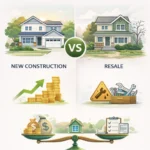
Builder Financing Can Make New Construction More Competitive With Resale Homes
This is where the financing discussion becomes especially relevant for buyers comparing new construction with an existing home.
A resale seller may reduce the price or agree to concessions, but a large builder may have additional ways to structure incentives through its preferred lender.
If a builder can significantly reduce the financing cost, a new home that initially appears more expensive than a resale property may have a monthly payment that is surprisingly competitive.
But the reverse can also happen.
A lower-priced resale home financed through an outside lender may still be the better overall purchase.
This is why comparing homes solely on asking price — or solely on advertised mortgage rate — can produce the wrong conclusion.
Compare the total monthly ownership cost.
How a Buyer’s Agent Can Help With Builder Financing Incentives
A buyer’s agent is not your mortgage lender and should not tell you which loan to choose. But an agent who works with new construction can help you understand which communities are offering incentives, identify questions to ask, and compare the real-estate side of competing builder offers.
That can be particularly useful when two communities have similar homes but very different incentives.
One builder might be offering a permanent rate promotion. Another might offer a larger closing-cost credit. A third may have a stronger incentive on a completed inventory home.
An agent can also help you keep the financing incentive in perspective by comparing the home price, upgrades, lot premium, HOA dues, taxes, builder reputation, location, commute, and resale considerations.
The mortgage is only one part of the purchase.
The best incentive does not make the wrong home the right home.
Questions to Ask Before Accepting a Builder Mortgage Offer
You do not need to become a mortgage expert, but you should understand exactly what you are being offered.
Ask the lender whether the advertised rate is permanent or temporary, what the actual note rate is, how many discount points are involved, who is paying those points, how long the rate is locked, what credit and down-payment assumptions are required, whether the incentive applies to your specific home, and what your total cash to close will be.
Then ask for a Loan Estimate so you can compare the offer with another lender.
The CFPB specifically recommends comparing the same type of loan across lenders because different pricing structures can otherwise make offers difficult to evaluate.
Bottom Line
Builder mortgage incentives can be one of the biggest financial advantages of buying new construction, particularly when market mortgage rates are elevated.
A builder may help fund a permanent rate reduction, temporary buydown, closing-cost assistance, or another financing incentive that meaningfully reduces the cost of buying the home.
But a low advertised rate should be the beginning of your questions, not the end of them.
Find out whether the rate is permanent, what it costs to obtain, which buyers and homes qualify, how long the offer lasts, and what the complete loan package looks like compared with an outside lender.
When the numbers work, a builder financing incentive can potentially save a buyer hundreds of dollars per month.
The key is making sure you are comparing the actual deal, not just the advertisement.
How We Can Help
If you are considering new construction around Charlotte, we can help you compare more than floor plans and base prices. We can identify communities offering current builder incentives, compare available inventory homes, look at HOA costs and property taxes, and help you evaluate how the total purchase fits your budget and lifestyle.
We can also help you ask the right questions about builder financing while you compare the lender’s actual terms with your other options.
You do not have to decide on a builder, community, or lender before reaching out. In many cases, comparing those options is exactly where buyer representation is most useful.
Want to Compare Charlotte Builder Incentives?
Builder promotions can include lower mortgage rates, closing-cost help and incentives on quick move-in homes. We can help you compare Charlotte-area communities and understand what each builder is offering before you make a decision.
Related Charlotte New Construction Guides
Related New Construction & Financing Guides
- Can You Use Your Own Lender When Buying New Construction?
- Should You Pre-Qualify Before Buying New Construction?
- Should You Lock Your Mortgage Rate Early When Buying New Construction?
- Builder Incentives You Should Negotiate
- First-Time Home Buyer’s Guide to New Construction in Charlotte
- Monthly Home Ownership Costs
- Costs of Homeownership
- Browse Charlotte-Area New Construction Communities
- Browse Charlotte-Area Home Builders
Frequently Asked Questions
Why can new construction builders offer lower mortgage rates?
Builders may use financial incentives to help fund discount points, rate buydowns, closing-cost assistance, or other financing benefits. The lower rate is generally part of the sales incentive rather than evidence that builders operate in a separate mortgage market.
Is a builder’s advertised mortgage rate permanent?
Not necessarily. Some promotions offer a permanent fixed rate while others use a temporary buydown that lowers the payment for the first one, two, or three years before it increases to the actual note rate. Buyers should confirm which structure applies before comparing offers.
What is a 2-1 mortgage buydown?
A 2-1 buydown temporarily calculates the payment using a rate two percentage points below the note rate during the first year and one percentage point below during the second year. The borrower then makes payments based on the full note rate beginning in the third year.
Is the builder’s preferred lender always cheaper?
No. Builder incentives can make a preferred lender very competitive, but buyers should compare the complete loan package with other lenders. Interest rate, APR, discount points, fees, closing credits, cash to close, and monthly payment all matter.
Should I choose a lower mortgage rate or a lower home price?
It depends on the size of each incentive, the financing terms, how long you plan to keep the mortgage, and your financial circumstances. Ask the lender to show both scenarios so you can compare the upfront and long-term costs.
Can builders pay closing costs?
Builders may offer closing-cost assistance subject to the terms of the transaction, loan program requirements, and applicable contribution limits. The specific amount and eligibility vary by builder, lender, home, and promotion.
Are builder mortgage incentives better on quick move-in homes?
They can be. Builders sometimes offer stronger incentives on completed or nearly completed inventory homes, although promotions vary and there is no guarantee that an inventory home will have a better financing offer.
Should I still get another mortgage quote?
It is generally useful to compare offers. CFPB recommends comparing loan terms and costs across lenders rather than focusing only on the advertised interest rate.
Sources
- Freddie Mac: Primary Mortgage Market Survey
- Consumer Financial Protection Bureau: Discount Points and Lender Credits
- Consumer Financial Protection Bureau: Comparing Mortgage Loan Choices
- Consumer Financial Protection Bureau: Understanding Mortgage Costs
- Consumer Financial Protection Bureau: Shopping for a Mortgage
- Fannie Mae: Temporary Interest Rate Buydowns
- Fannie Mae: Temporary Buydown Overview
- Freddie Mac: Temporary Subsidy Buydown Plans
Let Us Help You Compare More Than the Advertised Rate
Builder incentives can vary by community, home, lender and closing date. We can help you compare new construction options, current builder promotions, quick move-in homes, HOA costs, property taxes and other factors that affect the real cost of buying.
We can also help you ask the right questions about preferred-lender incentives so you can compare the full offer—not just the headline mortgage rate.
Stay Updated and Get Expert Help With Your New Home Search
Sign up to receive updates on Charlotte-area communities, builders, and market trends, and let us know if you’d like to be contacted by a real estate professional for personalized guidance.