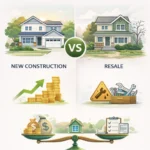
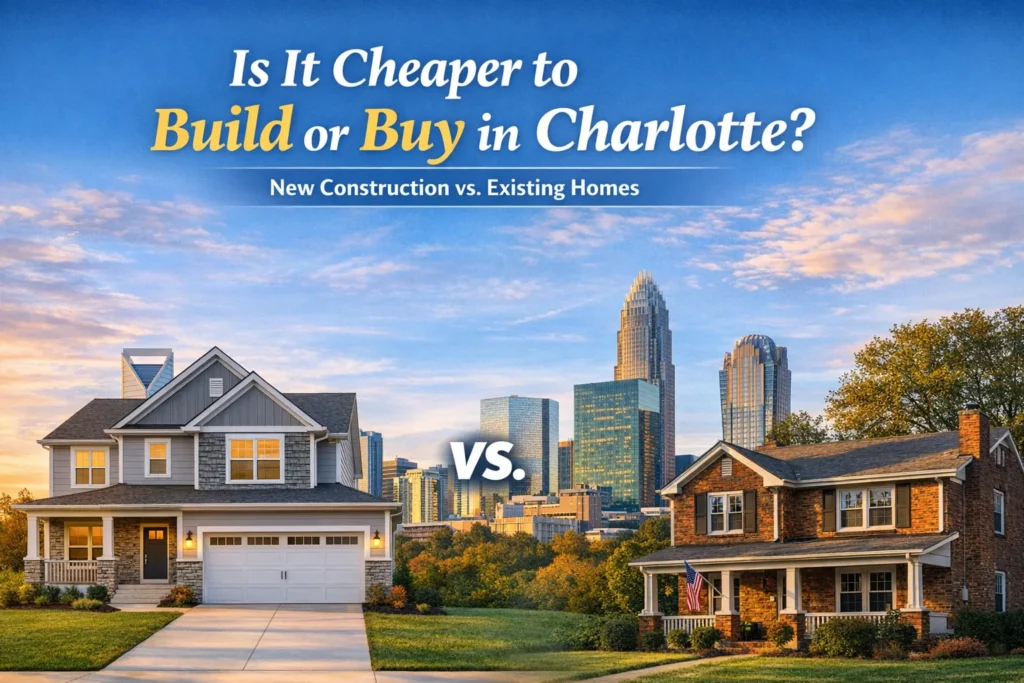

If you are comparing new construction vs. an existing home in Charlotte, the real answer is not as simple as “one is always cheaper.”
On paper, an existing home can still look like the lower-cost option. But once you factor in builder incentives, lower repair risk, warranty coverage, energy efficiency, and financing help, new construction can be more competitive than many buyers expect. Nationally, the comparison has shifted enough that in the fourth quarter of 2025, the median price of a new single-family home was $405,300, while the median existing-home price was $414,900. That was the third straight quarter in which existing-home prices were higher than new-home prices nationally.
Locally, the Charlotte market is still broad enough that the answer depends heavily on where you want to live, how much work you are willing to take on, and whether a builder is offering meaningful incentives. Canopy data for the Charlotte MSA showed a January 2026 median sales price of $406,500, up from $398,875 a year earlier.
For most buyers, the better question is not just “Which one is cheaper today?” It is “Which option gives me better value after price, repairs, incentives, and timing are all factored in?”
Quick answer: is it cheaper to build or buy in Charlotte?
In many cases, an existing home may still be cheaper upfront, especially in an established neighborhood or when the house does not need major work right away. But new construction can sometimes be the better financial move, especially when a builder is offering closing-cost help, rate buydowns, or price cuts. Builder incentive data backs that up: in March 2026, 37% of builders reported cutting prices, the average price reduction was 6%, and 64% reported using sales incentives.
So if you are comparing new construction and resale in the Charlotte area, the answer is usually this:
- Existing homes may win on upfront price
- New construction may win on total value
That is why side-by-side comparison matters more than assumptions.
Need Help Comparing New Construction vs. Existing Homes?
The right choice depends on more than list price. We can help you compare builder incentives, resale options, lot choices, repair risk, and overall value in the Charlotte area.
When new construction may be the better value
New construction tends to look stronger when buyers care about predictability, lower maintenance, and financing incentives.
A new home may come with:
- fewer early repair costs
- warranty coverage
- more efficient systems and materials
- more modern layouts
- builder-paid closing costs or rate buydowns
- less immediate need for cosmetic updates
That matters because a resale home that looks cheaper on day one may need a roof, HVAC replacement, flooring, paint, appliances, or repair work much sooner than a new home. At the same time, the median sales price of new homes has softened nationally. The U.S. Census Bureau reported the median sales price of new houses sold in January 2026 was $400,500, down from $429,600 in January 2025.
For some buyers, that combination of softer pricing plus builder incentives makes new construction the better value even if it does not look cheaper at first glance.
When an existing home may be the better value
Existing homes still make more sense for plenty of buyers.
A resale home may be the better choice when:
- you want an established neighborhood
- lot size matters more
- you need faster move-in
- you are comfortable taking on some updates
- the home is priced well and in solid condition
- location matters more than “everything brand new”
In many parts of Charlotte and the surrounding area, an existing home can still offer better positioning for the money, especially if you are comparing against a new community farther from the core. The tradeoff is that the sticker price may not tell the whole story once deferred maintenance and repair risk are added in.
Why the answer is not just about price
This is where buyers often make the wrong comparison.
A resale home may cost less upfront, but then need:
- inspection repairs
- appliance replacement
- cosmetic updates
- utility-cost catch-up from older systems
- maintenance sooner than expected
A new construction home may have a higher list price, but that number may not reflect:
- builder closing-cost help
- rate buydowns
- upgrade credits
- lower repair risk
- energy savings
- warranty coverage
That is why the smartest comparison is not new vs. old in general. It is usually:
- this builder home vs. that resale home
- this quick move-in home vs. that updated existing home
- this lot and incentive package vs. that neighborhood and repair list
Best time to buy in a new community
Timing inside a new community can make a real difference.
Buying early in a community
Buying at the start of a community often gives you:
- better lot selection
- more floor plan choices
- a wider range of structural options
- a chance to buy before later phases increase in price
This can be a strong move if your priority is getting the best homesite or getting into a neighborhood before prices move up. The tradeoff is that you may live through more construction around you and wait longer for the community to fully take shape.
Buying during final opportunities
Buying near the end of a community can be attractive for a different reason: leverage.
Final-opportunity homes are often where buyers may see:
- stronger builder incentives
- more flexibility on standing inventory
- quicker move-in timelines
- a more established community feel
- less uncertainty about what the finished neighborhood will be like
That lines up with current builder behavior. With price cuts and incentives still widely used, final-phase homes and quick move-ins are often where builders have the most reason to make a deal.
So if your priority is best lot choice, buying early may be better. If your priority is best deal or fastest timing, final opportunities can be worth watching closely.
How to decide which option fits you best
Most buyers do better when they stop asking a broad market question and start asking a personal one.
A better checklist is:
- Do I want lower maintenance in the first few years?
- How much cash do I want to keep for repairs or updates?
- Am I more sensitive to monthly payment or upfront price?
- Do I care more about lot choice or builder incentives?
- Is location more important than having everything new?
- Am I okay with taking on work after move-in?
- Would I benefit from a warranty and lower near-term repair risk?
That is usually where the answer becomes clearer.
What this looks like in the Charlotte area
In the Charlotte region, this comparison can shift quickly depending on the area.
For example, buyers comparing new construction in Waxhaw, Indian Land communities, Fort Mill new homes, Huntersville new construction, Concord communities, or Mooresville new homes may find that resale gives them more lot or location for the money. Others may find that a builder’s incentives on a quick move-in home make new construction surprisingly competitive.
That is why local comparison matters more than a national headline. The stats help frame the market, but the right answer comes from comparing actual options in the submarkets you are considering.
Frequently Asked Questions
Is it usually cheaper to buy an existing home in Charlotte?
Often, yes on upfront price. But not always once repairs, updates, and maintenance are factored in. New construction can be more competitive than buyers expect when incentives are strong.
Can new construction be a better value than resale?
Yes. Builder incentives, lower repair needs, warranty coverage, and energy efficiency can make new construction the better overall value in some situations.
When is the best time to buy in a new community?
Buying early can be best for lot selection and floor plan choice. Buying during final opportunities can be best for incentives, quicker timing, and builder flexibility. Current builder incentive data supports the idea that many builders are still making deals to move homes.
Are quick move-in homes a better deal?
Sometimes. Builders are often more motivated on completed or near-complete homes than on homes that have not started yet, especially when they want to close inventory sooner. That is an inference from current incentive and price-cut data, not a rule for every builder.
How do I decide between new construction and an existing home?
Compare total cost, not just list price. Look at incentives, likely repairs, location, lot size, timeline, and how much maintenance risk you are comfortable taking on. National and local pricing data can help frame the choice, but the better answer usually comes from comparing actual homes you could buy now.
Final thoughts
If you are asking whether it is cheaper to build or buy in Charlotte, the most honest answer is this:
Existing homes may still be cheaper upfront. New construction may be better value overall.
The right answer depends on what you are comparing, where you want to live, and whether builder incentives change the math enough to outweigh the benefits of resale.
That is why it helps to compare real options side by side instead of relying on assumptions.
Need Help Deciding Between New Construction and Existing Homes?
If you are weighing builder communities against resale options in the Charlotte area, we can help you compare pricing, incentives, lot choices, maintenance expectations, and overall value so you can make the right call for your situation.
Sources
- Canopy Realtor® Association – Charlotte housing market opens 2026 with steady demand
- Canopy Realtor® Association / ShowingTime Plus – Charlotte MSA market report
- U.S. Census Bureau – New Residential Sales
- NAHB Eye on Housing – Comparing New and Resale Prices: 4Q25
- NAHB / Wells Fargo Housing Market Index
- NAHB – Builder sentiment inches higher but affordability concerns persist
- NAHB – Cost of construction survey 2024
Stay Updated and Get Expert Help With Your New Home Search
Sign up to receive updates on Charlotte-area communities, builders, and market trends, and let us know if you’d like to be contacted by a real estate professional for personalized guidance.