
Building a new construction home can be exciting, but the advertised starting price rarely tells the whole story. Many buyers begin with the builder’s base price in mind and later realize the final cost is much higher once lot premiums, upgrades, closing costs, inspections, and post-closing expenses are added in.
That does not automatically mean a builder is being misleading. In many cases, the base price is simply a starting point for a specific floorplan with a standard set of included features. Once buyers choose a homesite, add structural options, personalize finishes, and factor in financing and move-in costs, the real budget becomes much clearer.
For buyers in the Charlotte area and throughout North Carolina and South Carolina, understanding these hidden costs early can make the building process much less stressful. It can also help buyers compare communities more accurately and avoid getting too attached to a home before understanding the full financial picture.
Why the Base Price Rarely Tells the Whole Story
A builder’s base price is usually tied to a particular floorplan with a basic included-features package, and sometimes it assumes one of the least expensive available homesites. That number can be useful as a starting point, but it is not the same as the all-in cost to build and close on the home.
In real life, many buyers choose a different lot, add structural upgrades, select design-center finishes, and still need to cover normal closing costs, prepaid taxes, insurance, and other expenses that are not part of the advertised price. The result is that two buyers looking at the same floorplan may end up with very different final numbers depending on their lot, options, financing, and priorities.
That is why one of the best questions a buyer can ask is not just, “What is the base price?” but, “What will my likely total cost be once everything is included?”
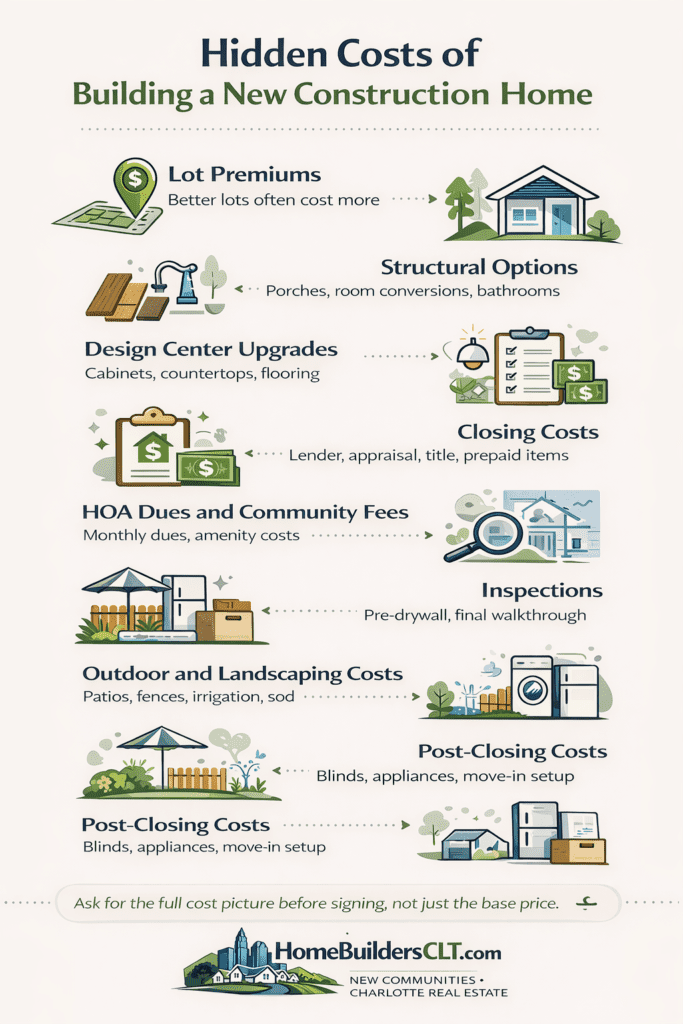
Lot Premiums Can Change the Price Quickly
One of the first hidden costs many buyers run into is the lot premium. A builder may advertise a home from a certain price point, but the lot that a buyer actually wants may cost significantly more than the lowest-priced homesite in the neighborhood.
Lot premiums often apply when a homesite offers something buyers value more, such as a cul-de-sac setting, more privacy, a wooded buffer, a larger yard, a better view, green space behind the home, or a location farther from major roads or community traffic. In some communities, the difference between lots can have a meaningful impact on the overall price even before the buyer starts selecting upgrades.
This is one reason it helps to ask about homesite pricing early in the process. Buyers often fall in love with the location of the lot before realizing how much it adds to the base price.
Structural Options Often Add More Than Buyers Expect
Many buyers assume the biggest costs will come from cosmetic upgrades, but structural options often move the price faster. These are the kinds of changes that affect how the home is built rather than how it is decorated, and because they usually must be chosen early, buyers often agree to them before they have fully processed how much they are adding to the budget.
Structural changes can include things like extending a patio, adding a covered porch or screened porch, enlarging a shower, changing room layouts, adding extra windows, expanding the garage, reworking the kitchen configuration, or adding an additional bedroom, bathroom, or bonus room. These upgrades can absolutely be worth it because they often improve how the home lives over the long term, but they tend to cost more than buyers initially assume.
It is also important to remember that structural changes are much harder or more expensive to do after the home is built. That is why buyers often feel pressure to make those decisions during the contract period, even if it stretches the budget.
Design Center Upgrades Add Up Fast
The design center is one of the most common places for buyers to go over budget. Model homes are designed to make the home feel as attractive as possible, and what buyers see during tours is often far above the standard included package.
Buyers may be drawn to upgraded cabinets, better countertops, enhanced flooring, decorative tile, premium lighting, stair upgrades, nicer trim details, upgraded plumbing fixtures, and better appliances. One or two upgraded choices may not seem dramatic on their own, but when those decisions are repeated throughout the kitchen, baths, living areas, and stairs, the total can rise quickly.
A smart way to manage this part of the process is to go into design appointments with a clear sense of priorities. Some buyers care most about the kitchen. Others want better flooring throughout or a stronger primary bath setup. The buyers who usually feel best about their decisions are the ones who choose where to spend intentionally rather than trying to upgrade every surface in the house.
Some Things Buyers Expect to Be Included Often Are Not
A major source of frustration in new construction comes from assuming certain items are standard when they are actually optional, limited, or not included at all. This varies widely by builder and community, which is why buyers should never assume that what they saw in a model home automatically comes with the base price.
Depending on the builder, buyers may find that items such as the refrigerator, washer and dryer, window blinds, ceiling fans, garage door openers, gutters, irrigation, fencing, mailbox packages, built-ins, or expanded outdoor living features are not included in the standard package. In one community, the included features may feel generous. In another, the lower base price may reflect a more stripped-down package that requires additional spending to get the home where the buyer wants it.
This is one reason it is so important to review the full included-features sheet and not just rely on the brochure, website, or model-home presentation.
Closing Costs Still Matter on New Construction
Many buyers spend so much time thinking about floorplans, lots, and upgrades that they do not fully account for closing costs. Even though the home is newly built, the financing side of the transaction still comes with normal mortgage-related charges.
These costs can include lender fees, appraisal costs, title-related charges, prepaid taxes, prepaid homeowners insurance, and escrow funding. Depending on the loan and the transaction, they can amount to thousands of dollars on top of the down payment and any upgrade deposits or option costs.
Builder incentives can help in some cases, especially if the builder is offering money toward closing costs. Still, buyers need to understand whether those incentives are tied to using a preferred lender, whether they cover all closing-related charges, and whether choosing that lender is the best overall deal.
Financing Timing Can Create Extra Cost Pressure
New construction homes often have a longer timeline between contract and closing than resale homes. That longer timeline can create uncertainty on the financing side, especially when interest rates are moving.
If the buyer does not lock a rate, the monthly payment may change before closing. Even when a rate is locked, there may be costs associated with lock periods or extending a lock if the home takes longer than expected to finish. A delayed completion date does not just affect the moving schedule. It can also affect mortgage costs, monthly payment expectations, and closing strategy.
That is why buyers should stay in close contact with their lender throughout the build and make sure they understand what happens if the timeline shifts.
Taxes, Insurance, and Escrow Are Easy to Underestimate
Another common hidden cost is the gap between what buyers think the monthly payment will be and what it actually becomes once taxes, insurance, and escrow are fully accounted for.
New construction tax estimates can be tricky because the early numbers may be based on the lot alone, partial assessments, or incomplete assumptions. Once the completed home is fully assessed, the tax amount may rise. Homeowners insurance also needs to be factored in realistically rather than treated as a minor side item.
If the buyer’s mortgage includes an escrow account, funds may need to be collected up front at closing for future tax and insurance payments. That can increase the amount of cash needed at closing and also affect the full monthly housing payment.
For buyers trying to stay within a budget, this is one of the most important areas to review carefully.
HOA Dues and Community Fees Should Be Treated as Real Ownership Costs
In many new home communities, HOA dues are part of the ownership picture. Sometimes there may also be setup fees, transfer fees, or capital contributions depending on the neighborhood and how the community is structured.
This does not mean HOA communities are a bad deal. In many cases, dues support amenities, landscaping, recreational spaces, lifestyle programming, or neighborhood maintenance that buyers genuinely value. The key is simply to treat those dues as a real monthly ownership cost rather than something minor that can be ignored.
A community with great amenities may still be the right choice, but buyers should compare it based on the full financial picture rather than just the base home price.
Landscaping and Outdoor Living Can Become a Second Project After Closing
One of the biggest hidden costs in new construction comes after closing, especially when buyers start looking at the yard and outdoor living areas more closely.
Many buyers assume they will be satisfied with the standard patio, basic landscaping, or initial backyard setup, but after move-in they often decide they want more usable outdoor space. That may lead to spending on a larger patio, deck, screened porch, fencing, extra sod, planting beds, drainage work, retaining walls, landscape lighting, or irrigation adjustments.
These costs are easy to postpone mentally during the contract phase, but they are still part of the real cost of making the home feel finished. Buyers who plan for those expenses early usually feel less financial pressure once they move in.
Inspections Are Still Worth Considering on a New Home
Some buyers assume that because a home is brand new, an inspection is unnecessary. In reality, many buyers choose to invest in one or more independent inspections during the building process.
A pre-drywall inspection can help identify issues before the walls are closed. A final inspection before closing can flag workmanship concerns or incomplete items. A warranty inspection before the end of the first year can also be helpful for documenting items the buyer wants addressed while builder coverage is still in place.
Even though inspections add cost, they can be one of the best values in the process if they help catch issues early and give the buyer more confidence going into closing.
Post-Closing Spending Is Often Higher Than Expected
Even when buyers stay close to budget during contract and construction, the spending often continues after move-in. A newly built home may still need blinds, appliances, furniture, storage systems, paint touch-ups, security equipment, internet setup, lawn tools, patio furniture, and other finishing touches.
Some homes also feel larger or differently configured than the buyer’s previous home, which can lead to additional furnishing costs. Garages, closets, bonus rooms, patios, and offices often become areas where buyers spend more than expected during the first few months.
These expenses may not be part of the builder contract, but they are very much part of the true cost of building and settling into a new home.
What to Look for in the Builder Contract
The builder contract matters just as much as the pricing sheet. Buyers should understand what is actually included, what is shown only for marketing purposes, how upgrade allowances work, and how additional charges will be handled if selections go beyond standard limits.
It is also important to understand deposit terms, change-order policies, timelines, financing deadlines, completion-date language, and any clauses related to substitutions or material changes. Buyers should know whether incentives depend on using certain vendors and whether there are costs or restrictions tied to those incentives.
A contract can contain important clues about how flexible the process will be and how protected the buyer is if costs or timelines shift.
A Practical Way to Think About the Total Cost
Rather than focusing only on the builder’s advertised number, buyers should think about the total cost in a few clear buckets.
The first bucket is the contract price itself, which includes the home, the lot, and any structural options. The second is design and finish upgrades, which can substantially change the final number depending on selections. The third is the financing and closing side, including lender fees, title charges, prepaid items, and escrow funding.
The fourth bucket is inspections and professional due diligence. The fifth is the real monthly ownership cost, including principal, interest, taxes, insurance, HOA dues, and utilities. The sixth is the post-closing setup cost, including blinds, appliances, landscaping, storage, furniture, and other items needed to make the home feel complete.
When buyers build their budget around all six of those areas, they usually end up with a more realistic number and a smoother experience.
How Buyers Can Avoid Budget Surprises
One of the best ways to avoid surprises is to ask for the included-features sheet early and review it carefully. Buyers should also ask about lot premiums before getting emotionally attached to a particular homesite. Going into design appointments with a clear spending plan can also help keep priorities in focus.
It is wise to review lender estimates carefully, budget realistically for taxes, insurance, and HOA costs, and leave some breathing room for the first few months after closing. Even a well-planned build can come with a few extra expenses, so flexibility matters.
Many buyers also benefit from having guidance from someone who can help them compare not just builders and communities, but the full cost picture behind each option.
For more on that side of the process, read <a href=”/guides/buyer-agency/should-you-use-an-agent-for-new-construction/”>Should You Use an Agent for New Construction?</a>.
Final Thoughts
A new construction home can still be an excellent choice. Buyers often appreciate newer layouts, better energy efficiency, modern finishes, and the ability to personalize the home to fit their lifestyle. But the best experience usually comes when buyers go in with a clear understanding of the true cost rather than focusing only on the base price.
The hidden costs of building a new construction home are not always hidden in a deceptive sense. More often, they are spread across lot pricing, upgrades, financing, closing, and move-in spending in ways that are easy to underestimate at the beginning.
The buyers who tend to feel best about the process are the ones who ask detailed questions early, compare builders based on transparency and overall value, and plan for the total cost from the start instead of chasing the lowest advertised number.
At HomeBuildersCLT.com, we help buyers look beyond the model home and builder marketing to understand the full picture. That includes comparing builders, communities, included features, lot premiums, upgrade value, and the real costs that can affect your budget before and after closing. If you are trying to decide where to build or which builder offers the best overall fit, we can help you narrow your options and ask the right questions early.
Need Help Comparing Builders, Communities, and True Costs?
Building a new home involves more than just the base price. We can help you compare Charlotte-area builders, understand upgrade value, and look at the real costs that may affect your budget before you sign.
Helpful Next Steps
Frequently Asked Questions
What are the most common hidden costs when building a new construction home?
The most common hidden costs include lot premiums, structural options, design center upgrades, closing costs, prepaid taxes and insurance, HOA dues, inspections, landscaping, fencing, blinds, appliances, and other post-closing setup expenses.
Are closing costs different on a new construction home?
They can be. The same general categories still apply, such as lender fees, appraisal, title charges, prepaid taxes, prepaid insurance, and escrow funding. The difference is that buyers are sometimes more focused on builder selections and forget to budget for the financing and closing side.
Do I need a home inspection on a newly built home?
Many buyers choose to get one. A new home can still have defects, incomplete work, or workmanship issues. Independent inspections can help catch problems before closing or before warranty deadlines.
Are builder incentives always a good deal?
Not always. Some builder incentives can be very helpful, especially toward closing costs, but they may be tied to preferred lenders or attorneys. Buyers should compare the full transaction, not just the advertised incentive.
What should I ask for before signing a builder contract?
Ask for the included-features sheet, lot premium details, structural option pricing, design allowance information, estimated closing costs, HOA dues, estimated taxes, incentive terms, and a clear explanation of what is not included.
How much should I budget beyond the base price?
There is no universal number because it depends on the builder, lot, loan, and upgrade choices. A better approach is to build a line-item budget for contract price, upgrades, closing costs, inspections, monthly ownership costs, and post-closing setup expenses.
Sources
- Consumer Financial Protection Bureau: What costs come with taking out a mortgage?
- Consumer Financial Protection Bureau: What fees or charges are paid when closing on a mortgage?
- Consumer Financial Protection Bureau: Loan Estimate Explainer
- Consumer Financial Protection Bureau: Closing Disclosure Explainer
- Consumer Financial Protection Bureau: What is an escrow account?
- Consumer Financial Protection Bureau: What is owner’s title insurance?
- Consumer Financial Protection Bureau: Shop for title insurance and other closing services
- Consumer Financial Protection Bureau: How much does it cost to receive a Loan Estimate?
- North Carolina Real Estate Commission: Questions and Answers on Home Inspections
- HUD Home Buying Guide
Stay Updated and Get Expert Help With Your New Home Search
Sign up to receive updates on Charlotte-area communities, builders, and market trends, and let us know if you’d like to be contacted by a real estate professional for personalized guidance.