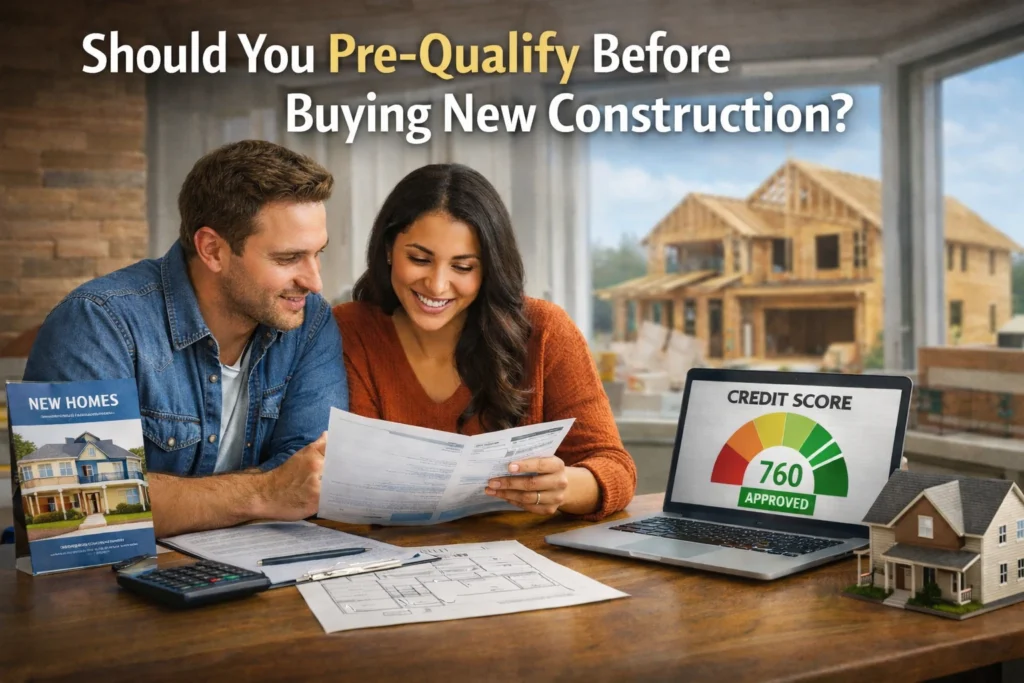

If you are thinking about buying a new construction home, one of the smartest first steps is getting pre-qualified before you visit too many communities or fall in love with a floor plan that stretches beyond your comfort zone. Builders are used to talking with early-stage buyers, but that does not mean financing should wait until later. In many cases, having at least a basic understanding of your budget before you shop can make the entire process smoother.
For buyers in the Charlotte area, this matters even more because builder communities can have quick move-in opportunities, lot releases, financing deadlines, and special incentive periods that move fast. When you already have a sense of where you stand financially, it becomes much easier to compare communities, understand monthly payment ranges, and decide whether a home is a real fit instead of just an exciting one.
Yes, It Usually Makes Sense to Pre-Qualify First
For most buyers, the answer is yes. Pre-qualifying before buying new construction gives you a practical starting point. It can help you estimate how much home you may be able to afford, flag any credit or income issues early, and put you in a better position when you start talking with a builder’s sales team.
New construction is different from resale in one important way: the person selling the home is usually doing this every day. Builders have systems, timelines, preferred lenders, contract structures, and upgrade options already in place. Buyers who show up without any financing preparation can still tour communities, but they are usually at a disadvantage compared with someone who already knows their likely price range and financing options.
Pre-qualifying is especially helpful if you are still deciding between different price points, home types, or locations. It gives you a clearer target. That can save time and help you focus on communities that actually line up with your goals.
What Pre-Qualification Actually Means
Pre-qualification is usually an early review of your finances based on information you provide to a lender. In plain language, it is often the lighter first step in the mortgage process. It may be based on your estimated income, debts, assets, and credit profile. Sometimes it is done quickly online or with a short conversation with a loan officer. In some cases, the lender may review enough information to give you a solid early read. In other cases, it may be more of a basic screening tool.
That is why buyers should not treat every pre-qualification letter as equally strong. Some are little more than a snapshot. Others are much more detailed. Before you rely on one in a builder community, ask the lender whether your credit was reviewed, whether income was documented, and what still needs to happen before full approval.
Pre-Qualification vs. Pre-Approval
The difference matters. A pre-qualification is usually an earlier, lighter review. A pre-approval is typically more thorough and often involves documentation such as recent pay stubs, W-2s, tax returns, bank statements, and other financial records.
For new construction buyers, pre-qualification is often enough to begin shopping intelligently. But if you are close to signing a contract, competing for a limited inventory home, or trying to move quickly on a spec home, pre-approval is often the stronger position. It gives both you and the builder more confidence that the deal can get to the finish line.
A simple way to think about it is this: pre-qualification helps you plan, while pre-approval helps you act.
What You Usually Need for a Pre-Qualification
Pre-qualification often requires less paperwork than pre-approval. In many cases, a lender will ask for your approximate annual income, employment information, estimated monthly debts, down payment amount, and permission to review some level of credit information. Some lenders may also ask basic questions about bank balances, other properties you own, or whether you have had any recent bankruptcies, foreclosures, or major credit events.
If the process is very light, you may be providing information verbally or through an online form. That can be convenient, but it also means the result is only as accurate as the information entered. If income is overstated, debts are missed, or credit issues are not yet visible, the estimate can change later.
What You Usually Need for a Pre-Approval
Pre-approval is typically more document-driven. You may be asked for pay stubs, W-2s, tax returns, bank statements, ID, employment history, and explanations for any unusual items on your credit or bank records. Self-employed buyers, commission-based earners, and buyers with rental income usually go through a more detailed review because income is not as simple to verify.
This deeper review is one reason pre-approval tends to carry more weight. The lender is not just taking your word for the numbers. They are starting to verify them.
How Credit Checks Work During Pre-Qualification
This is one of the biggest questions buyers have, especially if they are worried about their score dropping before they are ready to buy. Credit checks during mortgage shopping are not always the same. Some pre-qualification processes use a soft inquiry, while more formal pre-approvals usually involve a hard inquiry tied to an actual credit application.
The good news is that mortgage shopping is treated differently than randomly applying for several different kinds of credit. When buyers shop mortgage lenders within a typical rate-shopping window, the credit bureaus generally treat those mortgage inquiries differently for scoring purposes than unrelated credit applications. That means buyers can compare options without the same kind of repeated-score impact many people fear.
Still, it is smart to ask each lender up front whether they are doing a soft pull or a hard pull. Do not assume. Ask directly how they handle pre-qualification, whether your score may be affected, and what kind of credit review will happen next if you move forward.
Why Pre-Qualifying Helps When Buying New Construction
One of the biggest benefits is clarity. New construction pricing can move quickly once you factor in lot premiums, structural options, design selections, rate buydowns, HOA dues, taxes, and insurance. A buyer who only looks at the base price can easily misjudge affordability. Pre-qualifying helps you look at the bigger picture earlier.
It also helps with confidence. Instead of asking, “Can I buy here?” you start asking better questions, like “Does this community fit my target monthly payment?” and “Would I rather stay at this price point and use extra cash for upgrades or rate relief?” Those are much stronger buying decisions.
Another advantage is timing. Some builders want buyers to connect with a lender quickly after contract signing, and some require proof of funds or financing discussions before moving too far into the process. Being prepared helps you avoid unnecessary delays.
Pre-qualifying can also surface problems early enough to fix them. Maybe your debt-to-income ratio is tighter than expected. Maybe a credit card balance needs to be paid down. Maybe a disputed account is showing on your report. Finding that out before you are under pressure is much better than finding out after you have already committed emotionally to a home.
Should You Use the Builder’s Lender?
Sometimes yes. Sometimes no. The better answer is that you should seriously evaluate the builder’s lender, but not assume it is automatically your best choice.
Many builders work with affiliated or preferred lenders. In some cases, that can create real advantages for buyers. The builder’s lender may be more familiar with the community, the builder’s contract timelines, the construction schedule, certificate-of-occupancy timing, and incentive programs tied to that specific neighborhood. That familiarity can reduce friction and help the process move more smoothly.
Builder-affiliated lenders may also offer incentives such as closing cost assistance, lender credits, or interest rate buydown options when available. That can make a meaningful difference in your upfront cash needs or monthly payment, especially when builders are trying to move inventory or promote a specific phase of a community.
That said, buyers should still compare. The builder’s lender may be the best deal, especially after incentives are factored in. But sometimes an outside lender still wins on rate, fees, structure, or long-term cost. The only way to know is to compare the full picture.
What About Builders That Have Their Own Lenders?
Many national and regional builders either have affiliated mortgage companies or regularly work with preferred lending partners. That is common in new construction.
For buyers, the practical takeaway is simple: you are usually allowed to shop. Even if a builder strongly encourages its preferred lender, you should still understand your options. In many cases, the builder incentive is tied to using the preferred lender, so the comparison should be based on the total deal, not just the advertised interest rate.
For example, an outside lender might quote a slightly lower rate, while the builder’s lender might offer thousands toward closing costs or a temporary buydown that lowers your payment early on. The better choice depends on the numbers, how long you expect to keep the loan, and how valuable the incentive really is once all fees are considered.
Questions to Ask Before You Choose a Lender
Before you decide, ask whether the lender is using a soft or hard credit pull, what documents are still needed, how long the pre-qualification or pre-approval will remain usable, whether the rate can be locked later in the build process, and what incentives are tied to using that lender. You should also ask how they handle delayed closings, construction timelines, and extensions if the home is not ready when originally expected.
These questions matter because new construction financing is not always identical to resale timing. A lender who works with builder transactions regularly may be better equipped to navigate those moving parts.
When Pre-Qualification Is Not Enough
There are situations where pre-qualification is a good start but not strong enough on its own. That includes buyers with complex income, recent job changes, credit events, large debts, self-employed buyers, or anyone shopping at the upper end of what they think they can afford.
In those cases, moving to pre-approval earlier can save a lot of frustration. A stronger review up front can help confirm whether your plan is realistic before you commit to earnest money, upgrades, or design selections.
Need Help Comparing New Construction Communities?
We help buyers sort through builder options, community locations, timing, and the real costs that come with buying a newly built home in the Charlotte area.
The Bottom Line
Pre-qualifying before buying new construction is usually a smart move. It helps you understand your range, shop with more confidence, and avoid surprises. It also puts you in a stronger position when talking with builders, especially if you are considering quick move-in homes or time-sensitive incentives.
Just remember that pre-qualification is a starting point, not the finish line. Ask how thorough it is, ask how credit is being checked, and compare the builder’s lender with outside options before making a final decision. For many buyers, the best approach is to get pre-qualified early, get more serious with pre-approval as the search narrows, and compare total loan costs before signing off on the financing path.
If you are considering a new construction home in the Charlotte area, getting your financing questions answered early can make the shopping process much easier and more strategic.
Buying new construction comes with different financing timelines, lender options, and builder incentives than a typical resale purchase. At HomeBuildersCLT.com, we help buyers compare communities, understand builder processes, and think through the real costs before they sign. If you want help narrowing down Charlotte-area new home communities or understanding how financing fits into your search, reach out here.
Related Reading
Frequently Asked Questions
Should you pre-qualify before visiting new construction communities?
Usually, yes. Pre-qualifying gives you a realistic starting budget and can help you focus on communities that actually fit your financial comfort zone.
Does pre-qualification hurt your credit score?
Not always. Some lenders use a soft pull for pre-qualification, while others use a hard pull. Ask the lender directly before they run your credit.
What is the difference between pre-qualification and pre-approval?
Pre-qualification is usually an early estimate based on basic financial information. Pre-approval is typically a more detailed review with documentation and a stronger indication of loan readiness.
Should you use the builder’s preferred lender?
It is worth comparing. Builder lenders may offer incentives or smoother coordination with the construction timeline, but outside lenders can sometimes offer better overall loan terms.
Can you compare multiple lenders without damaging your credit too much?
Yes. Mortgage rate shopping is generally treated differently than applying for several unrelated credit accounts, and multiple mortgage inquiries within a set window are typically treated as a single inquiry for scoring purposes.
Sources
- Consumer Financial Protection Bureau — Prequalification vs. Preapproval
- Consumer Financial Protection Bureau — Get a Preapproval Letter
- Fannie Mae — Documents You Need to Apply for a Mortgage
- Consumer Financial Protection Bureau — What Happens When a Mortgage Lender Checks My Credit?
- Consumer Financial Protection Bureau — Request and Review Multiple Loan Estimates
- Consumer Financial Protection Bureau — Shopping for the Best Mortgage Loan
- Consumer Financial Protection Bureau — Affiliated Business Arrangements
- Experian — Hard Inquiry vs. Soft Inquiry
Stay Updated and Get Expert Help With Your New Home Search
Sign up to receive updates on Charlotte-area communities, builders, and market trends, and let us know if you’d like to be contacted by a real estate professional for personalized guidance.