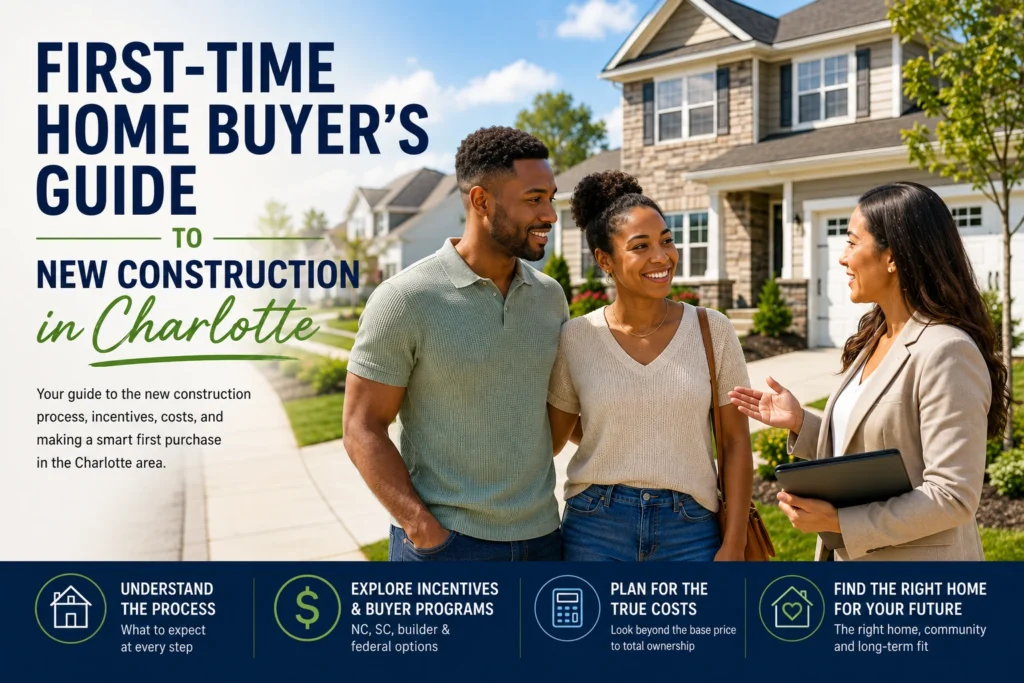

Buying your first home is a big step. Buying a newly built home as your first purchase can feel even bigger. There is a lot to like about new construction in the Charlotte area, including modern floor plans, energy-efficient features, brand-new systems, and the chance to personalize some parts of the home. But first-time buyers also need to understand that the process is different from buying a resale home.
New construction usually comes with different timelines, different contracts, different upgrade decisions, and different financial questions than a typical resale transaction. Builders often have their own sales teams, their own preferred lenders, and their own processes. That does not make new construction a bad option. In many cases, it can be a great fit for first-time buyers. It just means you need to go in with a clearer understanding of how the process works and what to watch.
For many Charlotte-area buyers, new construction can be appealing because it offers a chance to buy into a growing community with newer homes, lower near-term maintenance, and layouts designed for how people live today. At the same time, it is important to look beyond the model home and think carefully about budget, monthly costs, location, builder reputation, and what is actually included in the base price.
Why First-Time Buyers Consider New Construction
One reason first-time buyers are drawn to new construction is simplicity. A brand-new home can mean fewer immediate repair concerns, less worry about the age of the roof or HVAC system, and a more predictable ownership experience in the early years. New homes also tend to include more modern layouts, open kitchens, newer finishes, and energy-efficiency features that may be harder to find in older housing stock.
Another reason is community planning. Many new construction neighborhoods in the Charlotte area are designed around current buyer preferences. That can include sidewalks, community amenities, HOA-managed common areas, nearby schools, and access to major commuter routes. For a first-time buyer who wants a move-in-ready home in a neighborhood with a cohesive feel, that can be very appealing.
New construction can also feel emotionally easier than competing for a resale home in a tight market. Instead of rushing through multiple-offer situations, some buyers prefer the more structured process of choosing a lot, a floor plan, and available options through a builder.
How Buying New Construction Is Different From Buying Resale
The biggest difference is that you are usually buying from a builder rather than from an individual seller. Builders use their own contracts, their own timelines, and their own sales staff. The on-site agent at a builder’s model home works for the builder, not for you.
That distinction matters. A builder representative can be helpful and professional, but their role is to represent the builder’s interests. First-time buyers sometimes assume the on-site agent is a neutral guide through the transaction. In reality, buyers should understand that the builder’s team is there to sell homes in that community and protect the builder’s side of the process.
Another difference is timing. A resale home may close in a matter of weeks, but new construction can take months depending on the stage of the home when you go under contract. Some buyers contract on inventory homes that are nearly complete. Others choose homes earlier in the process and wait through construction. That longer timeline can affect rate strategy, moving plans, lease timing, and expectations.
What First-Time Buyers Should Do Before Visiting a Builder
One of the most important things first-time buyers should know is that the first visit matters. In many communities, your ability to have your own agent involved can depend on how and when you register with the builder. That is one reason buyers should not casually walk into model homes without understanding the process first.
Before visiting a builder, first-time buyers should get as clear as possible on what monthly payment feels comfortable, how much cash they want available for down payment and closing costs, whether they want a townhome or a detached home, which parts of the Charlotte area fit their commute and lifestyle, and whether they want to use a buyer’s agent from the start.
Even if you are still early in the search, having a basic framework helps. It keeps you from getting swept up by the model home experience and making decisions before you understand the full financial picture.
Understanding Base Price vs. Real Price
This is one of the most important parts of buying new construction. The advertised base price is not always the final price you will pay.
In some communities, the price you see may reflect the home before lot premiums, structural options, elevation choices, design-center upgrades, appliance packages, or other add-ons. Some builders include more in the base price than others. Some communities have significant premiums tied to lot location, homesite size, or views.
For first-time buyers, that means the most affordable-looking community is not always the most affordable after all choices are added in. It also means a home that feels comfortably within budget at first can start to stretch once upgrades and closing costs are layered in.
That is why buyers should ask early what is included in the base price, what are common upgrades buyers choose, whether lot premiums apply, what design-center selections cost, and what the expected all-in price range really looks like.
First-Time Home Buyer Incentives to Know About
This is one of the biggest areas first-time buyers ask about, and it helps to think about incentives in layers. Some come from state housing agencies. Some come through federal-backed loan programs. Some come from the builder itself. They can all help, but they do not all work the same way, and they are not all available to every buyer or every property.
If you are buying in North Carolina, one of the most relevant starting points is the North Carolina Housing Finance Agency. NCHFA’s NC Home Advantage Mortgage offers down payment assistance up to 3% of the loan amount for eligible buyers using participating lenders, and its NC 1st Home Advantage Down Payment program provides eligible first-time buyers and military veterans with $15,000 in down payment assistance when paired with an NC Home Advantage Mortgage. Those programs can be meaningful, especially for buyers whose biggest obstacle is upfront cash, but they still come with eligibility rules, lender participation requirements, and program limits that need to be reviewed carefully.
If your search includes the South Carolina side of the Charlotte region, SC Housing is worth a look. Its Palmetto Home Advantage program is available for new and existing homes across all 46 counties in South Carolina, does not require you to be a first-time buyer, and offers forgivable down payment assistance options of 0%, 3%, or 4% of the loan amount, subject to the program’s terms. That can make a difference for eligible buyers looking in places like Fort Mill, Indian Land, or other communities on the South Carolina side.
At the federal level, there is not one universal first-time buyer grant that automatically applies to everyone. In fact, USA.gov specifically warns that promises of “free government money” for homebuyers are often scams. What does exist are federal-backed loan programs that can make buying easier. FHA loans can allow down payments as low as 3.5% for eligible borrowers. USDA guaranteed loans can offer no-money-down financing in eligible rural areas, which can matter in parts of the broader Charlotte region. VA purchase loans can also be a major benefit for eligible veterans, service members, and some surviving spouses, often with no down payment requirement and no monthly mortgage insurance. These are not all first-time-buyer-only programs, but for many first-time buyers they are some of the most useful financing tools available.
There are also a few narrower federal homeownership programs that are worth knowing about even if they do not apply to everyone. HUD’s Good Neighbor Next Door program is one example. HUD says it offers a 50% discount on certain eligible HUD-owned homes for qualified law enforcement officers, teachers, firefighters, and EMTs who agree to meet the program rules. These are more specialized than mainstream financing options, but for the right buyer they can be worth exploring.
Then there are builder incentives, which are often the most visible offers first-time buyers see in new construction communities. Builders may offer closing-cost help, rate buydowns, design-center credits, appliance packages, or other promotions, often tied to the use of a preferred lender. Those offers can absolutely help, but they are not standardized. They vary from one builder and community to another, and they can change over time. The best builder incentive is not always the one with the biggest headline number. It is the one that improves the total deal when you look at rate, fees, monthly payment, and upfront cash together.
The most helpful mindset for first-time buyers is to treat incentives as one part of the transaction, not the whole reason to buy. A state program, federal-backed loan, or builder promotion can absolutely improve the numbers. But the home still needs to fit your budget, your location goals, and your comfort level after closing. For many buyers, the real win is not the flashiest offer. It is getting into the right home with a payment and cash requirement that still feel manageable once the excitement wears off.
Builder Incentives and Preferred Lenders
Many builders offer incentives, especially when buyers use the builder’s preferred lender or closing attorney. These incentives may come in the form of closing-cost help, design credits, appliance packages, or interest-rate related offers.
That can be valuable, especially for first-time buyers trying to keep upfront costs manageable. But incentives should always be reviewed carefully. A credit can be attractive, but buyers still need to compare the full loan terms, interest rate, lender fees, and monthly payment impact.
A builder incentive is only a good deal if the overall financial picture makes sense. First-time buyers should avoid focusing on the incentive alone without understanding what they are giving up or paying elsewhere in the transaction.
The Costs First-Time Buyers Often Underestimate
A lot of first-time buyers focus on down payment and mortgage payment, but the real cost of new construction usually includes more.
Beyond the contract price, buyers may need to budget for closing costs, HOA dues, property taxes, homeowners insurance, utility setup, blinds or window treatments, appliances if not included, washer and dryer, refrigerator, fencing, landscaping beyond builder basics, patio or outdoor additions, and furnishings and decor.
One reason new construction surprises some first-time buyers is that the home is brand new, but not always fully finished in the way they imagined. A builder may deliver a beautiful home, but buyers may still need to spend significantly after closing to make it feel complete.
Upgrades: Where to Be Careful
Upgrades are one of the easiest ways for first-time buyers to stretch their budget too far. It is easy to fall in love with model-home finishes, but not every upgrade delivers the same long-term value.
A helpful way to think about upgrades is to separate them into three buckets: structural or hard-to-change features, design upgrades that improve livability, and cosmetic upgrades that can be added later.
Structural decisions usually matter most because they are the hardest to change after closing. That might include things like extra bedrooms, bathroom layouts, covered outdoor space, or garage configuration. Flooring, lighting, and paint may matter too, but some items are easier to update later if you need to protect your budget.
First-time buyers do not need to recreate the model home. The better goal is choosing the features that will matter most to daily life while keeping the monthly payment and cash needs realistic.
Why Representation Still Matters With New Construction
Some first-time buyers assume they do not need representation when buying from a builder. But new construction is still a real estate purchase, and there is still a lot to evaluate.
A buyer’s agent can help with community comparison, pricing perspective, contract awareness, resale considerations, and the practical side of deciding whether one community fits better than another. They can also help keep first-time buyers focused on the full transaction rather than the emotional pull of the model home.
That does not mean a buyer’s agent replaces the builder’s team. It means the buyer has someone focused on the buyer’s side of the decision-making process.
Common Mistakes First-Time Buyers Make With New Construction
One common mistake is visiting builders too early without understanding budget or registration rules. Another is focusing only on the base price and not the true all-in cost.
Some buyers also underestimate post-closing costs, assume every builder includes the same features, or over-upgrade in ways that make the payment less comfortable than it should be. Others fall in love with a floor plan without thinking carefully about commute, school options, monthly costs, HOA structure, or long-term resale appeal.
The biggest mistake is usually not asking enough questions early enough.
How to Approach New Construction More Confidently
A smart first-time buyer does not need to know everything on day one. But it helps to approach new construction in the right order.
Start with budget. Then narrow location. Then compare community type, builder, and home style. From there, look carefully at what is included, what is extra, how long the process will take, and what the full monthly ownership picture looks like.
The goal is not just to buy a new home. It is to buy one that still feels like a good decision after the excitement wears off.
Bottom Line
New construction can be a great option for first-time buyers in the Charlotte area, especially for those who want a newer layout, lower early maintenance, and a more predictable move-in experience. But the smartest first-time buyers look beyond the model home and think carefully about budget, incentives, upgrades, location, and what the finished cost of ownership will really be.
A new home can absolutely be the right first home. The key is making sure it fits your life and your finances, not just your first impression.
Related Guides
- Should You Use an Agent for New Construction?
- Monthly Home Ownership Costs
- Costs of Homeownership
- New Construction Mistakes to Avoid
- Charlotte Townhomes and Condos: What Buyers Should Know
- Low-Maintenance Communities in the Charlotte Area
- Browse Charlotte-Area Communities
- Browse Builders
- Contact HomeBuildersCLT.com
How We Can Help
If you are a first-time buyer considering new construction in the Charlotte area, we can help you compare communities, understand builder differences, think through monthly costs, and narrow down which home types and neighborhoods fit your budget and lifestyle best. The goal is not just to get you into a new home, but to help you make a smart first purchase with fewer surprises along the way.
Thinking About Buying New Construction for Your First Home?
We help first-time buyers compare Charlotte-area new construction communities, understand the process, and think through builder incentives, upgrades, and monthly ownership costs before they commit.
Frequently Asked Questions
Is new construction a good option for first-time home buyers?
It can be. New construction often appeals to first-time buyers because the home is brand new, layouts are modern, and early maintenance needs may be lower than with an older resale home.
Do first-time buyers need an agent for new construction?
A buyer’s agent can still be valuable because the builder’s on-site team represents the builder, not the buyer. Having your own representation can help with comparisons, questions, and the overall decision-making process.
Are there first-time home buyer incentives for new construction in Charlotte?
Potentially, yes. Eligible buyers may be able to use North Carolina or South Carolina housing programs, FHA or USDA-backed financing, VA benefits if they qualify, and builder-specific offers such as closing-cost help or rate buydowns. The exact options depend on the property location, the loan type, the buyer’s eligibility, and the builder.
What costs do first-time buyers forget with new construction?
Buyers often focus on the contract price and forget about the rest of the ownership picture. Closing costs, HOA dues, blinds, appliances, refrigerator, washer and dryer, fencing, landscaping, and furnishing costs can all affect the true cost of moving in.
Should first-time buyers spend a lot on upgrades?
Usually, it makes more sense to be selective. Structural or hard-to-change features often deserve more attention than cosmetic upgrades that may be easier to add later.
Sources
- Consumer Financial Protection Bureau: Buying a House Tools and Resources for Homebuyers
- Freddie Mac: Buying a Home
- North Carolina Housing Finance Agency: NC Home Advantage Mortgage
- North Carolina Housing Finance Agency: NC 1st Home Advantage Down Payment
- North Carolina Housing Finance Agency: Income Limits
- SC Housing: Palmetto Home Advantage
- SC Housing: Programs for Homebuyers
- HUD: Let FHA Loans Help You
- HUD: Buying a Home
- USDA Rural Development: Single Family Housing Guaranteed Loan Program
- VA: Purchase Loan
- VA: VA-Backed Veterans Home Loans
- USA.gov: Government-Backed Home Loans and Mortgage Assistance
Stay Updated and Get Expert Help With Your New Home Search
Sign up to receive updates on Charlotte-area communities, builders, and market trends, and let us know if you’d like to be contacted by a real estate professional for personalized guidance.