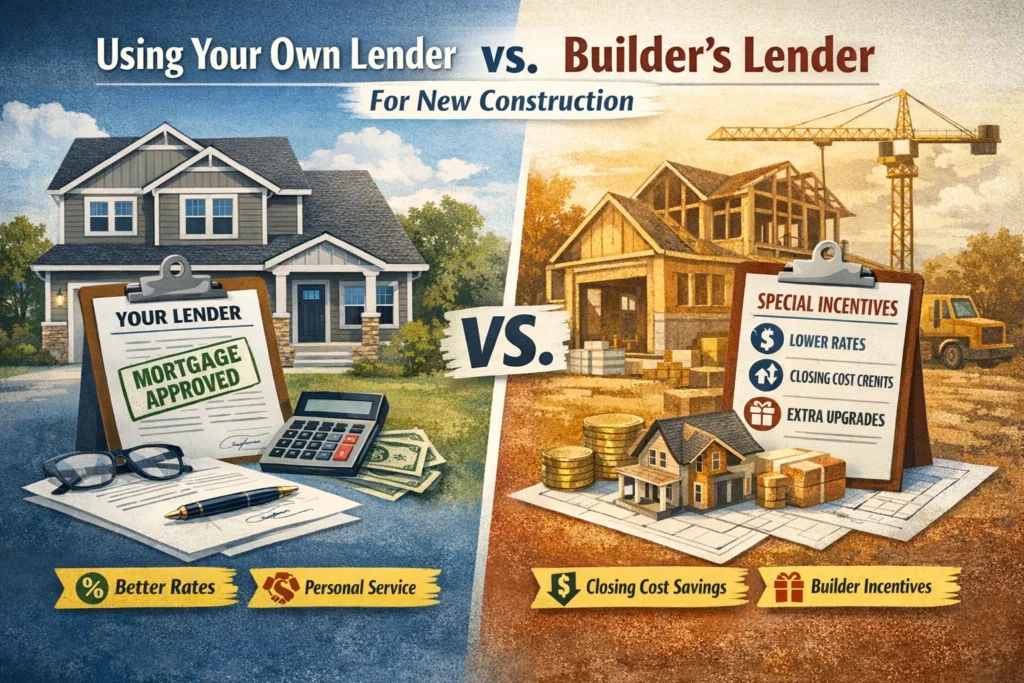

Buying a new construction home comes with a lot of decisions, and one of the biggest is financing. A question many buyers ask early in the process is simple: can you use your own lender when buying new construction?
In most cases, yes. Builders typically allow buyers to use their own lender, but many also strongly encourage buyers to consider the builder’s preferred lender or in-house mortgage company. That can create confusion, especially when the builder is advertising closing cost credits, rate buydowns, or other financing specials.
The good news is that this is not an either-or decision at the very beginning. In many cases, the smartest move is to talk with both the builder’s lender and at least one outside lender so you can compare the real numbers before deciding.
Yes, you can usually use your own lender
Most builders do not require you to use their lender. As the buyer, you can often choose a bank, credit union, mortgage broker, or independent lender that you trust. That gives you the freedom to shop for better terms, compare service, and make sure the financing fits your long-term goals.
That said, some builders make their preferred lender a bigger part of the process by tying incentives to that financing choice. So while you may be allowed to use your own lender, the builder’s lender may come with perks that make it worth considering.
The key is to compare the total value, not just the headline offer.
Why some buyers prefer to use their own lender
Using your own lender can give you more control over the process. If you already have a strong relationship with a local lender or mortgage broker, that can be a real advantage. You may prefer their communication style, trust their guidance more, or feel more confident that they are focused on your side of the financing process.
Another big reason buyers use their own lender is comparison. Rates, fees, lender credits, underwriting flexibility, and lock strategies can vary from one lender to another. The Consumer Financial Protection Bureau encourages borrowers to compare multiple Loan Estimates because comparing offers can help you find the best overall deal, not just the lender you talked to first.
An outside lender may also be a better fit if you have a more complex situation. That could include self-employment income, bonus or commission income, recent job changes, unusual assets, or a need for more hands-on problem solving. Some independent lenders and mortgage brokers are especially strong in these areas.
There is also the service factor. Some buyers simply want a lender who is easier to reach, more proactive, or more available on evenings and weekends. In a transaction with a long construction timeline, that level of communication can matter.
Why some buyers choose the builder’s lender
Builder lenders can be attractive because they often come with incentives. These may include closing cost credits, temporary or permanent rate buydowns, discounted fees, or even upgrade-related promotions tied to financing. Lender credits can reduce your upfront closing costs, although they may be paired with a higher interest rate depending on the structure of the offer. The CFPB notes that lender credits and points are part of a tradeoff between upfront costs and the rate you pay over time.
There can also be practical advantages. A builder’s lender is often familiar with the builder’s contracts, timelines, construction milestones, and preferred closing process. That familiarity can sometimes help things move more smoothly, especially if there are changes to the completion date or last-minute scheduling issues.
In some cases, builder lenders are also motivated to keep the entire transaction together. Because the financing, closing timeline, and home sale are more closely connected, they may be quicker to coordinate with the builder’s team.
That does not automatically mean the builder’s lender is the best deal. It just means their offer may include value that needs to be measured carefully.
The most important comparison: total cost, not just rate
This is where many buyers get tripped up. A builder’s lender may offer a credit that sounds substantial, but the loan could still cost more over time if the rate is higher or the fees are less favorable. On the other hand, your outside lender may quote a slightly lower rate, but the builder incentive could offset that difference and create a better short-term outcome.
That is why buyers should compare actual Loan Estimates side by side. The CFPB specifically recommends comparing Loan Estimates to evaluate both cost and lender fit.
Sometimes the builder’s lender wins. Sometimes your own lender does. Sometimes one lender is better on paper, but the other is more flexible or easier to work with. The right answer depends on the numbers and the situation.
What Should You Compare Between Lenders?
Do not stop at the advertised rate. When you compare a builder’s lender against your own lender, look at the full picture side by side.
Interest Rate
The quoted rate matters, but it should always be viewed alongside the lender’s fees, credits, and lock terms.
APR
APR gives you a broader look at borrowing costs by factoring in more than just the note rate.
Lender Fees
Review origination charges, underwriting fees, processing fees, and any other lender-specific costs.
Lender Credits
Builder lenders may offer credits toward closing costs, but those savings should be weighed against the total loan terms.
Discount Points
Check whether you are paying points to lower the rate and whether that tradeoff makes sense for how long you expect to keep the loan.
Estimated Cash to Close
This helps you see how much money you may actually need to bring to the closing table.
Monthly Payment
Look at the projected payment, including principal, interest, taxes, insurance, and HOA dues when possible.
Rate Lock Options
New construction timelines can shift, so ask how long the lender can lock your rate and what extensions may cost.
Ability to Close on Time
A competitive loan offer only helps if the lender can meet the builder’s schedule and keep the deal on track.
What about credit pulls when shopping lenders?
This is one of the biggest concerns buyers have, and it often keeps people from shopping around.
In general, mortgage-related credit inquiries made within a focused shopping window are treated much more favorably than many buyers realize. The CFPB says that within a 45-day window, the impact is the same no matter how many mortgage lenders you consult, and it also notes that inquiries for the same loan type are often treated as a single inquiry within roughly 14 to 45 days depending on the scoring model.
That does not mean you should apply with ten lenders just because you can. It does mean that talking with a builder lender and one or two outside lenders is usually a very reasonable move.
A small inquiry impact should not scare buyers away from potentially saving money over the life of a mortgage. In most cases, not shopping is the more expensive mistake.
A practical strategy for new construction buyers
For most buyers, the best approach is simple.
Start by getting clear on your budget and financing range. If you have not done that yet, read our guide on whether you should pre-qualify before buying new construction. Pre-qualification or pre-approval can help you understand where you stand before you start comparing lender offers.
Next, talk to the builder’s lender. Find out exactly what incentives are available and ask how long they last. Some promotions change frequently, especially when rates move or inventory shifts.
Then, speak with at least one independent lender, local lender, credit union, or mortgage broker. Ask for the same general loan scenario so you can compare as evenly as possible.
Once you have both offers, compare the Loan Estimates line by line. If one lender is clearly better, great. If the numbers are close, ask questions. Sometimes lenders will revise pricing, explain the credit structure, or offer a better fit after seeing a competing estimate.
Our team’s recommendation
Our recommendation is to shop around and talk to both the builder’s lender and at least one outside lender before making a decision.
The builder’s lender may offer meaningful savings. Your own lender may offer better rates, better service, or a better overall loan structure. You do not really know which one is best until you compare both.
For buyers in the Charlotte area, this matters even more because builder incentives, timelines, and preferred lender programs can vary widely from one community to another. A lender that works well for one builder may not be the best fit for another.
The goal is not to automatically avoid the builder’s lender or automatically choose your own. The goal is to understand the tradeoffs, compare the full picture, and make a decision based on total value.
Final takeaway
Yes, you can usually use your own lender when buying new construction.
But that does not mean you should ignore the builder’s lender. Builder financing can come with credits, lower upfront costs, or timeline advantages that are worth a serious look. At the same time, your own lender may offer stronger rates, more personalized guidance, or a smoother experience for your specific financial situation.
The smartest move is usually to shop both.
Compare the numbers carefully, ask questions early, and do not let fear over credit pulls stop you from doing your homework. A little mortgage shopping now can make a meaningful difference by closing day and beyond.
At HomeBuildersCLT.com, we help buyers make sense of the full new construction process, including financing decisions that can affect both upfront costs and long-term affordability. If you are comparing a builder’s lender against your own lender, our team can help you look at the bigger picture, from incentives and timelines to contract considerations and community fit across the Charlotte area.
Need Help Comparing Builder Lender vs. Your Own Lender?
Financing a new construction home is not always as straightforward as it looks. Builder incentives, lender credits, rates, and closing costs can all change the math. HomeBuildersCLT.com helps Charlotte-area buyers understand their options and move forward with more confidence.
Related Guides
Frequently Asked Questions
Can you use your own lender for a new construction home?
Yes, in most cases you can use your own lender when buying a new construction home. Many builders also have a preferred lender or in-house lender, but buyers are often free to compare outside options unless the contract says otherwise.
Is it better to use the builder’s lender?
Not always. A builder’s lender may offer closing cost credits, rate buydowns, or other incentives, but that does not automatically make it the best overall deal. The best choice depends on the full Loan Estimate, including rate, fees, credits, and monthly payment.
Should I compare the builder’s lender with another lender?
Yes. Comparing both is often the smartest move. Looking at side-by-side Loan Estimates can help you see whether the builder incentive really outweighs a lower rate or lower fees from an outside lender.
Will shopping lenders hurt my credit?
Usually not in the way many buyers fear. Mortgage inquiries made within a focused shopping window are generally treated much more favorably than separate unrelated inquiries, and the CFPB says multiple mortgage inquiries within 45 days have the same impact as one.
Why do builders want buyers to use their lender?
Builders often prefer their lender because the process is more coordinated. The lender may already understand the builder’s timelines, paperwork, and closing procedures. Builders may also use financing incentives to encourage buyers to choose that option.
What should I compare between lenders?
Compare the interest rate, APR, lender fees, lender credits, points, estimated cash to close, lock options, and whether the lender can meet the builder’s closing timeline.
Sources
- Consumer Financial Protection Bureau: Compare and negotiate your loan offers
- Consumer Financial Protection Bureau: What happens when a mortgage lender checks my credit?
- Consumer Financial Protection Bureau: What kind of credit inquiry has no effect on my credit score?
- Consumer Financial Protection Bureau: Request and review multiple Loan Estimates
- Consumer Financial Protection Bureau: How should I use lender credits and points?
- Consumer Financial Protection Bureau: Review your Loan Estimates
Stay Updated and Get Expert Help With Your New Home Search
Sign up to receive updates on Charlotte-area communities, builders, and market trends, and let us know if you’d like to be contacted by a real estate professional for personalized guidance.