
Population growth is one of the most important long-term signals for real estate, especially in a market like Charlotte. More people moving into a region can support job growth, new housing demand, retail expansion, infrastructure investment, and new construction activity. It can also create pressure on roads, schools, home prices, land availability, and local services.
For buyers comparing Charlotte-area communities, growth data helps explain why some towns feel very different than they did ten years ago. It also helps explain why new construction has expanded well beyond Charlotte itself into communities across Union, Cabarrus, Iredell, Gaston, York, Lancaster, and surrounding counties.
The latest population data shows a clear pattern: North Carolina remains one of the fastest-growing states in the country, Charlotte continues to be one of the strongest growth cities by raw population gain, and several smaller North Carolina towns are growing at some of the fastest percentage rates in the nation.
North Carolina Remains One of the Fastest-Growing States
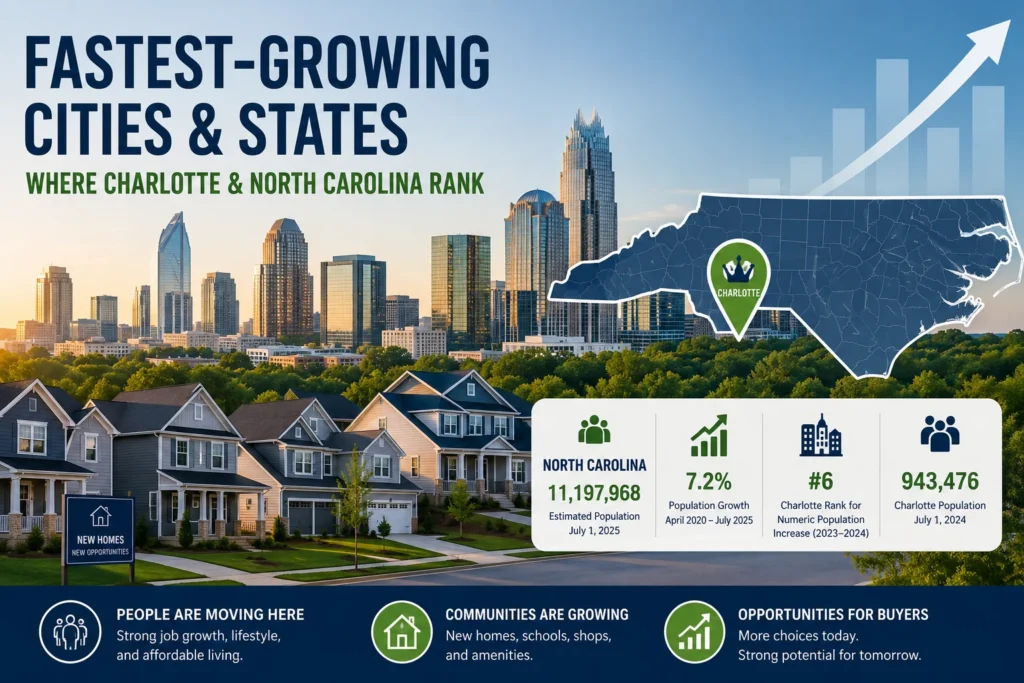
North Carolina’s population was estimated at 11,197,968 as of July 1, 2025, up from 11,046,024 in 2024 and 10,441,392 at the 2020 estimates base. That means North Carolina grew 7.2% from April 2020 to July 2025, according to U.S. Census Bureau QuickFacts.
The state’s growth is not just large in population count; it is also nationally significant. North Carolina was described by the Governor’s Office as the No. 1 state for domestic migration, the third-largest state for total population increase after Texas and Florida, and third in percentage growth based on the latest U.S. Census Bureau findings released in early 2026.
That matters for Charlotte because much of North Carolina’s growth is tied to job markets, lifestyle migration, affordability compared with many higher-cost states, and continued growth in major metros. Buyers moving from states like New York, New Jersey, Pennsylvania, California, Illinois, and parts of Florida often compare Charlotte not just to other North Carolina cities, but to other fast-growing Sun Belt regions.
Charlotte’s Growth Still Stands Out Nationally
Charlotte is one of the most important growth stories in the country because it combines large-city scale with continued population gains. The U.S. Census Bureau’s Vintage 2024 city and town estimates listed Charlotte as the 14th most populous city in the United States, with an estimated population of 943,476 as of July 1, 2024.
Charlotte also ranked sixth nationally for numeric population increase from July 1, 2023 to July 1, 2024, adding 23,423 residents. The only cities ahead of Charlotte by raw population gain in that Census release were New York, Houston, Los Angeles, San Antonio, and Fort Worth.
That is an important distinction. Charlotte may not always rank at the very top by percentage growth because it is already a large city, but by the number of people added, it remains one of the strongest-growing cities in the country.
The Bigger Story Is Regional Growth
Charlotte’s growth is not limited to the city limits. In real estate terms, the practical Charlotte market includes a wide network of suburbs, towns, and counties in both North Carolina and South Carolina.
That broader regional growth helps explain why buyers are looking beyond Charlotte into places like Fort Mill, Indian Land, Waxhaw, Weddington, Matthews, Huntersville, Mooresville, Concord, Kannapolis, Harrisburg, Belmont, Mount Holly, and York County communities.
The U.S. Census Bureau reported that population growth slowed nationally in many counties and metros from 2024 to 2025, but metro areas still grew faster than micro areas or places outside metro and micro areas. Census data also showed that metro areas grew by 0.6% from 2024 to 2025, even as growth slowed from the prior year.
That slower national growth context makes North Carolina’s performance more notable. Even as growth cooled nationally, North Carolina continued to post above-average gains.
Fast-Growing North Carolina Counties Matter for Charlotte Buyers
County-level growth gives buyers another useful way to understand where demand is moving. Carolina Demography reported that North Carolina added 145,907 people from 2024 to 2025, a 1.3% increase. It also found that 78 of North Carolina’s 100 counties grew during that period.
The fastest-growing North Carolina county by percentage was Brunswick County at 4.7%, followed by Iredell, Johnston, and Pender counties at 2.8%, and Franklin County at 2.6%. For Charlotte-area buyers, Iredell County is especially relevant because it includes fast-growing communities north of Charlotte, including Mooresville and parts of the Lake Norman market.
Carolina Demography also noted that counties in the Raleigh and Charlotte metropolitan areas saw growth rates above the state overall. That supports what many buyers are already seeing on the ground: growth is not isolated to one city. It is spreading through suburban and exurban communities where new housing, land availability, schools, commute patterns, and lifestyle preferences all play a role.
Fast-Growing North Carolina Towns to Watch
Smaller towns can grow quickly by percentage because they start from a smaller population base. That does not always mean they are adding more people than Charlotte or Raleigh, but it does show where change is happening quickly.
The North Carolina Office of State Budget and Management reported that several North Carolina municipalities ranked among the fastest-growing in the nation from July 2023 to July 2024. Belville ranked fifth nationally with 35.7% growth, Calabash ranked 20th at 22.9%, Wendell ranked 42nd at 16.3%, Angier ranked 60th at 13.6%, Bolivia ranked 61st at 13.4%, Holly Ridge ranked 87th at 11.4%, and Zebulon ranked 91st at 11.1%.
The same OSBM report also looked at the period from April 2020 to July 2024. Over that four-year period, Wendell grew 71.2%, Bolivia grew 67.1%, Angier grew 55.0%, Zebulon grew 51.9%, Leland grew 47.4%, Calabash grew 47.4%, and Northwest grew 47.3%.
For buyers, the takeaway is not that every fast-growing town is automatically the best place to buy. It is that rapid growth can change a community’s feel quickly. Roads, schools, shopping centers, medical access, public services, and future housing supply can all evolve as more people arrive.
Charlotte Compared With Other Fast-Growing Cities
Charlotte’s growth profile is different from many smaller boomtowns. Smaller towns may show higher percentage growth, but Charlotte’s raw population gain puts it among the strongest large-city growth markets in the country.
The U.S. Census Bureau’s Vintage 2024 city estimates ranked Charlotte sixth nationally for numeric population increase from 2023 to 2024, while also placing Charlotte as the 14th most populous city in the country. That combination of size and growth is why Charlotte remains such a major relocation and new construction market.
By comparison, Leland, North Carolina ranked 14th nationally among the fastest-growing cities and towns by percentage growth from 2023 to 2024, with 9.4% growth and a 2024 population of 34,451. This is a good example of how North Carolina’s growth story includes both large-city gains and smaller-town expansion.
What Growth Means for New Construction Buyers
For new construction buyers, population growth is both an opportunity and a caution flag.
Growth can create more housing options, more shopping, better amenities, new schools, improved infrastructure, and stronger long-term demand. It can also create competition for homes, rising lot premiums, longer commute times, school crowding, construction disruption, and changing neighborhood expectations.
This is why buyers should look beyond the model home. A new construction community may be attractive today, but buyers should also understand what is planned nearby, how many future phases remain, what roads serve the area, whether schools may be reassigned, and how the broader town or county is growing.
A fast-growing town can be a great fit for buyers who want newer housing and future amenities. It may be less ideal for buyers who want a more established, slower-changing area.
Why Charlotte-Area Growth Is Spreading Outward
Charlotte’s growth has pushed buyers into a wider range of communities. Some buyers want to stay close to Uptown, South End, SouthPark, Ballantyne, or major job centers. Others are willing to move farther out for more space, newer homes, larger lots, lower taxes, or specific school preferences.
That is one reason communities in Union County, Cabarrus County, Iredell County, Gaston County, York County, and Lancaster County have become such important parts of the Charlotte-area housing conversation.
For example, buyers who want a newer home but cannot find the right fit in Mecklenburg County may compare options in Waxhaw, Indian Trail, Weddington, Concord, Harrisburg, Mooresville, Belmont, Mount Holly, Fort Mill, Indian Land, or Rock Hill. Each area has a different mix of commute patterns, school systems, tax considerations, new construction inventory, and future growth expectations.
Growth Is Not the Same as Livability
Fast growth can be a positive sign, but it should not be the only reason to choose a community.
Buyers should still consider whether the daily lifestyle works. Commute time, school assignments, road capacity, HOA dues, tax rates, medical access, grocery options, resale appeal, builder reputation, and future land use all matter.
A high-growth area may offer strong long-term potential, but it may also feel unfinished while the community is still building out. A slower-growth area may have fewer new construction options, but it may offer more established infrastructure and a clearer sense of place.
The best choice depends on the buyer’s budget, timeline, commute, lifestyle, and tolerance for change.
Growth Snapshot: North Carolina and Charlotte
Benefits and Drawbacks of Fast-Growing Cities
Fast-growing cities can create real opportunities for homebuyers. When more people and employers move into a region, that growth often supports new restaurants, shopping centers, medical offices, schools, parks, road projects, and housing communities. For buyers who want newer homes, modern amenities, and long-term demand, a growing market can be attractive.
Growth can also help support resale value over time. If a city or town continues attracting new residents, future buyers may be more likely to look in that same area. This does not guarantee appreciation, but strong population trends can be a positive signal when they are paired with job growth, good location, quality housing, and infrastructure investment.
For Charlotte-area buyers, this is one reason fast-growing suburbs and towns can be appealing. Areas with new construction often bring newer floor plans, updated community amenities, and more choices than many older, built-out neighborhoods. Buyers may also find opportunities in communities that are still developing, especially if they are comfortable living through some growth and construction while the area matures.
The tradeoff is that fast growth can create pressure. Roads may feel crowded before improvements catch up. Schools may need redistricting, expansions, or new buildings. Popular communities can see rising home prices, higher lot premiums, and more competition for desirable homesites. What feels quiet today may feel much busier in five or ten years.
Fast-growing areas can also feel unfinished. A new community may look great on paper, but nearby shopping, restaurants, parks, medical offices, and road connections may still be years away. Buyers should pay attention to what exists now versus what is planned, because promised future growth does not always happen on the expected timeline.
There can also be uncertainty around taxes, HOA dues, infrastructure, and local services. As towns grow, they may need to invest in roads, utilities, police, fire, parks, schools, and public facilities. Those improvements can make an area more livable, but they can also affect long-term costs.
The best approach is to view growth as one factor, not the only factor. A fast-growing city may offer strong long-term potential, but buyers still need to evaluate commute, schools, builder quality, HOA rules, road capacity, resale appeal, and day-to-day lifestyle. Growth can be a positive sign, but the right community is still the one that fits your budget, timing, and how you actually want to live.
The Bottom Line
North Carolina is one of the fastest-growing states in the country, and Charlotte remains one of the strongest large-city growth markets by raw population gain. The state’s growth is also showing up in smaller towns, fast-growing counties, and suburban markets that are reshaping where buyers look for new construction.
For Charlotte-area buyers, the key is to use growth data as context, not as the only decision factor. Growth can help explain where new homes are being built and where demand is moving, but the right community still comes down to budget, commute, schools, lifestyle, builder fit, and long-term resale considerations.
Helpful Charlotte-Area Growth and Relocation Guides
- Browse Charlotte-area new construction communities
- Compare Charlotte-area home builders
- Moving to Charlotte from New York
- Moving to Charlotte from New Jersey
- Moving to Charlotte from California
- Best Charlotte suburbs for commutes
- Future infrastructure projects around Charlotte
- Is new construction a good investment?
How HomeBuildersCLT.com Can Help
HomeBuildersCLT.com helps buyers compare new construction communities, builders, towns, and relocation considerations across the Charlotte region. Population growth can help explain why certain areas are seeing more development, but it does not replace local research.
If you are comparing Charlotte-area communities, we can help you think through growth patterns, commute tradeoffs, builder options, HOA dues, school considerations, and long-term resale factors before you choose a community.
HomeBuildersCLT.com is not affiliated with any builder. Builder names, community names, and logos belong to their respective owners. Pricing, incentives, availability, HOA dues, taxes, school assignments, floor plans, and community details can change quickly and should always be verified directly with the builder, local government, school district, HOA, and appropriate professionals.
Comparing Fast-Growing Charlotte-Area Communities?
Growth can create more choices, but it can also make the home search more complicated. HomeBuildersCLT.com can help you compare Charlotte-area builders, communities, commute patterns, HOA dues, and long-term resale considerations before you choose a new construction home.
Frequently Asked Questions
Is Charlotte one of the fastest-growing cities in the United States?
Yes. In the U.S. Census Bureau’s Vintage 2024 city and town estimates, Charlotte ranked sixth nationally for numeric population increase from July 2023 to July 2024, adding 23,423 people.
Is North Carolina still one of the fastest-growing states?
Yes. North Carolina’s population reached an estimated 11,197,968 as of July 1, 2025, and the state grew 7.2% from April 2020 to July 2025. North Carolina was also described as the No. 1 state for domestic migration in the latest Census-based findings.
What North Carolina towns are growing quickly?
Recent Census-based data from the North Carolina Office of State Budget and Management highlighted fast-growing municipalities such as Belville, Calabash, Wendell, Angier, Bolivia, Holly Ridge, Zebulon, Leland, and Fuquay-Varina.
Why does population growth matter for homebuyers?
Population growth can support housing demand, new amenities, retail growth, and long-term resale strength. It can also create pressure on roads, schools, infrastructure, and home prices, so buyers should look at both the opportunity and the tradeoffs.
Does fast growth mean a town is a good place to buy?
Not automatically. Fast growth can be a positive signal, but buyers should also consider commute, schools, taxes, HOA dues, builder quality, infrastructure, road capacity, and whether the community fits their daily lifestyle.
Sources
- U.S. Census Bureau QuickFacts: North Carolina
- U.S. Census Bureau: Population Growth Reported Across Cities and Towns in All U.S. Regions
- U.S. Census Bureau: Vintage 2025 Metro, Micro, and County Population Estimates
- NC OSBM: North Carolina’s Municipalities Among Fastest Growing in the Nation
- Carolina Demography: U.S. Census Bureau 2025 County Population Estimates
- North Carolina Governor’s Office: North Carolina Ranked Top State for Domestic Migration
Stay Updated and Get Expert Help With Your New Home Search
Sign up to receive updates on Charlotte-area communities, builders, and market trends, and let us know if you’d like to be contacted by a real estate professional for personalized guidance.